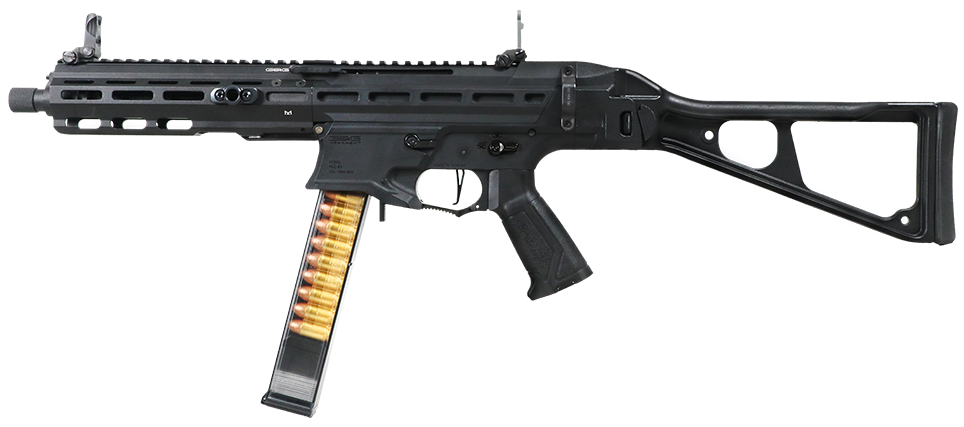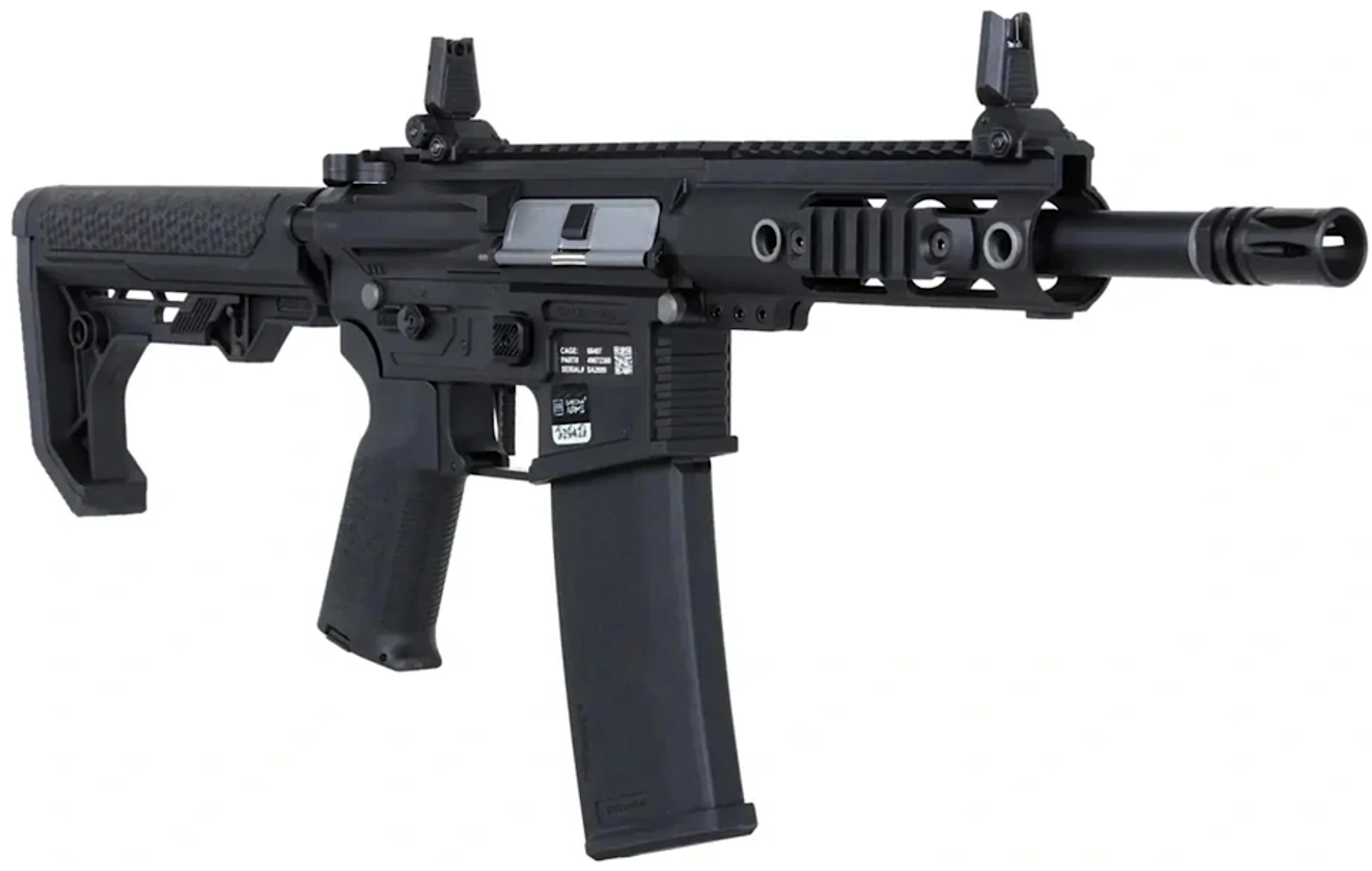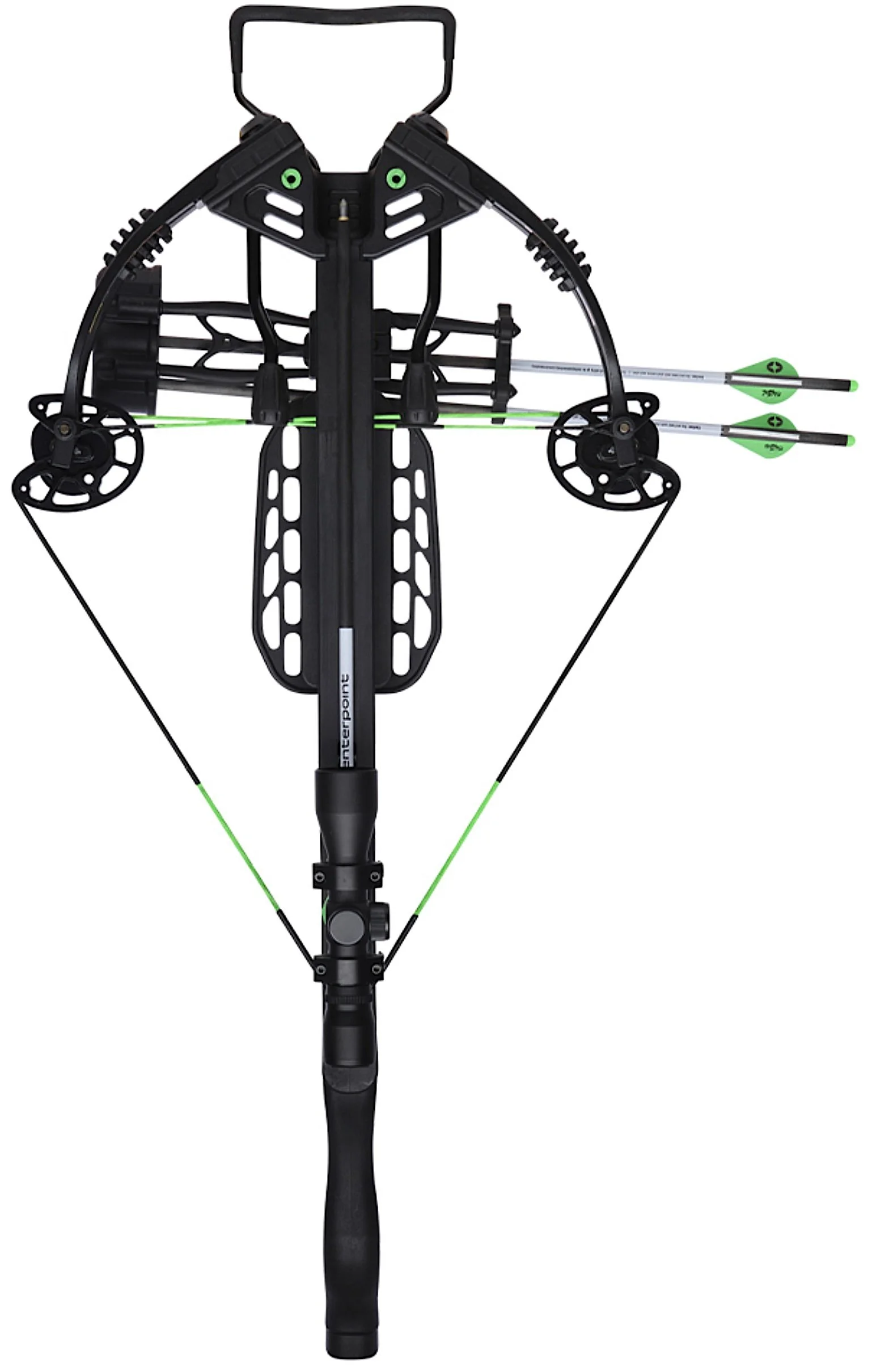

Today we’re checking out the G&G PCC45 Pro, an AEG M-LOK Airsoft SMG / PCC-style carbine that’s modeled after the modern pistol-caliber .45 format. It’s a compact little platform with a folding stock, a clean modern look, and a setup that should be a lot of fun for tighter indoor/outdoor spaces where you want something quick-handling without going full-length rifle.
As always, this is a Table Top Review, so we’re not going to be doing any shooting or chrono work in this video. The goal here is to go over the specs, the overall build quality, materials, controls, and features, then finish off with the pros and cons so you know what you’re getting before the field test. We do carry this one in our Canada store and I’ll put a link in the description. At the time of recording we don’t currently have it in the US store, but I’ll include a link to something comparable in the US store so you can at least browse similar AEG options.
Specifications:
Manufactured / Distributed By: G&G (Made in Taiwan)
Platform: Airsoft AEG (Electric)
Ammunition: 6mm plastic airsoft BBs
Style: PCC .45-inspired carbine / SMG format
Fire Modes: Semi / Full Auto (and programmable 3-round burst)
Velocity: Listed around 360 FPS (other claims ~330–350 FPS depending on BB weight/setup)
Weight:4.44 lbs (2.0 kg)
Length:29.1 in (74 cm)
Inner Barrel:10 in (25.5 cm)
Threading:14mm CCW
Battery (recommended): Commonly suggested 7.4V small stick LiPo (battery space is limited in the handguard)
In the Box:
G&G PCC45 Pro AEG
110-round mid-cap magazine
Instruction manual
Cleaning rod
The manual is fairly large and covers operation and features well, but battery specs are oddly hard to find in it.
Walk Around:
The PCC45 Pro is a great-looking compact PCC setup. It’s not overly heavy, but it also doesn’t feel like a lightweight “toy”, there’s a nice balance of polymer and metal.
Up front you’ve got the CNC aluminum M-LOK handguard, and it gives you a lot of flexibility for mounting accessories. The front sight is a flip-up style (part metal / part polymer), and the rear sight is a metal flip-up peep sight.
Sighting adjustments follow the common setup:
Front: elevation
Rear: windage
The muzzle comes with a black tip (not a red/orange one), and you also get 14mm CCW threads for add-ons like a tracer unit, mock suppressor, or alternate flash hider.
Controls are a strong point on this platform:
Ambidextrous selector (safe / semi / full-auto, and programmable for 3-round burst)
Ambidextrous charging handle that makes it easy to access the hop-up
Ambidextrous mag release
The magazine has a realistic “.45-style” look. One handling note: if that front insert/follower isn’t seated correctly, you’ll want to be careful inserting the mag so you don’t snag or damage it.
The folding stock is simple and quick to use, with a rubber butt pad that helps it shoulder nicely.
Pros:
Compact PCC format with a folding stock (easy to maneuver, store, and transport)
M-LOK handguard gives lots of mounting options (light, grip, etc.)
Metal where it matters (handguard, barrel, sights, controls/pins/latches)
Fully ambidextrous controls, great for lefties and righties
ETU + Gen4 MOSFET = solid trigger response and efficiency
Uses a proprietary PCC45 magazine, which can be pricier/chunkier than common M4 mags
Battery space is tight inside the handguard, so battery choices are limited in size
Handguard access for the battery isn’t hard, but it can take a bit of fiddling to fit everything cleanly
Final Thoughts:
Overall, the G&G PCC45 Pro feels like a well thought-out PCC-style AEG that checks a lot of boxes: it’s compact, it’s easy to maneuver, the folding stock makes it convenient for transport and storage, and you get the benefit of the M-LOK handguard for mounting a light, grip, or other accessories without needing a bunch of adapters. The ambidextrous controls are a big plus, and the ETU + Gen4 MOSFET setup is exactly what you want on an AEG like this for consistent trigger response, efficiency, and the ability to run semi, full auto, or 3-round burst depending on how you program it.
That said, there are a couple practical trade-offs to keep in mind: the battery space is tight in the handguard so you’re going to be limited on what fits (and it’s worth planning that out before you buy), and the PCC45 magazines are more proprietary than standard M4 mags which can affect cost and availability if you want to stock up. The field test will tell the real story, we’ll see where it chronos in the real world, how consistent it is, and how it feels to run in full auto. But based on the tabletop handling and feature set, this looks like a solid option for anyone wanting a modern PCC-style AEG that’s different from the usual M4 layout.
This one’s really growing on me because it’s not your standard AR platform. We review a lot of AR-style rifles (and there’s nothing wrong with ARs, they’re popular for a reason), but this one has a very different vibe. It’s based on the SA80 British service rifle design and comes in a compact bullpup layout that gives you a long inner barrel without needing a long overall rifle.
Today’s Table Top Review is the G&G L85A2 (A2 version) ETU Airsoft AEG Rifle — and yes, a full Shooting / Field Test Video will be coming shortly. I definitely want to get this one out and properly test it.
This model is available in our Canada store. At the time of recording this review, it wasn’t available in the US store, but I’ll add an equivalent/similar US option (or a list of comparable AEG rifles) in the post links.
Specifications:
Manufacturer / Distributor: G&G (Made in Taiwan)
Replica Of: SA80 / L85A2 (British 5.56×45 NATO service rifle family)
Platform: Airsoft AEG (Electric)
Ammunition: 6mm plastic airsoft BBs
Operation: AEG with simulated blowback (reciprocating bolt for a slight “tap” feel)
Fire Modes: Semi / Full Auto (and programmable for 3-round burst via MOSFET programming)
ETU System: Programmable MOSFET + Electronic Trigger Unit (ETU)
Motor: High-torque motor (rated around 25,000 RPM)
Gearbox / Internals: Full metal gearbox, heat-treated metal gear set
Bushings:8mm oilless bushings for smoother gear rotation
Hop-Up: Adjustable hop-up (access via dust cover)
Trigger: AEG electric trigger (single-action-only style in practical terms)
Safety: Cross-bolt safety
Sights: Metal, fully adjustable front & rear
Front: elevation
Rear: windage
Rear peep sight includes two aperture sizes
Weight:6.0 lbs (2.7 kg)
Overall Length:27.5 in (70 cm)
Inner Barrel Length:16 in (40.6 cm)
Magazine:450-round high-cap AR-style AEG magazine (AR/M4-style AEG mags should fit)
Velocity: Approx. 370–400 FPS with 0.20g BBs (varies by setup/conditions)
Top Rail: Yes (carry handle/rear sight assembly sits here; optics possible with a riser)
Flash Hider: Metal AR-style, black (no orange tip on this one)
Sling Mounts: Multiple mounting points; front appears reversible L/R, rear has mounts on both sides
Build Quality & Materials:
This rifle has a really solid, substantial feel and is nicely balanced. There’s a lot of metal here.
Notable metal parts include (from what you can see and feel):
Upper & lower receiver areas
Carry handle / rear sight assembly
Front & rear sights
Magazine (metal high-cap)
Trigger guard (metal for sure)
Barrel, flash hider
Sling mounts, pins/screws, switches and assorted hardware
Polymer / rubber components include:
Handguards
Pistol grip
Cheek rest area (polymer)
Butt plate (rubber)
Overall: it looks great, feels great, and doesn’t feel “toy-ish” at all.
In the Box:
G&G L85A2 ETU AEG rifle
1× metal high-cap magazine
Cleaning rod
Product brochure / extra paperwork
Transport muzzle cover / cap
Manual access via QR scan (links to G&G’s online manual)
Walk Around Notes:
A few highlights from handling it up close:
Bullpup layout: compact overall, but the barrel/inner barrel length is still substantial.
Sighting system: the carry handle doubles as the rear sight platform with flip apertures.
Optics compatibility: you can mount an optic on the top rail, but you’ll likely want a riser so your eye line sits naturally.
Dust cover + hop-up access: you can open the cover and access hop-up adjustments the normal AEG way.
Charging handle note: my rifle did not come with the charging handle piece. I checked my unboxing footage and it wasn’t on there and it wasn’t in the box. It’s not essential for function, but at this price point it’s something you’ll want to confirm is included on yours.
Battery Compartment:
The battery area is under the handguard, and here’s the main downside:
If you’re running a larger battery, you’ll likely need to remove hardware (including the sling mount and a bolt) to open the lower handguard section.
With smaller nunchuck-style batteries, you may be able to fit them in with less disassembly, but bigger packs will probably require tools.
So yes: it works, but it’s not a quick tool-free battery swap design.
Quick Function Check:
I did a quick dry-fire demo using a 9.6V battery, and honestly it felt a bit underpowered/odd (some partial taps and inconsistent behavior). That could be the battery itself (mine was not great), but I would suggest this rifle will really come alive with a proper 11.1V LiPo and hope to use this setup in the field test video.
I’ve seen demos where the rate of fire is very high using an 11.1V setup, so that’s what I’ll be testing with for the shooting video.
Pros:
Lots of metal in the construction with a super solid weight, feel, and balance
Unique bullpup British-style rifle (not just another AR build)
Simulated blowback adds a bit of feedback vs. standard AEGs
Works with AR/M4-style AEG magazines (easy to find replacements/midcaps/highcaps)
Good optics flexibility on the top rail (carry handle sight system included, or add your own)
Programmable fire mode: Full Auto or 3-round burst
No orange tip (and if you prefer one for visibility, you can always add your own)
Cons:
Limited accessory mounting options (mostly just the top rail; not a modern “add rails everywhere” setup)
Battery access can require tools and disassembly, especially for larger batteries
Priced on the higher side (around $600+ CAD)
My sample was missing the charging handle part, check yours when it arrives
Final Thoughts:
This is a really nice AEG. It feels premium in the hands, the two-tone green looks great, and it’s a cool change from the sea of AR platforms, while still keeping things practical with AR-style AEG mag compatibility.
The simulated blowback isn’t going to replace the feel of a true gas blowback rifle, but it’s a nice touch, and paired with the ETU/MOSFET system and upgraded internals, it helps justify why this model sits in a higher price bracket.
Next up: the field test / shooting video, ideally with a proper 11.1V battery so we can see what this rifle really does when it’s running at its best.
In this Table Top Review, we’re taking a detailed look at the G&G ESG B-10 2.0 Gas Airsoft Shotgun. This is a very unique Airsoft platform, as it’s fully gas powered—no spring, no AEG system, and no blowback. Just straight gas operation.
Gas-powered Airsoft shotguns are fairly rare, and this one stands out even more because it’s essentially a semi-automatic gas shotgun capable of firing five or ten BBs per trigger pull. That makes it a serious close-quarters option and something I’m genuinely excited to field test.
As always, this is a Table Top Review only. A full Shooting / Field Test Video will be coming later, where we’ll see how it performs in real-world use.
Links to purchase this product in Canada and the US will be included in the video description.
Specifications:
Manufacturer / Distributor: G&G
Made In: Taiwan
Power Source: Green Gas
Ammunition: 6mm Airsoft BBs
Action: Gas powered, semi-auto
Burst Modes: 5-shot or 10-shot (selectable)
Trigger: Double-action only
Construction: Metal & polymer
Weight: 5.6 lbs (2.52 kg)
Overall Length: 18.39 inches (46.7 cm)
Inner Barrel Length: 12 inches (30.5 cm)
Magazine: 105-round AR-style mid-cap
Claimed Velocity:
~235 FPS in 5-shot mode
Lower in 10-shot mode
Rails: Picatinny rails on top and sides
Selector: Ambidextrous
Sling Mounts: Front and rear QD points
While the FPS may seem low, it’s important to remember that five or ten BBs are being fired simultaneously, which requires significantly more gas per shot.
In the Box:
G&G ESG B-10 2.0 Gas Airsoft Shotgun
105-round AR-style mid-cap magazine
Product brochure
(Manual not present in this package, but typically included or available online)
The shotgun comes packaged in a large box with a sleeve that differentiates the 2.0 version from the original B-10.
Design & Layout:
The ESG B-10 2.0 uses a bullpup layout, which keeps the overall length short while still allowing for a reasonably long inner barrel. Despite its compact size, the gun feels very solid and heavy, likely due to its internal gas system and metal components.
Notable design features include:
Picatinny rails on the top and both sides
Ambidextrous selector switch for 5- or 10-shot bursts
Ambidextrous magazine release
QD sling mounts front and rear
Non-orange flash hider
Polymer butt plate with internal gas reservoir
Because of the low rail height relative to the grip, you’ll almost certainly want to install some form of optic or sight to get a usable sight picture.
Controls & Operation:
The selector switch serves as both the safety and burst selector, allowing you to choose between five or ten BBs per trigger pull. It’s ambidextrous and easy to reach from either side.
One thing worth noting is how the selector cycles internally. There can be a one-shot delay when switching between modes, meaning the first pull after switching may still fire the previous burst count before changing over.
The trigger is double-action only, as there’s no blowback system. While heavier than a single-action trigger, it’s not excessive—especially considering the amount of ammunition being fired with each pull.
Magazine Compatibility:
The ESG B-10 2.0 uses standard AR/M4-style Airsoft magazines, including mid-caps and high-caps. It ships with a 105-round mid-cap, but you can easily use other compatible magazines from your collection.
The magazine locks in securely but does require a firm push to seat properly.
Gas System:
The gas reservoir is housed in the stock and holds a substantial amount of gas. Based on initial handling and other reviewers feedback, you should be able to fire multiple magazines before needing to refill, despite the high BB output per shot.
This is something we’ll fully confirm in the upcoming field test.
Pros:
Unique gas-powered semi-auto shotgun design
Fires 5 or 10 BBs per trigger pull
Strong metal construction with excellent weight and balance
Compact bullpup layout for close-quarters use
Compatible with standard AR/M4 Airsoft magazines
Efficient gas system despite high BB output
Multiple rail options for optics, lasers, and accessories
Sling-ready with front and rear QD mounts
No orange tip, preserving realistic appearance
High-quality G&G build at a reasonable price point
Cons:
A sight or optic is essentially mandatory for proper aiming
Double-action trigger is heavier than single-action designs
Higher price compared to common AR-style AEGs
No hop-up adjustment (typical for Airsoft shotguns)
Final Thoughts:
The G&G ESG B-10 2.0 Gas Airsoft Shotgun is a standout platform in the Airsoft world. Its ability to fire massive bursts of BBs with each trigger pull makes it an ideal close-quarters and room-clearing tool, while the bullpup design keeps it compact and maneuverable.
If you’re looking for something different from the usual AEG rifles, this gas shotgun offers a lot of fun, solid performance potential, and serious intimidation factor.
A full shooting and field test video is coming soon.
In this Table Top Review, we’re taking a detailed look at the KJ Works KP-19S CO2 Blowback Airsoft Pistol. I’ve already reviewed the standard KP-19 in the past, and while the two pistols share a lot in common, there are some important differences between the KP-19 and the KP-19S that are worth covering.
I’m not entirely sure what the “S” officially stands for, possibly Sport—but interestingly, I’d actually argue that the non-S KP-19 is the more competition-oriented version, especially for IPSC-style Airsoft shooting. That said, the KP-19S still offers excellent performance, strong build quality, and a feature-rich design.
As always, this is a Table Top Review only. A full Shooting / Field Test Video will follow later.
This pistol is currently available in our Canada Replica Airguns store, and if a similar model is available in the US store, links will be provided in the video description.
Magazine: Full-size dropout metal magazine, 25-round capacity
Weight: 1.96 lbs (890 g)
Overall Length: 9.84 inches (250 mm)
Inner Barrel Length: 4.25 inches (108 mm)
Claimed Velocity: 366+ FPS
Hop-Up: Adjustable
Rail: Under-barrel Picatinny rail
Sights: Fiber-optic front and rear
Safety: Ambidextrous
Magazine Release: Reversible
Threaded Barrel: Inner and outer threading
Field Strippable: Yes (1911-style takedown)
The pistol includes a removable inner barrel extension, which may be required to reach the higher advertised FPS—something we’ll confirm in the upcoming field test.
In the Box:
KP-19S CO2 Blowback Airsoft Pistol
Full-size metal CO2 magazine
Inner barrel extension
Allen keys
Small bag of Airsoft BBs
Instruction manual (Usually!)
The pistol comes packaged in a basic cardboard box, but all essential accessories are included.
KP-19 vs KP-19S – What’s Different?
The KP-19S shares most of its core design with the standard KP-19:
Same frame, grip, slide profile, trigger guard
Same skeletonized trigger and hammer
Same magazine compatibility
Key Differences
KP-19 (Non-S):
Flared magwell
Compensator
Removable rear plate for mounting a red dot
More competition-oriented configuration
KP-19S:
No flared magwell (cleaner, more streamlined look)
The KP-19S is a large pistol with a fairly wide grip. Shooters with smaller hands may find it bulky, but balance and weight distribution are excellent. At just under two pounds, it feels solid without being overly heavy.
Notable features include:
Slide cutouts on the top and sides
CNC-style gold/brass-colored fluted barrel visible through the slide
Fiber-optic sights that are extremely easy to pick up
Ambidextrous safety
Reversible magazine release
Dual threaded barrel system (inner and outer threads)
The full blowback action is strong, crisp, and satisfying, with excellent slide movement and reset.
Field Strip:
Field stripping follows a classic 1911 takedown:
Align the slide notch
Push out the takedown pin
Remove the slide assembly
Once opened, you gain easy access to:
Inner barrel
Recoil spring
Hop-up adjustment wheel
Reassembly is quick and straightforward, making cleaning and maintenance easy.
Pros:
High metal content with excellent weight and balance
Strong, realistic full blowback action
Excellent fit and finish typical of KJ Works pistols
High-capacity 25-round metal magazine
CO2 or gas compatibility (with appropriate magazines)
Dual threaded barrel for accessories and extensions
Bright fiber-optic sights (easy to acquire on any background)
Short, light, adjustable 1911-style trigger
Ambidextrous safety and reversible mag release
Easy field stripping and hop-up access
Cons:
Grip is wide and may not suit shooters with smaller hands
Higher price point compared to similar KWC 1911 models
Rear sight is not adjustable and does not accept a red-dot plate
Optics would need to be rail-mounted from underneath
Final Thoughts:
The KJ Works KP-19S is a high-quality, full-featured CO2 blowback Airsoft pistol with excellent build quality, strong recoil, and competition-inspired styling. While it lacks some of the modular competition features of the KP-19 non-s version, it offers a cleaner, streamlined look and the same reliable performance.
If you’re looking for a quality CO2 Airsoft pistol with a fantastic trigger, solid blowback, and premium construction, the KP-19S is a strong contender.
A full shooting and field test video will be coming soon.
I was away for a bit on a well needed vacation in Kona Hawaii but I’m back now and ready to dive back into things so get ready for more reviews! In this December Massive Mystery Unboxing, I crack open a stack of newer Airsoft and BB guns that landed in the Replica Airguns inventory. Full shooting reviews are coming later – this is your quick spec rundown so you can see what’s what at a glance.
Bullpup “evolutionary shotgun” with a single barrel, selectable 5 or 10-round burst, and an internal gas reservoir in the stock. Uses standard M4-style AEG mags for capacity.
British bullpup classic with modern electronics – ETU, MOSFET, and selectable semi / full-auto or semi / 3-round burst, plus blowback for added realism.
Type: Airsoft AEG rifle (with ETU and blowback)
Ammo: 6mm airsoft BBs
Power: Electric (LiPo-ready AEG)
Weight: ~6 lb / 2.7 kg
Velocity: ~370–400 fps with 0.20 g BBs (store range 350–400 fps)
Compact .45-style SMG with a lightweight polymer receiver, slim M-LOK front end, and G&G’s Gen.4 MOSFET & ETU. Great choice for a fast, modern CQB/field hybrid build.
Type: Airsoft AEG SMG
Ammo: 6mm airsoft BBs
Power: Electric
Weight: ~4.44 lb / 2.0 kg
Velocity: ~360 fps (overall range 350–400 fps with 0.20 g BBs)
A race-style Hi-Capa with ported slide, fiber-optic sights, threaded barrel and an adjustable “speed” trigger. Runs on both green gas and CO2, with a non-blowback system for efficiency and consistency.
Type: Hi-Capa style gas airsoft pistol (non-blowback)
Glock-18 style CO2 BB pistol with select-fire (semi and full-auto), metal slide, polymer frame, and full blowback. Great fun-factor steel BB blaster with 4.5mm ammo.
Type: CO2 blowback BB pistol (select-fire, semi / full-auto)
This isn’t an airgun, but it will show up in a least some of my airgun videos, you just won’t usually see it. The DJI Neo 2 is my new AI camera drone that I’ll be using for outdoor shooting segments, walk-around tests, and any time I need moving shots without a camera operator.
Up until now I’ve been using the original DJI Neo and the HoverAir X1 Pro Max. The HoverAir still has slightly better pure video quality, and the original Neo had decent AI features, but together they meant more gear to carry and more batteries to manage. The Neo 2 is the first drone that can realistically replace both for what I do on this channel.
I picked up the Fly More Combo, which includes the Neo 2, the RC-N3 controller, three batteries, a charging hub, and the antenna/transmitter module pre-installed. With three packs I can get roughly 35–40 minutes of real-world flying, which is more than enough to cover a shooting session.
The biggest upgrade over the original Neo is the two-axis gimbal. Instead of cropping the image to keep the horizon level when the drone tilts in the wind, the camera physically moves side-to-side and up/down. Combine that with updated processing and you get up to 4K 60 fps (and even 100 fps in 4K), which is perfect for smoother tracking shots when I’m walking, moving between targets, or doing action-style footage.
The Neo 2 is also loaded with sensors and obstacle avoidance: fisheye cameras on multiple sides plus a front LiDARunit. It does a great job of seeing trees, branches and other obstacles and routing around them, which is exactly what I need when I’m focused on shooting and talking, not flying.
For control, I can either use the phone app for quick AI “follow me” and smart shots, or the RC-N3 for longer-range, more traditional drone flying and higher altitude shots. There’s also a very cool gesture control system (I call it “Jedi mode”) where I can move the drone up, down, left, right, closer or further just by using hand signals, no need to stop recording or dig through menus.
Bottom line: you probably won’t see the DJI Neo 2 in many of my videos, but you’ll definitely see what it captures. It lets me add smoother tracking shots, aerial views and more dynamic angles to my Replica Airguns content, all without needing a dedicated camera person. For a solo creator who films a lot outdoors, it’s a very handy tool to have in the bag.
Type:Airsoft Rifle Manufacturer:KJWorks Model:M700 Take Down Materials: Metal with textured synthetic stock Weight: 7.5 pounds (3415 grams) Barrel: Smooth bore barrel Propulsion: Gas operated (Green Gas or Propane) Action: Bolt Ammunition Type: 6mm plastic Airsoft BB’s Ammunition Capacity: 10–11 round metal magazine FPS: Up to 450 FPS
Trigger Pull: The trigger on the KJWorks M700 Take Down Gas Airsoft Sniper Rifle performs as expected for a bolt-action style hunting or sniper rifle. Most of the work is done when operating the bolt, leaving your trigger finger with a light, short, and crisp pull to release the firing pin. This shlep a lot keeping everything steady since you can relax your grip adn really focus on your shot placement.
Accuracy: Be sure to watch my full Field Test Shooting Video for the KJWorks M700 Take Down Gas Airsoft Sniper Rifle to see its performance in detail. I only tested it indoors at my Sea Can range due to cold weather conditions, which aren’t ideal for gas guns. Shooting distance was limited to about 30 feet, but I plan to revisit this rifle outdoors in better weather for longer-range results. At 30 feet, the M700 produced a tight 1-inch grouping and averaged around 400 FPS using .25-gram Airsoft BB’s. Note: I did encounter some magazine loading issues when fully loaded, BBs from the right side of the double-stack magazine occasionally jammed and didn’t feed properly into the breach.
Build Quality: The KJWorks M700 Take Down Gas Airsoft Sniper Rifle feels solid and well-made throughout. The fit and finish are good, and all the mechanical components functioned properly aside from the occasional BB feed issue. I like the textured synthetic stock and soft rubber butt pad. This rifle features a lot of metal construction, including the bolt, inner and outer barrel, magazine, sling and bipod mounts, trigger and guard, Picatinny rail, and safety. It feels robust and well-balanced overall.
Realism: The KJWorks M700 is modeled after the Remington 700 platform, giving it a very authentic hunting rifle look. The Airsoft version mimics the real firearm closely in both form and function. Since it’s powered by Green Gas rather than a spring, the bolt action is smooth, light, and realistic to operate. All the parts that would normally be metal or steel on the actual Remington M700 are also made out of Metal with the Airsoft version. The stock is also Fiber reinforced like the real stele version.
Pros:
Gas-operated bolt is far easier to cycle than a traditional spring-powered bolt rifle.
Heavy use of metal parts throughout.
Excellent balance and solid overall feel.
Take-down design makes it easy to transport and store.
Fiber-reinforced stock adds durability.
Metal sling and bipod mounts for customization.
Full-size drop-out metal magazine holds both gas and BBs.
Easy-to-adjust hop-up screw.
Ideal FPS for long-range shots without being overpowered.
Consistent accuracy, good 30-foot performance should translate well to longer distances.
Cons:
No sights or optics included, you’ll need to add your own.
Occasional magazine feeding issues, especially when fully loaded.
Slightly higher price compared to most spring-powered bolt-action Airsoft rifles.
Comments: I’ve tested a few spring bolt-action Airsoft rifles before, and while those are simple (just load BBs and shoot), the gas-powered M700 offers a much smoother and faster bolt operation, perfect for quick follow-up shots. When seconds matter and targets are closing in, that speed can make a real difference.
The KJWorks M700 Take Down Gas Airsoft Sniper Rifle is a great ready-to-shoot platform out of the box and can be easily upgraded with a sling, bipod, and of course, a scope, since it comes without sights.
My review unit had a minor magazine issue, but I believe this was specific to the sample I received and not a widespread problem. Overall, it’s a very capable and well-built Airsoft sniper rifle that delivers solid power, realism, and usability.
I tested another Steambow model in this Field Test Shooting Video, the Steambow AR Series M10 Tactical Crossbow. Like my other Crossbow Field Test videos, I recorded the Chronograph velocity while I was shooting the target so there was no need for separate segments, everything was done in one go with four cameras rolling. I didn’t put a dedicated camera on the Chronograph because I wanted a camera on the target; my camera glasses generally pick up the chrono readings anyway. I only have so many cameras, but everything recorded as planned. If you want the full specs and a closer look at the M10, watch my dedicated Table Top video.
Steambow quotes about 190–200 fps for the AR Series M10. My six chrono readings were 189, 191, 189, 189, 190 and 191, which worked out to a 190 fps average. Using the included 142-grain, 6.5-inch aluminum bolts produced roughly 11.4 foot-pounds of energy, so both velocity and FPE were basically on target with Steambow’s numbers. That’s adequate for small pests, but humane shots always come down to accuracy, you’ll want head or shoulder placement, and I’m not ready to declare any compact crossbow a guaranteed solution for that. Test accuracy for yourself.
For accuracy I shot six rounds at a paper target 30 feet downrange from my usual seated in the back, hands rested up front shooting position. The first shot from the Steambow AR Series M10 Tactical Crossbow was a few inches low, so I adjusted my point of aim up and ended up with an impressive 1-inch, 4-shot group just left of center. One bolt missed the target entirely, could have been me or a bad bolt (I’ll blame the bolt on that one). Still, for a compact crossbow this was an excellent result, comparable to some pellet rifles.
Overall the Steambow AR Series M10 Tactical Crossbow performed really well. I like the cocking and bolt-feeding system, cocking is simple: shoulder the stock, press the release, then pull the front down using the foregrip for leverage. Even with the higher power of this model you don’t need a lot of strength, and with practice follow-up shots can be quick. I’d add a red dot to the rail to help dial in accuracy and buy a few extra bolts for target practice and hunting. The M10 is one of Steambow’s pricier offerings, but it also has the highest ammo capacity and the most customization options. If you want the ultimate compact crossbow setup, the ability to preload multiple bolts and have extra 10-shot magazines on hand makes the M10 the one to consider.
I’ve tested a few compact crossbows before, but nothing with a multi-bolt loading system like the Steambow setup I’m testing in this video. As with my other Crossbow Field Test videos, I recorded Chronograph velocity at the same time I was shooting the target so I didn’t need two separate segments, I did it all in one pass with lots of cameras rolling. I didn’t dedicate a camera to the Chronograph for this test because I wanted a camera focused on the target; my camera glasses usually capture the Chronograph readings for me. I only have so many cameras, but everything was captured fine. If you want to learn more about the specifications and details of the Steambow AR-6 Stinger II, then watch my dedicated Table Top Video located here.
Steambow lists 180 fps as the claimed velocity for the Steambow AR-6 Stinger II Tactical. I consistently measured right around 160 fps, pretty close to the claim. Using the included 142-grain, 6.5-inch aluminum bolts my chrono readings ranged from 159 to 164 fps, averaging 163 fps, which is very consistent. That produced about 8.4 foot-pounds of energy, so both velocity and FPE were a little under Steambow’s stated numbers. That’s enough for small pests, but humane shots depend on accuracy, you’ll want head or shoulder placement, and I’m not fully convinced this bow is always up to that task. You’ll need to judge its accuracy for your own use.
On elevation (up and down) the Steambow AR-6 Stinger II was fairly accurate. Where it struggled more was windage: I had to aim noticeably to the right to move bolts toward the bullseye. The sight is very basic (a single fiber-optic post just behind of the Picatinny rail), which likely contributed to the windage issue. Despite that, I managed a roughly 4-inch group at 30 feet, with one bolt behaving like a flyer.
Overall the Steambow AR-6 Stinger II performed well. I really like the cocking and bolt-feeding system — cocking is easy by shouldering the stock, pressing the release, then pulling the front of the bow down using the foregrip for leverage. You don’t need to be super strong to do it, and with practice you could get very quick at follow-up shots. I’d definitely add a red dot to the rail to help dial in accuracy, and I’d buy a few extra bolts for target and hunting. The AR-6 Stinger II is pricier than some basic models, but the ability to preload multiple bolts in the built-in clip and unleash six shots in seconds makes the extra cost worth it to me.
If you want the full tabletop details on the G&G RK Beta AK AEG, check my Table Top Video, it covers features, controls and build in close-up. For this Field Test Shooting Video I moved into the Replica Airguns indoor sea-can range to run practical checks: chronograph testing to measure real-world velocity with field-weight BBs, then live-fire accuracy checks in both semi-auto and sustained full-auto to see how it behaves under realistic use.
Starting with the chrono work, for the G&G RK Beta AK AEG Airsoft Rifle I ran seven shots through my Chronograph using .25-gram BBs (I usually test with the slightly heavier .25s because they better represent what players use in the field rather than ultra-light test rounds). G&G rates the rifle at about 390 fps with .20-gram BBs, so I expected a lower result with .25g ammo, which is exactly what I got. My seven-shot string read: 371, 372, 370, 371, 349, 369 and 370, an average of about 367 fps. Only one shot dropped below 350 fps and the rest clustered right around 370, so velocity was consistent and predictable for a field setup and close to the claimed 390 even with heavier rounds.
For accuracy I placed a fresh pepper target to my ammo trap at 30 feet and fired a 10-round semi-rested string: hands braced on a sandbag up front and seated on a stool at the rear for a repeatable hold. Out of the box, using the open sights, I put most shots into a tight ~1.5-inch group with just one flyer just outside the main cluster. Hits were slightly high and a touch right of center, not surprising given there’s essentially no refined rear sight on this sample, so I was eyeballing the aim a bit. I then switched to full auto and basically shot until the spring tension softened, well over 100 rounds went into the trap. As expected the group opened up under sustained fire, but impacts still concentrated in roughly the same zone as the 10-shot semi-auto grouping earlier, roughly a 3-inch spread overall. Imagine how much tighter those strings would get with a proper optic or red dot fitted.
My take: it’s refreshing to test out an AK-style AEG instead of another AR-variant, the G&G RK Beta AK AEG Airsoft Rifle feels beefier and more planted, and that solid construction pays off in handling and perceived durability. The chrono numbers and on-target accuracy with .25g BBs put the rifle right in the sweet spot for short-to-mid-range field work, and performance remained respectable even without a precision sighting system. You’ll want to add a red dot or other optic to unlock the rifle’s full potential, but if you’re after a compact, rugged AK AEG that shoots consistently and groups well under both semi and full auto, the G&G RK Beta AK is worth any extra outlay.
If you want the complete specs and a tabletop walk-through for the G&G ARP9 3.0P AEG Pistol-Caliber Carbine, watch my Table Top Video where I cover build, controls and features in close detail. For this Field Test Shooting Video I moved into the Replica Airguns indoor sea-can range to put the G&G ARP9 3.0P AEG Pistol Caliber Airsoft Carbine through practical shooting checks, chrono testing for real-world velocity and live shooting to see how it groups in both semi-auto and full-auto. The sea-can gives a repeatable, controlled environment that’s ideal for comparing performance to other AEGs I’ve tested.
For velocity I ran six shots through my Chronograph using .25-gram BBs — I generally prefer the slightly heavier .25s for testing because they better represent practical use than lighter .20 gram rounds. G&G’s spec is about 380 fps with .20-gram BBs, so I anticipated a lower number with .25s and that’s exactly what I saw. My six-shot string read 344, 342, 342, 342, 341 and 341, which averaged out to 342 fps. Those readings were very consistent with multiple duplicates in the string, so the ARP9’s output was predictable and stable for an AEG running typical field BBs.
Next I moved to accuracy: I placed a fresh pepper target to the trap at 30 feet and shot 10 rounds from a semi-rested position, hands braced on a sandbag up front, seated on a stool at the rear for a stable, repeatable hold. The main cluster landed just left of the bullseye; the densest portion of the group was roughly 1 inch and the overall group measured just over 2 inches. That tells me the G&G ARP9 3.0P AEG Pistol Caliber Airsoft Carbine is more than capable of tight, repeatable groups when shot carefully. I then switched to full auto and ran a mag dump of about 58 rounds from a full rest. As you’d expect the group opened up and shifted a bit (likely from my hold changing during sustained fire), but most hits still stayed within approximately a 2-inch radius, which is impressive for a compact, high-rate AEG under sustained fire.
My hands-on impression is that the ARP9 3.0P hits a very useful sweet spot: it’s compact and maneuverable for CQB but doesn’t feel like it gives up accuracy or usable range compared to larger AEG platforms. With the factory wide-open rear aperture I was getting solid contact on target, putting a red dot or small optic on the top rail would tighten things further and make follow-ups easier. Power and consistency are right where I’d want them for a short-to-mid-range compact rifle, and while it’s not the cheapest AEG on the market it feels well made and worth the price for anyone after a versatile, high-quality compact AEG. If you want both a practical CQB carbine and a reliable field performer, the ARP9 3.0P is definitely worth considering.
I first reviewed the KJWorks M700P (the “P” for Power) back in 2018, so I was curious to see how the standard take-down version would perform. Ideally you’d mount a 3x (or higher) optic and test it at outdoor sniper ranges more typical for Airsoft sniper play, but the weather was rubbish for this session. Like last time with the M700P, I ended up doing the review inside my sea-can airgun range, which is fine for chronograph work but limits targets to about 30 feet.
For the indoor velocity test of the KJWorks M700 Take Down Gas Airsoft Sniper Rifle, I shot .25-gram plastic BBs through my Chrony. Over a five-shot string I averaged 403 fps, slowest was 400 fps and the fastest 406 fps, so reasonably consistent for a gas rifle. The gas mag was fully topped up with propane and the ambient temp was about 17°C (63°F). Lighter .20-gram BBs would of course register higher speeds, though in sniper builds you’ll often end up using heavier BBs than .20 g for better downrange performance.
Using the same .25-gram BBs for a close-range accuracy test at roughly 30 feet, the M700 Take-Down put most shots into about a 1-inch group with one odd flyer out to the right, could have been a bad BB or user error. I ran the test with a simple red dot since the rifle ships with no sights and I only needed something quick on the Picatinny rail for close work. I also had trouble getting all ten rounds from the 10-round mag onto the target because of some misfeeds / misreads; I don’t recall the M700P exhibiting this behavior, so it may be a quirk specific to my test unit.
Overall the KJWorks M700 Take Down Gas Airsoft Sniper Rifle is a nicely executed sniper-style Airsoft rifle — very easy to dismantle and carry in a pack, reasonably gas-efficient, quiet, and powerful enough for the role. The feeding hiccup seemed to crop up when the follower was near the top of the stack (spring tension at its peak) and mainly affected BBs on the right side of the double-stack magazine — which makes me suspect a defect in my sample rather than a design choice. It doesn’t come with sights, so you’ll need to pick up a scope or optic, and personally I prefer the take-down model for its extra versatility.
I recently started testing out the new DJI Osmo Nano, and while this camera may be marketed as an action/vlogging camera, I immediately saw how it could become a real asset for creating Replica Airguns review videos. On my channel, I’m always filming from multiple angles—close-ups of the guns, tabletop shots, and shooting demonstrations. The Nano’s small size and magnetic mounting system open up a lot of creative possibilities that larger cameras just can’t manage.
Why the Osmo Nano Fits Airgun Reviews
The DJI Osmo Nano is compact, lightweight, and extremely versatile. Thanks to its built-in magnets and the wide range of mounts that DJI includes in the box, I can attach it just about anywhere—on a target stand, a tripod, even a piece of metal in my indoor range. For my type of reviews, where I often want a stable angle on the gun while still moving around myself, this is a huge advantage.
Another big plus is that the Osmo Nano is not just flexible but also delivers great image quality. It records in 4K with 10-bit color and even offers a D-Log mode for those who want to fine-tune their footage in post-production. That’s a level of control you usually don’t get from such a small device.
Key Specs
Here are a few highlights worth noting:
Resolution & Color: Up to 4K recording, 10-bit color, and D-Log for advanced color correction.
Stabilization: Rock-solid electronic stabilization, so even handheld or mounted-to-moving-objects shots stay smooth.
Magnetic Design: Attach it quickly to mounts, gear, or almost any surface.
Lightweight Form Factor: Easy to carry, position, and experiment with new camera angles.
DJI Osmo Nano vs. Insta360 Go Ultra
A lot of people will naturally compare the Osmo Nano to the Insta360 Go Ultra since they’re both in the same category. But from my testing, DJI’s camera has some strong advantages:
Lower Price: The Osmo Nano is much more affordable.
Included Accessories: DJI packs in more mounts and options straight out of the box.
Color Flexibility: With 10-bit recording and D-Log, it offers a lot more room for dialing in your footage.
For someone like me who’s already juggling multiple cameras during a review, having a cost-effective and flexible option like this makes a lot of sense.
Final Thoughts
The DJI Osmo Nano may be tiny, but it’s built with creators in mind. For airgun reviews, it allows me to set up angles I wouldn’t normally capture, without having to invest in another full-sized camera or rig. Smooth footage, great color, and the freedom to mount it just about anywhere—it’s a perfect addition to my setup.
If you want to see it in action, check out my video where I share some first impressions and show real-world examples of what the Nano can do.
This is one camera I’ll definitely be adding into the mix for future Replica Airguns reviews.
I had the chance to take the KJWorks KP-18 TBC CO2 Full Blowback Airsoft Pistol out for some testing today in the Replica Airguns Indoor Shooting Range to see how it performs. I’ve already done my close-up tabletop breakdown (specs, build, pros/cons), so if you want the close-up visuals adn details, go check that video out. For this session I concentrated solely on performance, a quick 5-shot chronograph run to record velocity and a 10-round semi auto group at 30 feet followed by the rest of the mag in full auto to get a practical feel for out-of-the-box accuracy.
For the chronograph test I used a fresh 12-gram CO2 capsule with stand.25 gram Airsoft BBs, and the temperature was about 20°C. Five shots with .25 gram Airsoft BBs registered 301, 301, 291, 285, and 281 fps, averaging out to 292 fps. That’s within the expected range for a full-blowback CO2 pistol running heavier .25 gram Airsoft BBs, you’d see higher velocities with lighter .20 gram rounds, and it’s plenty adequate for Airsoft games and target work plinking.
On the accuracy side I fired from 30 feet using a semi-rested shooting position (hands braced on a sandbag while seated). In semi-auto the KJWorks KP-18 TBC CO2 Full Blowback Airsoft Pistol shot just slightly low and a touch left, producing roughly a 2-inch group with most rounds clustered reasonably well. Switch to full-auto, however, and it becomes almost impossible to keep on target, the pistol tended to climb high and stray to the right, putting most shots completely off the target. That full-auto behavior makes it poor for controlled rapid-fire engagement, but in semi-auto it’s much more manageable.
All told, the KJWorks KP-18 TBC CO2 Full Blowback Airsoft Pistol is a strong option if you like the Glock style or already own (or plan to own) a real-steel Glock. physically and mechanically it shares a very similar feel. KJWorks has a reputation for high-quality, well-made products, and this pistol is another solid example. If you don’t need official Glock licensing but want a Glock-based Airsoft pistol, the KP-18 is a great choice, especially for shooters who value realism and good build quality in a reasonably priced package.
For the chronograph test I used a fresh 12-gram CO2 capsule with standard BBs, and the temperature was about 20°C. Five shots with .25 gram Airsoft BB’s registered 307, 301, 306, 304, and 308 fps, which averages out to 305 fps. That’s right in the expected range for a non-blowback CO2 Airsoft Pistol of this type using heavier .25 gram Airsoft BBs, expect higher velocities with lesser weight .20 gram Airsoft BBs. For sure enough power for backyard plinking and casual target work.
On the accuracy side I fired from 30 feet out, semi-rested (hands braced on a sandbag while seated on a stool in the back). The Ruger P345 CO2 NBB Airsoft Pistol shot fairly well centered, but landed a touch left and slightly low, overall grouping was around 2 inches with only one flyer, which, oddly enough, was dead center in the bullseye when I checked the target later. The sights are fixed out of the box, so you’ll want to account for that small left/low bias when aiming or consider a simple sight/laser addition if you need a perfect zero.
All told, the Umarex Ruger P345 CO2 NBB Airsoft Pistol would make a decent entry-level Airsoft pistol. You can additionally offset cost by purchasing inexpensive stick magazines rather than investing in pricier full-size mags that come with other more elaborate Airsoft Guns. It has a good, reassuring weight for an external plastic Airgun, which helps it feel well-balanced in the hand. For someone after an affordable, reliable sidearm for plinking or casual training, the P345 is a solid option.
Type: Blowback CO2 Airsoft Pistol. Manufacturer: Distributed by KJ Works. Model:KP-18 TBC. Materials: Metal & Polymer. Weight: 1.7 pounds (770 grams). Total Length: 7.9 inches (20cm) Barrel: 4 inches (10.6cm) metal non-rifled. Propulsion: CO2 x 1 (Gas mags available). Action: Semi & full auto blowback, SAO trigger. Ammunition Type: .6mm plastic Airsoft BB’s. Ammunition Capacity: 22 round drop out full size metal magazine. FPS: Claimed 410 (with barrel extension).
Trigger Pull: The trigger on the KJWorks KP-18 TBC CO2 Blowback Airsoft Pistol behaves like a true Single Action Only unit, pleasantly light with a fairly short travel. There’s a bit of initial take-up, but you can clearly sense the crisp break near the rear where the release occurs, extremely light, consistent, and free of any noticeable slack. Remember you’ll need to rack the slide to chamber the first BB; after that the blowback mechanism handles all subsequent cycling.
Accuracy: I haven’t yet fired the KJWorks KP-18 TBC CO2 Blowback Airsoft Pistol or produced a Field Test Performance video for it. However, I’ve already completed a full field and shooting test for the very similar KJWorks KP-13, so I’d expect comparable on-target performance between the two. I’ll post a full field test and shooting video for the KP-18 TBC down the road, stay tuned.
Build Quality: KJWorks pistols are generally well made, and I expect the KP-18 TBC to follow that pattern. Based on my hands-on time with the KJWorks KP-18 TBC CO2 Blowback Airsoft Pistol and my first impressions of the KP-18, fit and finish look excellent. As with other models, you’ll find metal and polymer components positioned where they would be on a real modern semi-auto pistol, which contributes to the solid, authentic feel.
Realism: The KJWorks KP-18 TBC is a close visual replica of the real-steel Glock G18-style pistol, albeit without official licensing. Umarex holds the Glock license for many BB and Airsoft models, and the fact that a green-gas magazine from the Umarex Glock 17 full-blowback fits the KP-18 suggests KJWorks may be manufacturing some Glock-pattern airguns for Umarex. Glock has historically objected to unlicensed replicas in North America, so how this will play out remains unclear. For now, both licensed and unlicensed options exist for buyers.
Pros:
Metal and Polymer with decent weight and good feel to it.
Heavy Full blowback operation.
Excellent fit and finish as always with KJWorks pistols.
High capacity full size drop out magazine that holds the CO2 and 22 rounds.
Well hidden safety incorporated into the serial number under the barrel.
Working trigger safety.
White dot front sight and white outlined rear sight for easy target acquisition.
All working components like a real steel Glock styled pistol.
Comes with extended threaded outer barrel for adding a possible compensator or mock-suppressor.
Comes with barrel extension for higher velocity shooting (Possibly for easier import into Canada).
Would make a good training weapon if you are a real steel Glock owner.
Has a semi and full auto selector toggle located on the left rear of the slide.
Can use CO2 or gas magazines.
Field strip-able.
No orange tip.
Cons:
Sights are not adjustable.
Full auto will use CO2 like crazy but may be worth it.
Not a licensed version.
Comments:
If you’re a Glock enthusiast seeking a realistic training piece, you can shoot more affordably and in more places, there are more choices than ever. If official licensing matters, Umarex is the go-to option, although I haven’t seen a full-auto Glock from them yet. For those who prioritize a full-auto-style experience, the KJWorks KP-18 TBC CO2 Blowback Airsoft Pistol is as close to a real-steel Glock full-auto feel as you’re likely to find. I also appreciate the magazine interchangeability with some Umarex Glock mags if you already own a Glock 17 Airsoft pistol for instance. Whatever route you choose, it’s great to see more Glock-pattern airguns coming to market.
In this Umboxing Preview Video I take a quick look at tow Airsoft Guns from KJWorks, one is a Gas Blowback Airsoft Rifle and one is a CO2 Full Blowback Airsoft Pistol. I don’t get into too many of the details or specifications as this is really the first time I have seen either of these Airsoft Guns in person, a full table top and field test video review will be coming up for both of these Airguns down the road but I did want to get them out there so everyone know these are either in the Replica Airguns Online Store or will be showing up soon.
The first item I grabbed out of the box was the KJWorks KP-18 TBC CO2 Full Blowback Airsoft Pistol which looks a lot like a Glock but with a full auto selector switch on the left side of the slide and it also is the TBC model so it comes with a barrel extension that attaches to the inner barrel and the option to add a mock suppressor to the outside barrel threads. This version comes with a CO2 magazine but I am sure there are option to use it with a Gas magazine also.
Next out of the box was the KJWorks M700 Take Down Gas Airsoft Sniper Rifle which is a break down bolt action gas operated Sniper based Rifle as the name suggests. It is super easy to assemble and has a nice smooth bolt with the only sighting option being the addition of a scope added to the included picatinny rail. The base of this rifle is very heavy so it is is not a light weight rifle by any means.
Here are some more details for each of these Airsoft Gun:
I took the Umarex Combat Zone Enforcer CO2 NBB Airsoft Pistol out for some testing today to see how it performs in action. I’ve already put together a detailed tabletop review a while back covering all the specs, build quality, pros, and cons, so if you’re after the close-up details you can check that out separately. For this session, I wanted to focus only on performance—running it over the chronograph to measure velocity and then shooting a 10-round group at 30 feet to check accuracy in a more practical setup.
For the chronograph test, I used a new 12-gram CO2 cartridge paired with standard 0.25-gram BBs, and the weather was sitting at about 24°C (75°F). Across five shots, the readings came in at 327, 330, 330, 323, and 321 fps, averaging out to 326 fps. That’s a solid number for a non-blowback pistol running slightly heavier BBs, and if you were to switch down to .20-gram BBs, you’d likely see a noticeable increase in velocity.
When it came to accuracy, I shot from 30 feet in a semi-rested stance, bracing my hands against a sandbag while seated. The Umarex Combat Zone Enforcer CO2 NBB Airsoft Pistol grouped right around 2.5 inches, which is respectable for its category. Straight out of the box, with fixed sights that can’t be adjusted, it landed shots centered left to right and just a touch low. Since there’s no hop-up built in, you’ll need to adjust your point of aim or consider adding a laser if you want a more refined zero.
All in all, the Umarex Combat Zone Enforcer CO2 NBB Airsoft Pistol performed about as expected. Velocity was a little lower than I had initially hoped, but that comes down to using .25-gram BBs, which naturally slow things down a bit. Accuracy was solid for an entry-level pistol, and while the double-action trigger is on the heavier side, it breaks cleanly and predictably once you get used to it. It’s not really designed for rapid-fire action shooting, but if you’re looking for a budget-friendly sidearm that works reliably and allows you to carry multiple compact, affordable magazines, the Enforcer is definitely up to the task.
Today I got to test out the Novritsch SSX-23 NBB Airsoft Sniper Pistol and put it through its paces. I’ve already done a full tabletop review covering the specs, features, pros, and cons, so if you want a close-up look and all the finer details, be sure to check that out. Today, we’re focusing entirely on performance—running it through the chronograph to see how fast it shoots and then sending ten rounds downrange at 30 feet to see what kind of real-world accuracy it delivers.
For the velocity test, I used a fresh 12-gram CO2 cartridge and standard 0.25-gram Airsoft BBs. The test was done in about 24°C (75°F) weather. Five shots over the chronograph clocked in at 300, 304, 309, 295, and 300 feet per second, giving an average velocity of 302 fps. That’s a little slower than I was expecting, but given the heavier .25-gram BBs, it’s still respectable—and switching to lighter .20-gram BBs should bump up the velocity somewhat.
Accuracy testing was done from 30 feet in a semi-rested position, bracing my hands on a sandbag while seated. The pistol grouped at roughly 2.5 inches, which is decent, though I suspect a better BB match could tighten that up further and maybe adding more hop-up as well. Out of the box, it hit close to the bullseye but tended to land a bit low and to the left. The sights aren’t adjustable, but you do have the option to mount a red dot on the rear rail side for finer aiming.
Overall, I came away impressed with the Novritsch SSX-23 NBB Airsoft Sniper Pistol. While the velocity was slightly under my expectations with .25s, the accuracy was solid, the double action trigger was longer and heavier but worked well, just make sure not to point the barrel down or take a long time engaging the trigger or a BB may roll out of the barrel (additional Hop-up may sort this out?). I was also surprised at how quiet it was—using very little gas, which translates into a lot of shots per fill, easily up to 100 or more. If you’re after a true purpose built sniper pistol that has good power, efficiency, accuracy and is super quiet and stealthy, this one deserves a spot on your shortlist.
I had a really fun time teasing out the KJWorks Full Metal 1911 TBC CO2 Airsoft Pistol. I’ve already done a full tabletop review covering all the specifications, features, pros, and cons, so check that one out if you want the detailed breakdown adn more closer up video. Today’s video is all about the performance. I’m running it through the chronograph to see how fast it really shoots, and then putting ten rounds on paper target at 30 feet to get a realistic look at its true accuracy.
For the velocity test, I loaded up a fresh 12-gram CO2 cartridge and standard 0.25-gram Airsoft BBs. The temperature during testing was about 24°C, or 75°F. Six shots over the chronograph came in at 296, 316, 299, 296, 301, and 294 feet per second, which works out to a 300 fps average. Not bad using the heavier .25 gram Airsoft BB’s. That’s a solid result for this full blowback platform, and on a warmer day adn using .20 gram Airsoft BB’s, you could probably squeeze a bit more speed out of it.
As per usual, accuracy testing was done from 30 feet out, shooting from a semi-rested position with my hands braced on a sandbag for stability and sitting on a stool in the back. The KJWorks Full Metal 1911 TBC CO2 Airsoft Pistol printed slightly high, but windage was spot-on, and the string came in at roughly a 1.5-inch group. One shot wandered off a bit low as a flyer, but overall, the grouping was tight for a CO2 blowback Airsoft pistol, showing it’s more than capable of consistent performance.
Overall, I came away impressed with the KJWorks Full Metal 1911 TBC CO2 Airsoft Pistol. The single-action trigger is crisp and light, giving it a very clean break. The blowback is strong and sharp, adding to the realism, and the build quality looks and feels solid in the hand. With its accurate shooting, great trigger feel, and satisfying recoil, this pistol is an excellent pick for anyone after a high-quality CO2 blowback 1911 that looks, feels, and performs the part. Another winner form KJWorks!