We are back on the indoor range for another dedicated shooting assessment, shifting gears to focus entirely on the Barra 1866 Tactical Lever Action CO2 .22 Caliber Pellet Rifle. This is a .22 caliber lever-action pellet rifle that uses CO2 and features authentic shell-ejecting and shell-loading mechanisms. For this session, the focus turns squarely to downrange performance, tracking velocity consistency over the chronograph and a dedicated paper target test to evaluate its accuracy. if you haven’t already checked out my table top review for the Barra 1866 Tactical, you can do that here
Chronograph & Velocity Baseline
The Barra 1866 Tactical is powered by dual 12 gram CO2, and for this test, we started with brand new cartridges in slightly chilly conditions just under room temperature. To establish our velocity baseline, the rifle was run with fairly heavy grain (15.43 grain) Gamo Match Diablo .22 caliber pellets across a standard testing string.
Here is how the shot string registered over the sensor:
Shot 1: 321 FPS
Shot 2: 349 FPS
Shot 3: 353 FPS
Shot 4: 333 FPS
Shot 5: 337 FPS
Average of 339 FPS with 4 foot pounds of energy
The rifle turned in an overall performance generally hovering around the mid-300 FPS mark in these slightly cooler conditions. Previously, the non-tactical brass version achieved closer to 400 FPS, suggesting that warmer temperatures and lighter pellets might yield higher velocities.
Target Accuracy & Grouping Results
Moving to the paper target, the Barra 1866 Tactical Lever Action CO2 .22 Caliber Pellet Rifle was aimed using its factory open sights at a distance of 30 feet. While a pistol red dot was initially placed on the back, a dead battery meant sticking to the standard open sights. Aiming just below the bullseye, the sights centered perfectly left and right.
Cycling the lever and ejecting the shells proved to be an engaging experience. The shots struck a bit high on the target, but the rounds clustered decently once the proper zone was found. The pellets generally wanted to group about an inch and a half away from each other. Despite shooting slightly high, the rifle delivered noticeable impact energy and a solid "wallop" downrange even managing to make the target pop off the pellet backstop.
Shooting Impressions & Operational Notes
Running the Barra 1866 through a shooting sequence highlights a few distinct mechanical characteristics:
Shell Ejecting Mechanism: The shell-loading and ejecting action is highly enjoyable, adding a fun and realistic element to the shooting rhythm.
Lever Cocking Safety: A crucial operational note is that the lever must be pulled tightly to the stock to disengage the secondary safety. If the lever is not pulled tight against the stock, the rifle will not fire.
Sights: The open sights function well and center perfectly left and right, though they may shoot slightly high depending on the range.
Final Thoughts
The Barra 1866 .22 Caliber Tactical Lever Action Pellet Rifle proved to be a tremendously fun shooter. Delivering respectable velocities with heavy pellets and decent accuracy out of the box, it stands out as an engaging option for lever-action enthusiasts. For shooters seeking a realistic plinker, it remains a highly enjoyable choice.
In this table top review, we are taking a close look at the Barra 1866 Tactical CO2 Lever Action .22 Caliber Pellet Rifle. While the original classic version featured a gold receiver and faux wood stock, this updated model brings a modern tactical aesthetic to the classic Winchester 1866 platform. The biggest draw to the Tactical version is the black synthetic stock, the M-LOK handguard, and the multiple Picatinny rail options for adding modern accessories.
Key Specifications:
Model: Barra 1866 Tactical.
Type: Pellet Rifle.
Caliber: .22 caliber pellets.
Power Source: Dual 12-gram CO2 cartridges (housed in the rear buttstock).
Velocity: Claimed 450 FPS.
Action: Single-Action Lever Action Repeater.
Safety: Thumb safety behind the hammer and a secondary grip safety built into the lever.
Barrel: 18-inch rifled steel octagonal barrel.
Construction: Mostly all-metal construction with a black synthetic stock and handguard.
Weight: 6.5 lbs (2.9 kg).
Overall Length: 38.5 inches (90.7 cm).
Sights: Flip-up rear iron sight (featuring a peep notch and a lower notch).
Optics Rail: Removable short Picatinny rail over the receiver and a long continuous Picatinny rail on the handguard.
Magazine Capacity: 10-shot tube magazine (comes with 10 silver shells designed specifically for the .22 caliber version).
Handling & How It Works: Weighing in at 6.5 pounds and measuring 38.5 inches long, the Barra 1866 Tactical has an incredibly solid feel thanks to its heavy metal receiver and barrel. This is a single-action lever action repeater, meaning you must manually cycle the lever to cock the hammer and load a shell into the breach for every shot. To fire, you load the individual shells into the tube magazine, rack the paracord-wrapped lever downwards to chamber a round, ensure the lever is squeezed snug against the stock to disengage the secondary safety, and pull the metal trigger. When you rack the lever again, the empty shell ejects straight out the top of the action just like the real deal.
Pros:
Excellent heavy weight and realistic feel thanks to the nearly all-metal construction.
The sleek black synthetic stock and M-LOK handguard completely update the classic platform into a modern tactical rifle.
Very few replica rifles are available in .22 caliber, which offers fantastic downrange energy and impact.
Abundant mounting options: M-LOK slots and multiple Picatinny rails make it incredibly easy to add red dots, flashlights, lasers, or bipods.
The custom paracord-wrapped lever handle looks great and improves grip comfort during cycling.
Dual 12-gram CO2 system provides a very cost-effective power source with less cool-down effect than a single cartridge, allowing for extended shooting sessions.
Operating the lever and watching the empty casings eject vertically makes this gun incredibly rewarding and fun to shoot.
The claimed 450 fps gives you plenty of power for mid-range target shooting and small pest control.
Cons:
Because the empty shells eject vertically straight out of the top, you cannot easily mount a traditional magnified rifle scope directly over the receiver; an offset red dot or long eye-relief pistol scope mounted further forward is required.
You will inevitably lose some of the ejecting shells if you shoot outdoors in the grass, so picking up a spare set is highly recommended.
The lever must be held firmly snug against the stock while shooting, otherwise the built-in secondary safety will prevent the trigger from pulling.
If you are looking for a fun, realistic lever-action repeater that combines nostalgic shell-ejecting operation with modern tactical accessory compatibility, the Barra 1866 Tactical is a fantastic option. Stay tuned for the Field Test Shooting video coming up shortly.
Getting a mystery box from the Canadian Replica Airguns warehouse feels a lot like Christmas and we are getting closer to Christmas... Today's unboxing was a tall package, and while it contained some excellent accessories, including Gear Stock 6mm airsoft BBs, a UV-activated Airsoft tracer unit, and a LiPo safety bag—the real highlights were two very distinct lever-action rifles.
The first rifle out of the box is the Barra 1866 Tactical CO2 Edition. It takes the classic 1866 lever-action platform and gives it a highly modular, modernized upgrade.
Initial Thoughts & Basic Specs:
Ammunition & Power: This model is a .22 caliber pellet rifle that runs on a dual CO2 system housed in the back.
Realistic Operation: It features a fully functional shell-ejecting system and includes ten metallic shells.
Smooth Action: Operating the lever action on this rifle feels incredibly smooth.
Tactical Upgrades: The tactical design includes top and bottom Picatinny rails and an octagonal barrel.
Sighting: The rifle comes with a front sight and a versatile rear sight that functions as a notch or flips up into a peep sight.
The second rifle is the Daisy 499B Match Grade Champion, famously billed as the world's most accurate BB gun. It feels essentially like a highly enhanced Daisy Red Ryder on steroids.
Initial Thoughts & Basic Specs:
Premium Build: This is a full-sized rifle featuring a beautiful, fully wooden stock and forend. It is noticeably longer and more robust than a standard Red Ryder.
Action: The metal lever produces a heavy, satisfying clunk when cocked during a dry fire.
Competition Sights: Built for precision, it utilizes a front peep sight and a very small rear peep sight.
Extras: A heavy-duty shooting sling is included in the box.
Target Audience: While it is a fantastic platform for younger shooters, its larger size and premium quality make it highly suitable for older youths and adults.
I am incredibly excited to put both of these lever actions to the test. I will be producing full tabletop and field test shooting videos for both rifles very soon, so stay tuned.
Today I am testing out the Crosman 2240XL Special Edition here in the Sea Can indoor shooting range. It is getting a bit colder and raining outside, but the Sea Can is sitting at a comfortable 19 to 22 degrees Celsius, providing a great baseline environment for testing a fresh CO2 cartridge. If you haven't already, be sure to check out the dedicated Table Top Review for all the specifications and build details on this model. For this field test, our focus is entirely on performance: running it through the chronograph for real-world velocity and testing the downrange accuracy.
Chronograph & Velocity Performance For the velocity baseline, I used a brand new CO2 cartridge and loaded up some heavier .22 caliber Crosman Premier Hollow Points, which sit around the 14 to 15-grain mark. Crosman claims around 460 FPS on the box, but keep in mind that is typically achieved using the lightest possible ammunition.
Here is how the 5-shot string performed through the chronograph:
Shot 1: 329 FPS
Shot 2: 330 FPS
Shot 3: 337 FPS
Shot 4: 335 FPS
Shot 5: 335 FPS
The Crosman 2240XL Special Edition settled in nicely around a 333 FPS average. Because this is a bolt-action setup rather than a fast-firing semi-auto, the CO2 doesn't cool down too rapidly between shots, which helps keep the velocity remarkably consistent across the string.
Downrange Accuracy & Target Testing Moving over to the accuracy test, I set up a fresh paper target 30 feet downrange. For this setup, I decided to mount a bit of a monstrosity of a 4x optical magnification scope using the dovetail mounts, which I pulled right off another gun just for this test.
I took about 9 shots from a rested position on the table. The first two shots were close together, but the grouping eventually opened up to about 2 inches, including one major flyer that I definitely didn't feel like I pulled. Honestly, I wasn't super impressed with this particular grouping. The 2240 platform is famous for its accuracy, so this spread might be down to a few different factors: potential nicks on the pellets during loading, the cheap optical sight I attached, or just user error while trying to stabilize it.
Handling Notes & Optics Fitment One of the absolute highlights of the Crosman 2240XL Special Edition is the trigger. It has a very nice, light, and short pull with essentially zero break required. However, shooting a pistol with a magnified scope from a rested position proved to be awkward. Trying to pull a pistol-length platform close to your face for proper eye relief (using a rifle scope rather than a pistol scope) can make everything feel quite shaky.
If you plan on running a larger optic like this, I highly recommend adding a shoulder stock to help stabilize the gun. Alternatively, swapping the massive scope out for a compact red dot or sticking to standard pistol sights would make this much more comfortable to shoot in its stock pistol form.
Final Thoughts The Crosman 2240XL remains an incredibly highly modifiable platform, fitting right in with the various pumper and .177 caliber variants available on the market. While my grouping today wasn't the tightest, the potential of this gun is massive once you dial in the right optics, ammo, and perhaps a stock for better stability.
Welcome back to Replica Airguns. I get asked all the time about which airguns hit the hardest, but a lot of people focus on the wrong attributes. They often look strictly at velocity instead of the raw energy and blunt force required for different tasks.
In this guide, we are breaking down the four main types of airgun ammunition: Airsoft, steel BBs, lead pellets, and rubber balls. The goal is to show you exactly what each ammo type excels at and where they fall short so you can choose the right tool for your specific needs.
6mm Airsoft: Safe Training and Plinking
Airsoft guns fire 6mm round balls, which are generally made of plastic, though you can find copper or zinc-coated variants. Because these are some of the lightest projectiles, ranging from 0.20 to 0.45 grams, they have the lowest overall energy and often lower velocities.
Best For: Airsoft is ideal for force-on-force skirmishes (with proper eye protection) because the lightweight rounds sting but do not penetrate the skin.
Practical Uses: They are great for safe indoor garage shooting without the risk of breaking windows, or for humanely chasing nuisance crows or vermin out of your yard without causing them permanent harm.
Platform Tech: Heavier airsoft rounds utilize backspin, or "hop-up", to float straight through the air for better accuracy, and they are typically fired from highly realistic, full-blowback gas or CO2 replica pistols. Most rifle Airsoft guns are AEG’s using a battery and spring setup which allows for easy semi and full auto operation.
Worst For: These are entirely ineffective for pest control (extermination) or any scenario requiring deep penetration or high impact energy.
4.5mm Steel BBs: Fast-Action Shooting
Steel BBs are 4.5mm in diameter, which translates to a .177 caliber round ball. Weighing in at approximately 5.3 grains, they are much denser than Airsoft rounds.
Best For: Steel BBs are fantastic for fast-action plinking, breaking glass bottles, and tearing up pop cans.
Platform Features: These are often used in 1-to-1 replica blowback pistols with drop-out full size magazines, giving shooters an authentic firearm feel for tactical manipulation practice.
The Dangers: Steel does not deform upon impact, meaning these BBs are highly prone to dangerous ricochets if you shoot at hard surfaces indoors or up close.
Worst For: Steel BBs lack the blunt force for home defense and are unethical for pest control as trey are a bit under powered and generally not as accurate as similar pellet guns.
Lead Pellets (.177 and .22 Caliber): Precision and Pests
Unlike round BBs, pellets are designed to be fired through a rifled barrel. Common sizes include .177 caliber (4.5mm, weighing 5 to 10 grains) and the much heavier .22 caliber (5.5mm, weighing 12 to 16 grains).
Best For: The soft lead engages the spiral grooves in a rifled barrel, providing unmatched precision and accuracy.
Terminal Ballistics: Because lead is soft, it expands and flattens upon impact, transferring its heavy kinetic energy directly into the target.
Practical Uses: This improved energy transfer makes pellets the ethical choice for small pest control.
Worst For: Pellet platforms are rarely designed as rapid-fire action shooters; they typically utilize slower single-shot (bolt actions) or rotary magazines that can require a bit of trigger finger strength to shoot quickly.
Rubber Balls (.43, .50, and .68 Caliber): Less-Lethal Blunt Force
This category represents the heavy hitters, firing massive projectiles that range from soft sponge rubber to dense steel-core balls, dust balls, and pepper balls.
The Power Factor: A .68 caliber home defense marker can produce upwards of 20-50 Joules (or roughly 15-35 foot-pounds) of energy with dedicated home defense styled Rubber Ball Guns.
Best For: The .68 caliber and high-powered .50 caliber options are explicitly designed for less-lethal home defense.
How They Work: Instead of penetrating, these massive projectiles dump incredible raw energy and blunt force directly onto the target, effectively stopping threats through extreme pain.
Training Options: The smaller .43 caliber variants are frequently chambered in realistic blowback replica pistols, making them excellent for tactical and paintball-style force-on-force training.
At the end of the day, picking the right Airgun comes down to matching the ammunition mass and energy to your target. You can find all the gear discussed here, from Airsoft replicas to less-lethal launchers, at the Replica Airguns Canada and US stores. Make sure you are subscribed to our channels across Rumble, YouTube, Vimeo, Instagram, X and Facebook for more detailed reviews and field tests.
In this table top review, we are taking a close look at the Crosman 2240XL Special Edition, a .22 Caliber CO2 Pellet Pistol. While I haven't shot this exact model yet, I have shot the standard 2240 non-XL version, and they share a very similar firing mechanism. The biggest draw to the XL version is the factory-upgraded metal breech with an 11mm dovetail rail, and the threaded muzzle for added versatility.
Key Specifications:
Model: Crosman 2240XL Special Edition
Type: Pellet Pistol
Caliber: .22 caliber lead pellets
Power Source: 12-gram CO2 (1 cartridge)
Velocity: Up to 460 FPS
Action: Single-Shot Bolt Action
Safety: Cross-Bolt Safety
Barrel: Rifled Steel Barrel, Threaded muzzle (1/2" x 20 threads)
Stock/Grips: Plastic grips
Construction: Mostly metal (steel breech, barrel, loading chamber) with plastic grips
Weight: 1.8 lbs
Overall Length: 12.5 inches
Sights: None included
Optics Rail: 11mm Dovetail Rail
First Impressions & Build Quality: The 2240XL brings a much-needed factory upgrade to the legendary 2240 platform: a full steel breech. This alone is a huge addition, making the gun stand out and providing a much higher quality feel. The gun is almost entirely metal, including the barrel, CO2 loading chamber, bolt, and breech. The grips are plastic, which is fairly standard, but one of the best things about the Crosman 2240 platform is how highly customizable it is. There are countless aftermarket parts available, and you can even easily swap out the grips fro wood grips or for a Crosman shoulder stock to turn it into a backpacker-style carbine.
Weighing in at 1.8 pounds and measuring 12.5 inches long, The Crosman 2240XL Special Edition has a solid feel in the hand. The threaded barrel comes with a thread protector and gives you options for adding mock suppressors or other attachments.
How It Works: This is a single-action, bolt-action pellet pistol. To operate it, you must first cock the bolt and manually load a .22 caliber pellet into the chamber. Once the bolt is pushed forward and locked down, the trigger is engaged and ready to fire. Powered by a single 12-gram CO2 cartridge housed in the lower tube, it is capable of firing up to 460 FPS depending on the weight of the pellets used. Because it's a single-shot bolt action, you'll need to manually load a pellet for every shot, but you won't need to pump it since the CO2 provides the power.
Pros:
Upgraded steel breech from the factory provides a robust build and premium look.
Built-in 11mm dovetail rail makes adding a red dot or magnified optic easy.
Threaded muzzle (1/2" x 20 threads) with an included thread protector for attachments.
Solid CO2 power at up to 460 FPS.
Highly customizable platform with endless aftermarket parts available.
Excellent light single-action trigger with very little take-up.
Mostly metal construction ensures long-lasting durability.
Cons:
Does not come with any open sights, an optic is required out of the box.
Relies on CO2, meaning velocities will fluctuate as the gun cools down during rapid fire and potentially as CO2 volume lowers.
Standard plastic grips are somewhat basic.
Final Thoughts: The Crosman 2240XL Special Edition takes an already proven pistol and adds the features most shooters end up buying aftermarket anyway. Having the steel breech and dovetail rail right out of the box makes mounting an optic straightforward, and the threaded muzzle is a fantastic touch, even if it’s just mainly for looks. If you're looking for a powerful .22 caliber airgun for small pest control that can be modified to your exact liking, the 2240XL is a superb starting point.
Stay tuned for the Field Test Shooting video coming up down the road.
We are halfway through September, and another unannounced delivery just showed up at the door. This box was surprisingly compact but incredibly dense, hinting at a hefty amount of possible ammunition inside. Cracking it open revealed a massive 4,000-count bottle of BBs and an updated classic from Crosman.
The sheer weight of this package came from a bulk 4,000-round bottle of Gear Stock 4.5mm steel BBs. These specific rounds feature a copper coating, which looks great but comes with a few historical caveats.
Copper vs. Zinc: In my experience, copper-coated BBs can tarnish over time. Unlike zinc, which stays relatively clean, older copper coatings can oxidize and leave a dark, powdery residue on your hands and inside your airgun's barrel.
Quality Check: If you burn through your ammo quickly, the tarnishing won't be an issue. We will have to see if modern manufacturing has improved the coating durability on this Gear Stock batch, but I typically lean toward zinc-coated BBs for long-term storage and cleaner shooting.
The main event in this box is the Crosman 2240 XL. The 2240 platform has been a staple in the airgun community for decades, and the XL version finally addresses the most common pain points shooters had with the base model out of the box.
Core Specs: The 2240 XL is a CO2-powered, bolt-action, single-shot pistol chambered in .22 caliber. It weighs in at 1.8 pounds, features a rifled steel barrel, and utilizes a standard 12-gram CO2 cartridge.
The Metal Breech Upgrade: The standard 2240 and its multi-pump cousin, the 1322, utilize a plastic breech. Mounting an optic on those older models requires clamp-on barrel adapter rings, which can easily twist out of alignment. The 2240 XL ships with an upgraded all-metal breech featuring a milled 11mm dovetail rail, allowing for a rock-solid red dot or scope mount straight from the factory.
Threaded Muzzle: The front of the barrel has a threaded muzzle cap. You can unscrew the tip to attach 1/2" UNF aftermarket compensators or moderators, adding another layer of customization.
Because the 2240 XL features a dovetail rail instead of iron sights, it is built specifically for optics. This plays perfectly into the massive aftermarket support for Crosman’s 22xx and 13xx platforms.
I own a heavily modified "backpacker" setup on one of my personal Crosman .22s, featuring a skeletonized rear shoulder stock and a magnified scope. At sub-500 FPS, a .22 caliber pellet is highly effective for close-range pest control. When dealing with nuisance animals like crows attacking songbirds, an ultra-high-velocity pellet will often pass straight through the target, wasting its kinetic energy. A heavier .22 pellet moving at moderate speeds dumps its full energy upon impact, providing a much more immediate and humane dispatch.
The full tabletop and field test shooting videos for the Crosman 2240 XL are coming up next. Make sure you are subscribed on Rumble, Vimeo, X, Threads, or TikTok to catch the full performance breakdown when it goes live.
First Look & Overview In this table top review, we are taking a look at the Marksman Spring BB / Pellet / Dart Pistol, an inexpensive and versatile option for backyard and basement plinking. This model is primarily constructed with a plastic exterior shell, housing a single-stroke spring-piston power plant. Coming in at around $50 CAD, this is not a high-end replica, but it offers a highly accessible shooting experience with the ability to handle multiple types of ammunition.
Action: Single-stroke spring piston, break-barrel style loading
Magazine: 18-round BB reservoir (single-shot for pellets and darts)
Power Source: Spring piston
FPS: Maximum 200 FPS
Weight: ~1 lb (454 grams)
Overall Length: 9 inches
Construction: Mostly plastic exterior with internal metal components
Sights: Fixed fiber optic sights (front and rear)
Safety: Cross-bolt safety
Build Quality & Design The Marksman Spring BB / Pellet / Dart Pistol features a lightweight, predominantly plastic external construction. While it lacks the substantial heft of full-metal replicas, weighing in at just 1 pound, it feels quite comfortable in the hand. The grip has a nice texture and isn't overly thick, making it suitable for shooters with smaller hands even though the pistol maintains a slightly bulky, blocky 1911-style appearance. Despite the external plastic shell, the internal spring piston system and critical mechanical components are made of metal.
Magazine & Loading System Loading this pistol is a unique process. It features a built-in 18-shot internal reservoir for 4.5mm steel BBs. To fire, the rear section of the slide is pulled back to activate the spring piston. Pushing the top portion forward opens the breech in a break-barrel fashion, allowing access to the loading bay. When using BBs, they drop in from the internal reservoir. If you are shooting pellets or darts, you will load them one at a time directly into the breech. An included rubber speed-loader accessory lets you easily drop BBs into the reservoir by simply pinching it, a convenient feature that saves loading time.
Handling & Controls Operating this spring piston pistol requires manual cocking before every shot. The slide is used to cock the internal spring, and the trigger features a skeletonized design within a built-in fairly heavy trigger guard. The trigger pull is decent but requires a deliberate press. The cross-bolt safety effectively locks the trigger, ensuring that the pistol cannot be fired once cocked and loaded until you have disengaged it. (Mine did have an issue)
Sights & Optics The Marksman Spring BB / Pellet / Dart Pistol comes equipped with fixed fiber optic sights on both the front and the rear. This makes target acquisition noticeably easier, especially against various backgrounds or in lower light conditions. The sights are fixed and non-adjustable, and the pistol even though it looks like it does, it does not include accessory rails for mounting aftermarket optics or lasers.
Performance Expectations This airgun is not built for shattering power records, boasting a maximum velocity of around 200 FPS. Because of its low power output, it is very quiet to operate, making it ideal for close-range indoor plinking or backyard target shooting where noise is a concern. The spring piston action means there is no CO2 to buy, keeping your operating costs extremely low.
Pros
Very affordable (around $50 CAD)
No CO2 required; low ongoing operating cost
Versatile ammo compatibility (shoots BBs, pellets, and darts)
18-round internal BB reservoir
Included quick-load pinch accessory for BBs
Fiber optic sights front and rear
Lightweight and easy to handle for various hand sizes
Quiet operation ideal for indoor or backyard shooting
Cons
Low velocity (max 200 FPS)
Predominantly plastic exterior construction
Requires manual cocking for every single shot
Fixed, non-adjustable sights
No accessory rails
Final Thoughts The Marksman Spring BB / Pellet / Dart Pistol isn't about raw power or ultra-realistic blowback action. It's an accessible, budget-friendly airgun that doesn't require extra CO2 purchases. With the ability to shoot multiple types of ammo and a convenient included BB loader, it delivers straightforward, simple fun. Stay tuned for the upcoming field test shooting video to see exactly how this performs down range.
Be sure to check out our exclusive long-form video content on YouTube, Vimeo and Rumble and connect with us on Facebook, Twitter and Instagram.
In this table top review, we take a close look at the Steambow B08 .68 Caliber Tactical Crossbow, a compact and versatile system designed for shooting rubber balls, paintballs, or foam projectiles. This model is particularly suited for controlled environments like indoor ranges (such as a sea can setup or even basement or backyard), thanks to its relatively moderate power and flexible ammunition options.
A full shooting test will follow separately, but for now, let’s break down the specifications, features, and what comes in the box.
Energy: Approx. 7 ft-lbs (up to ~15 ft-lbs with stronger limbs)
Magazine Capacity: 8 rounds (removable)
Weight: Just under 4 lbs
Length: 24.2 inches
Width: 3.15 inches (body, excluding limb span)
Height: 8.3 inches
Materials: Fiberglass, metal, and polymer construction
Stock: AR-style adjustable (6-position) with cheek rest and rubber butt pad
The B08 is distributed by Steambow GmbH (Austria) and is built on a modular platform compatible with other Steambow systems like the M10.
Key Features
Modular Platform
One of the standout aspects of the B08 is its modular design. The lower receiver is identical to the Steambow M10, meaning you can swap uppers to shoot either:
.68 caliber balls (B08 upper)
Crossbow bolts (M10 upper)
This gives users flexibility to adapt the platform for different uses.
Quick Change Limb System
The included 35 lb limb is easy to swap out:
Secured by a single bolt
Can be upgraded up to heavier options (up to ~120 lbs available)
Allows tuning for power vs. ease of cocking
Magazine-Fed Repeater System
8-round removable magazine
Spring-fed system with follower
Auto-loading mechanism (not semi-auto, but fast cycling)
The system works by “breaking” or pulling back the stock, which:
Cocks the string
Loads the next round
Prepares the trigger
Cocking Mechanism
Shoulder-supported operation
Pull stock inward to cock
Very easy with 35 lb limb
Allows relatively fast follow-up shots once familiar
Sighting System
Fiber optic front sight
Rear alignment via top trough channel
While simple, it works well for close-range shooting. However, the included Picatinny rails (top and bottom) allow for:
The B08 comes well-packaged with multiple internal boxes and includes:
Steambow B08 main unit
35 lb limb
Foregrip
8-round magazine
25 “foam” balls (closer to hard nylon in feel)
Protective shooting glasses
Allen keys (for assembly and adjustments)
String wax
Extra string
Mounting hardware
Instruction manual
Note: A small locking component for the upper assembly may come separate and is not clearly explained in the manual, but is required for proper function.
Operation Overview
Load magazine with up to 8 rounds
Insert magazine into front housing
Cock by pulling stock inward
Fire using single-action trigger
The ball is held in place by a simple groove and string system, guiding it forward during firing.
Performance Notes (Initial Impressions)
Smooth and reliable operation
Easy to cock with 35 lb limb
Suitable for indoor shooting environments
Compatible with various projectile types
Heavier limbs will:
Increase velocity and energy
Require more effort to cock
Pros
Lightweight and compact (under 4 lbs)
Modular system (compatible with M10 platform)
Magazine-fed repeater design
Easy cocking with included limb
Quick-change limb system
Picatinny rails for accessories
Comes with useful extras
Quiet operation
Reusable ammunition options
Cons
Higher price point
No traditional rear sight included
Learning curve for efficient operation
Included limb may feel underpowered for some users
Final Thoughts
The Steambow B08 offers a unique blend of crossbow mechanics and tactical styling, combined with modular flexibility and relatively safe indoor usability. It’s especially appealing for users who want:
A reusable ammo platform
Quick follow-up shots
Expandability with other Steambow systems
While the included 35 lb limb keeps it easy to use and accessible, upgrading the limb will unlock more performance potential for those looking for higher energy output.
I stopped by the Blue Line booth and Connor showed me a line of peppered gel deterrent products they’re hoping to bring into Canada as dog-spray style options (with stronger versions available in the U.S., depending on regulations).
The key difference vs typical pepper spray: these use a jet/propulsion system that fires a more directed stream, designed to reduce blowback and improve placement.
JPX2 Gen 2 (2-shot)
Takes a 2-shot cartridge; each trigger pull fires one shot.
The cartridge is replaceable after use (Connor emphasized it’s essentially disposable once fired).
Connor said range is about 20 ft; manufacturer specs cite roughly 5–23 ft depending on conditions.
4-shot option (JPX4-style)
Connor also showed a 4-shot version aimed at law enforcement markets, but they’re hoping it can be available more broadly as well.
Guardian Angel 4 (compact 2-shot)
A small two-shot, pocketable option with a simple safety and clip—intended as a quick, lightweight grab-and-go device.
Connor also mentioned optional laser sight accessories for better aiming, and that all versions are around the same practical range envelope.
If these can be brought in cleanly for Canada, they look like a good fit for a store + review pipeline: JPX2 Gen 2 for the main feature set, JPX4 for the multi-shot crowd, and Guardian Angel 4 for people who want something ultra-compact and simple.
I caught up with Mark at the Umarex booth to check out a stack of new releases for 2026, ranging from backyard BB “fun guns,” to a major upgrade for the Thompson, plus a dual-fuel hunting/pest-control PCP concept and some serious less-lethal / training options.
Storm Line BB Rifle (dual CO2, full auto): A traditional, “tamer-looking” BB rifle that’s anything but tame.
Capacity: 400-round main reservoir + 25-round ready magazine
Action: Full auto
Vibe: Affordable, high-volume backyard fun, while keeping the styling less “tactical,” which could help for markets like Canada.
Ridge Tech Lever Action (CO2): Lever actions are hot, and this one leans modern while staying simple and budget-friendly.
Feed system: 8-round magazine + 120-round reservoir built into the mag
Use case: Tin-can plinking and family backyard sessions, “CO2 Red Ryder for adults” energy.
Thompson M1A1 Drum Magazine Upgrade: The #1 request finally landed: a drum mag for the Thompson.
Capacity: 400 BBs
How it runs: Wind as needed to keep feeding similar to Airsoft High cap magazines
Best part: The drum magazine is planned to be sold separately and should work with the older stick-mag Thompson versions too, so existing owners can upgrade without buying the whole gun again.
Outpost (25 cal) “Dual Fuel” PCP Concept: One of the most interesting items in the booth, a platform aimed at practical use over pure plinking.
Power source: Runs on a nitrogen cartridge or as a traditional PCP-style setup out of the box
Caliber: .25 only
Design notes: Side lever, folding stock for compact carry, onboard spare-mag storage (prototype shown)
Positioning: Built for small game / pest work and “preparedness” minded buyers
Canada angle: CO2 use (if supported) could drop velocity, but in this form it sounded like it may currently be on the “too fast for Canada” side, so detuned / CO2-focused variants were discussed as a possibility.
S68 (68 cal, CO2, ~16J): Compact launcher format with real punch for its size.
We made it to the Barra Booth here at SHOT Show 2026 and once again I caught up with Jacob to check out what’s new for 2026, lots of “modern western” energy this year, plus some serious PCP development and even a very functional slingshot.
New “cowboy” premium single-action revolver (PCP cartridge-powered): Unlike most revolvers in this category that run on CO2, this one uses refillable air cartridges (small pressure chambers) filled to ~2000 PSI. You load a pellet into the nose cone, charge multiple cartridges at once using a charging manifold (up to six at a time), then drop the loaded cartridges into the cylinder just like shells.
Caliber shown: .22
Hand pump fill estimate: roughly ~10 pumps (quick top-offs), with a tip to pump → degas → pump againfor more consistent cartridge pressure.
Frame/version: brass frame first, with other versions planned.
Positioning: premium / highest-quality cowboy-style item in their lineup; made in Italy.
Early price talk: roughly $400–$500 range (with cartridges), but still TBD.
1866 CO2 Lever Action – Tactical version (launching this year): Built off their popular CO2-powered 1866 lever action (two CO2 cartridges in the buttstock, shells load into the gun, lever cycles and ejects).
Updates: black stock, M-LOK fore-end, larger Picatinny section, and paracord wrap on the lever for comfort.
Calibers: .22 is the focus (with .177 also planned/available).
New slingshot (with internal grip magazine): A compact, foldable slingshot that stores ammo in the grip and feeds by gravity—engineered so it releases one steel shot at a time.
Uses flat bands (easy to swap/upgrade for strength/velocity).
Sighting: built-in sight plus fiber optic references for left/right-handed use and different ranges.
Replica-style break barrels (AK + M16 formats): Two new break-barrel rifles styled after an AK and an M16 with non-functional replica controls, but standard break-barrel operation.
Sights/optics: adjustable iron sights plus Picatinny rail for optics.
Calibers mentioned/planned: .177 / .22 / .25.
New PCP platform: “300Z” (pre-production prototype in hand): A more serious, modern tactical PCP design with:
Rotary magazine (prototype shown in .30 cal, 8 rounds)
Power testing target: up to ~80 ft-lb in .30 cal
Notes: barrel shroud look—not a suppressor; Canada discussion included licensing/detune possibilities.
Updated PCP: “270Z” (built off the 250Z, redesigned internals): A redesigned system meant to feel more like a traditional bolt action, with increased plenum volume (machined from a solid block of aluminum) targeting ~20% more power than the 250Z.
Features: adjustable cheek rest, M-LOK fore-end
Timing: Q2 target for the 270Z; Q3 target for the 300Z.
Jacob also emphasized an ongoing push toward higher workmanship, better materials, and improved performance, and it shows, especially in the new premium western revolver and the next-gen PCP lineup.
In this part two video of our three part video series covering all the different ammo and barrel types that can be used with the Alias GEM Multi Ammo Mini CO2 Airgun, I test out the .50 caliber Paintball (Rubber Ball) barrel and ammo option to see what velocity and accrual I can get from the Alias Gem CO2 Airgun. If you have too already watch my Table Top Video and or my BB and Airsoft Field Test Shooting Video, then make sure to do so when you get a chance. Right off the bat I want to say that the Alias GEM Multi Ammo Mini CO2 Airgun is not at all an Airgun you are going to want to buy in terms of raw performance as you will see in this video and my other Field Test Videos for it in this series. It is however a very unique Airgun you can shoot up close with and have some fun shooting whatever ammo you decide to go with on that given day.
Starting with velocity, I should have put a brand new CO2 in the Airgun as I end up finding out only getting three good shots out of my remain CO2, because of the super short barrel and rather inefficient use of the CO2, you only get around 12-15 full use shots out of the Alias GEM Multi Ammo Mini CO2 Airgun and that is with the larger 12 gram CO2! For that reason I only based my average velocity through my Chronograph on the first three shots I took, which were all pretty close in velocity. Here are the results: 200, 207, 203 with an average of 203 fps using fairly light weight .50 Caliber Rubber Balls. Again the super short barrel does not do this Airgun any favors in the power department.
Moving onto the accuracy portion of this test, well you really don’t need to watch this part as I was not able to hit my 8x11 target setup 30 feet away. Part of the problem is that there are no sights on the .50 Caliber Paintball Barrel and the other factor is that the Alias GEM Multi Ammo Mini CO2 Airgun kind of throws rounds all over the place no matter what ammo or barrel type you choose, so trying to figure out exactly where to aim is kind of hard and so I may have simply not been aiming in the best location on the target to get best results. In hind sight I probably should have just shot this Airgun a lot closer than I do when making my standard Field Test Shooting Videos, but this is my standard shooting location and so I stuck with it.
After I make my videos, I sometimes see things I did not notice when I was making them, and in this case I can see that the .50 caliber Paintball Rubber Rounds I was using did not always go as deep in the barrel as you need to front load them and kind of tap them and let gravity help ease them in. I should have perhaps used a pencil or something like it to push the Rubber Balls all the way in for more consistent performance in terms of velocity and accuracy. Well now we all know! You are not going to be using this Paintball Airgun for any kind of Paintball war games and so in my opinion I would go with the included 6mm Airsoft BB’s for shooting in areas where a 4.5mm metal BB may not be good idea. The 6mm Plastic Airsoft BB’s seemed to have the highest velocity averaging 383 fps with .25 gram Airsoft BB’s and I was able to get some of them on the paper target at 30 feet away.
This Field Test Shooting Video for the Alias GEM Multi Ammo Mini CO2 Airgun is part one of three videos where I will be testing out the included 4.5mm Steel BB Barrel and 6mm Airsoft Barrel options that come with it in the box. I also have the .50 Caliber Paintball and rocket Barrels that I will be testing in Field test Videos two and three consecutive to this video. Normally I first test velocity and then I test accuracy, but in this three part video series I test velocity and accuracy at the same time being that the Alias GEM Multi Ammo Mini CO2 Airgun is a single shot pistol. I get the same end testing results as I would normally get, but I do only shoot 5 rounds at the target, spoiler alert the Alias GEM Multi Ammo Mini CO2 Airgun is not all that accurate, so I am not sure if adding another 5 more shots would have shown us a different result.
In terms of velocity, keep in mind the barrel is super short on the Alias GEM Multi Ammo Mini CO2 Airgun at just over 3 inches when using the 4.5mm Steel BB, the 6mm Airsoft, and the .50 caliber Paintball Barrels. That said with 4.5mm Steel BB’s I did average 263 fps and with 6mm .25 gram Plastic Airsoft BB’s, I averaged 383 fps which was actually pretty good. The temperature was mid warm so pretty close to room temperature when I performed my test.
Accuracy was not nearly as good as I was hoping for, I was not expecting stellar results and I would say I got even less than stellar results only getting 3 of the 4.5mm Steel BB’s on the paper target and only 2 of the 6mm Airsoft BB’s on the target. I did struggle with exactly where I needed to aim the Alias GEM Multi Ammo Mini CO2 Airgun as BB’s were so inconsistent. Perhaps if I was able to figure out the ideal aim point, I would have had more BB’s land on the target. Even the sights are hard to use with such a small Airgun having a super short barrel. If you are hoping the .50 caliber Paintball rounds and Rockets (Bolts) do better, don’t count on it…
All in all Alias GEM Multi Ammo Mini CO2 Airgun is a super cool and unique Airgun that has a lot of options when it comes to ammo choice. I would not recommend using it at anywhere close to 30 feet away as I did in this test, this is how my Airgun range is setup. It would be a lot better at 20 feet or even 10 feet since it is not a lot of fun if when you shoot at something, you don’t really ever hit it ;) Stay posted for my upcoming Field Test Shooting Videos for the .50 Caliber Paintballs and the Rockets (Bolts). I have also made a Table Top video you can check out if you are interested in more of the details and specifications along with some nice close up video of the Alias GEM Multi Ammo Mini CO2 Airgun.
I had the pleasure of interviewing Mark from Umarex again at SHOT Show 2025 and Mark went over some of the new products from Umarex coming out this year. Make started of by showing me two new MOS (Modular Optic System) Gen 5 Glocks in a Glock 17 and Glock 19 versions. Both come with Umarex based red dot sights but you can change them up for something different if you choose to down the road. We then took a look at the new Umarex AER16 AR AEG Rifle in 4.5mm Steel BB rather than 6mm Airsoft similar to the Barra e400 that came out last year. In a nutshell it is a battery/spring operated 4.5mm Steel BB Full Auto AR Replica. Mark then showed us some A&L AK based AEG Airsoft Rifles they are now distributing that feature Full steel body construction with high-quality real laminated wood handguard and skeletal folding stocks. These are one to one in terms of size and weight adn very detailed. We then finished up the interview taking a look at the Legends Saddle Lever Action Shell Loading Rifle and the Umarex Smith & Wesson Competitor Shell Loading revolver.
I spoke with Jacob from Barra and he went over a lot of new products adn updated products Barra is introducing this year. We discussed some new PCP Air Rifles with Canada import options, Jacob went over some new updates to their 1866 Muti-pump BB and Pellet Lever Action Rifle, and he went over Barra’s Gen 2 400e AEG BB rifle which include a higher capacity magazine, an increased velocity and unproved internal tolerances for smoother BB flow. Lastly Barra is introducing high grade 4.5mm BB’s that a re procession ground to be more uniform for improved accuracy and better BB feeding. Great for full auto guns.
I’m back from SHOT Show 2025 Las Vegas and finished transferring and uploading all the video from all the cameras we shot it all on. We had a great time, we met a lot of great folks at the booths and it’s now time to put it all together and make some videos for everyone so I can share the experience!
I always like to put out a “Teaser Video” with some quick clips of the entire experience including some of the travels, a bit of the resort we stayed at, shots of Vegas and of course lots of the SHOT Show 2025 experience along with the booths we visited. Enjoy this quick preview and stay posted for my upcoming Interview Videos shortly…
Type: Multi-Ammo Pistol. Distributer:Alies Airguns. Model:GEM. Materials: Mostly metal with some plastic build. Weight: Barrel dependent. Total Length: Barrel dependent 3.5 inches (89mm) with BB and Airsoft Barrels. Barrel: Barrel dependent 2 inches (51mm) with BB and Airsoft Barrels Propulsion: 8 or 12 gram CO2 (12 Gram CO2 required adaptor sold separately). Action: Break Barrel / Single shot. Ammunition Type: 4.5mm Steel BB's / 6mm Airsoft BB’s (Can also purchase .117 Pellet, .50 & .43 cal Paintball, 9mm Arrow Barrels) Ammunition Capacity: 1 round. FPS: up to 400 using 4.5mm Steel BB’s.
Trigger Pull: The Alias GEM Multi Ammo Mini CO2 Airgun is a true single action only pistol that requires the pulling back of the hammer for each shot. This does give it a very nice trigger action that is short to medium in length with an easy release. The makeup is about medium for a single action trigger with a bit of an unpredictable release as there is no point in time that you feel it breaking on you. This can be good or bad depending on how you like your triggers as it is hard to tel when ti will actually release but the smoothness makes it a good trigger overall in my opinion
Accuracy: I have not shot the Alias GEM Multi Ammo Mini CO2 Airgun at all so far as it requires 8 gram CO2 and so I am waiting on the 12 gram adaptor for it before I can even give it a quick try. I will be making a full Field test Review for it swapping between a bunch of barrel options to see how each barrel adn ammo type performs in terms of power adn accuracy so stay posted for that video down the road a bit.
Build Quality: Build quality for the Alias GEM Multi Ammo Mini CO2 Airgun is very good with an almost all metal build other than the front and back sights, the trigger, the safety adn the barrel release. I kind of wish these parts were also metal as the rest of the Airgun is so pristine! The weight of this pistol feels very dense as it is so small yet has a good weight. The fir and finishes is all very good with the chrome finish on most parts and even the inclusion of what I believe are real gem stones on each side of the grips. The mechanical parts are also smooth and precise.
Realism: As far as I know the Alias GEM Multi Ammo Mini CO2 Airgun is not a replica of any production real steel gun that I am aware of. It looks to me like some sort of futuristic compact laser pistol? In terms of gun shape and what we are use to in terms of what a gun is it checks most of the boxes but it is it’s own design for sure.
Pros:
Super compact design, probably the smallest Airgun available.
Multiple quick change barrel and ammo options.
Mostly all metal build, very high quality materials.
Nice smooth and light SAO trigger.
Able to also use 12 gram CO2 with optional adapter.
Comes in different colors (red or black).
Decent velocity up to 400 fps depending on ammo type.
Eye-catching chrome and gemstone detailing make it a collector's piece.
Cons:
Uses 8 grams CO2 standard, harder to get and more expensive.
Only a single shot, not an action shooter.
On the pricy side at over $300 Canadian.
Comments:
I have to say that the Alias GEM Multi Ammo Mini CO2 Airgun is not going to be for everyone as the price point is up there a bit for such a simple single action gun. That said it is super unique and the quality adn design is top notch. It may in fact be the smallest CO2 Airgun on the market adn you can literally put it in your front pocket easily. That combined with all the barrel and ammo options makes it super flexible if you plan on shooting a variety of different ammo types. Like I said in the video you may even be able to get away with buying it as a gift for your wife or girlfriend since it technically can be defined as being jewelry with the imbedded Gem stones in the grips. That may be a bit of a stretch unless she is also an Airgun fan.
In this Field Test Shooting Video conducted in the Replica Airguns Sea Can indoor Shooting Range, I test the Umarex Markpoint Break Barrel .177 Cal Pellet Pistol’s power in velocity using my Chronograph along with the accuracy shooting at a Paper Target setup 30 feet away. If you are also interested in details, specifications and more close up video of the Umarex Markpoint Break Barrel .177 Cal Pellet Pistol, then make sure to watch my Table Top Video I already made for it here…
When I placed 6 pellets from the Umarex Markpoint Break Barrel .177 Cal Pellet Pistol through my Chronograph, I removed the fastest and slowest recorded shots, and got an average of 290 fps, there was a fairly big range in fps as some dieseling may have been occurring, since this Pellet Pistol had not been shot before and there may have been some oils in the barrel. Here are my recored velocities for all 6 shots: 213, 286, 308, 270, 304, 298. I was using lead flathead pellets that weighed 8.2 grain each. So you will for sure get much higher velocities using 5 grain alloy pellets, probably very close to the 400 claimed fps.
Moving on to my accuracy test, the Umarex Markpoint Break Barrel .177 Cal Pellet Pistol did pretty good. I was not sure how it would shoot for me as the trigger is pretty firm, which can cause the shooter to pull a shot or two. I was able to keep my shots pretty consistent with perhaps one shot getting a bit away from me. That said, out of the 10 shots I placed on the paper target setup 30 feet down range, I managed to get 9 of them all within about 2 inches of each other with the larger spread being elevation, windage was within about 3/4 of an inch, so consistent velocity may have played a roll here. I did use a semi rested shooting position with my hands resting on a sand bag up front, and sitting on a stool in the back to help stabile me as much as possible. I was happy that out of the box the aim point was pretty well centered just a bit to the right if anything.
All in all the Umarex Markpoint Break Barrel .177 Cal Pellet Pistol performed as much as I could have expected for a $50 Canadian low cost pellet shooter. I really wish an add on sight of some sort was possible, as there does not seem to be anyway of adjusting the sights on the Umarex Markpoint Break Barrel .177 Cal Pellet Pistol, so hopefully yours shoots well centered for you also. I do not recommend this Air Pistol for people with smaller hands as it is a bulky Airgun with very wide and large grips. The trigger also does take a bit of finger strength so not a gun for younger shooters perhaps. For the price it is a very unique Pellet Pistol with a very modern and futuristic look to it which may or may not appeal to everyone.
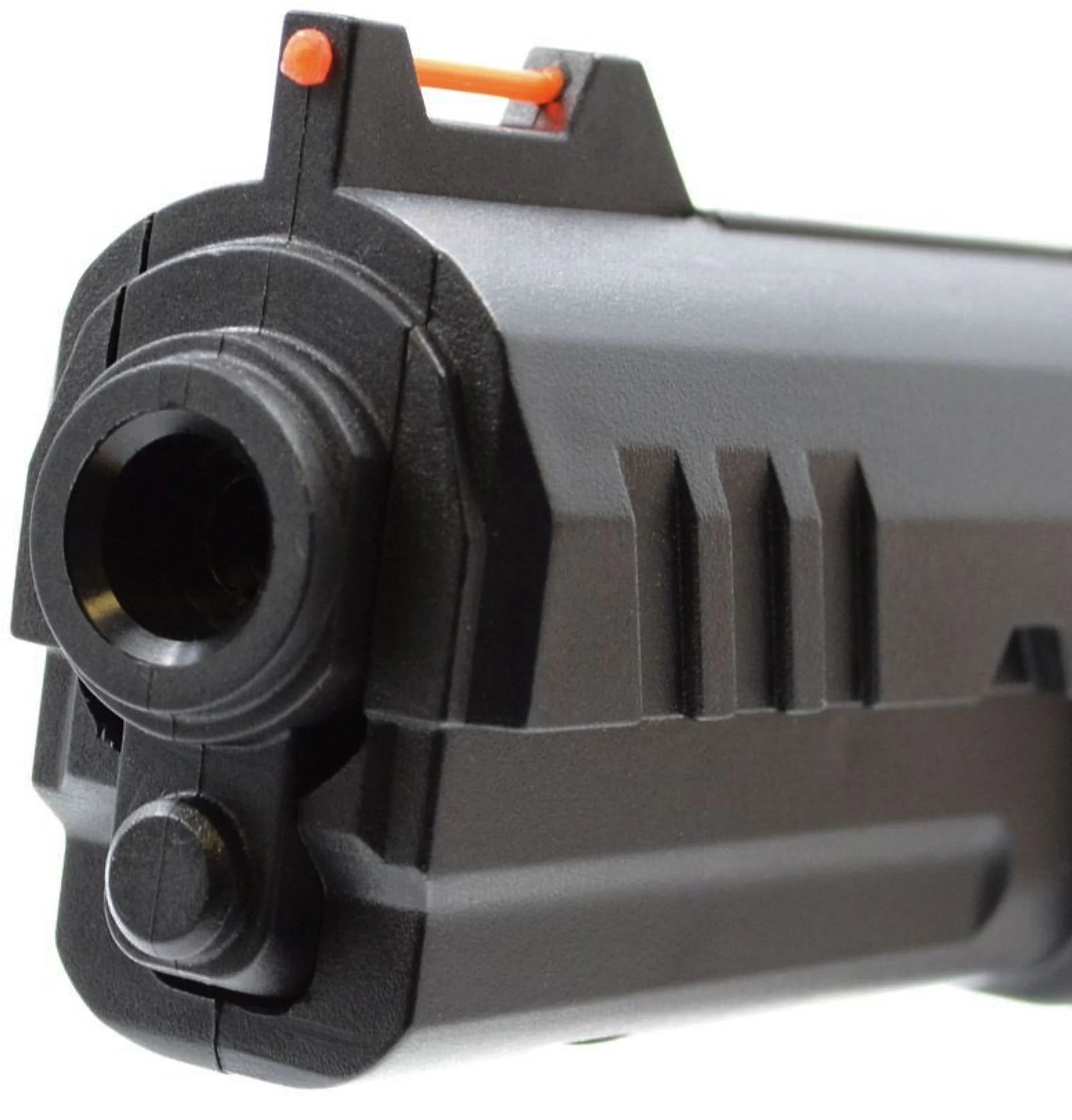
Type: Pellet Pistol. Manufacturer:Umarex Model:Markpoint. Materials: Mostly plastic with some metal. Weight: 1.79 pounds (812 grams). Barrel: 9.75 inch (24.8 cm) Rifled steel barrel. Total Length: 17 inches (43.2 cm). Power Source: Spring piston. Action: Break Barrel - Single Action Only. Ammo Type: .177 caliber pellets. Ammo Capacity: Single shot. FPS: 395 with alloy pellets, 300 with lead pellets.
Trigger Pull: The trigger pull on Umarex Markpoint Break Barrel .177 Cal Pellet Pistol is single action only and you will have to break the barrel and fully cock it to activate the trigger in order to shoot it. You will have to also insert a pellet for each shot when the barrel is in the open position. The trigger itself is a bit on the heavy side with a short takeup. It is not super heavy but I would not consider it light or even medium weight. There is a grip safety that needs to be pressed in at the back of the grip, or the trigger will not function. This is a nice additional safety feature.
Accuracy: So far I have not had the opportunity to test the Umarex Markpoint Break Barrel .177 Cal Pellet Pistol, but the plan is to get to my Field Test Shooting Video shortly and see how it performs in terms of power and accuracy. The Umarex Markpoint Break Barrel .177 Cal Pellet Pistol does have a nice long rifled steel barrel so it has the potential to be very accurate. My main concern is with the sights as they are none adjustable and if it is not well centered out of the box then the only way to adjust it will be by adjusting your aim point to correct any off center shots. There is also no way that I can see to mount a red to or scope of some sort. It looks like there is a rail system on the barrel but it is just cosmetic and there is no way to mount a picatinny accessory to it. I am not sure why Umarex simply did not make the rail a true picatinny rail?
Build Quality: For around a $50 Canadian pellet pistol that has the potential to be a pretty decent entry level target pistol, the Umarex Markpoint Break Barrel .177 Cal Pellet Pistol is pretty well made and feels very solid and mechanically tight. It is mostly plastic but does not feel cheap at all. It is a rather large pistol, especially the grips being fairly wide, so for people with small hands, it may be a bit hard to hold.
Realism: The Umarex Markpoint Break Barrel .177 Cal Pellet Pistol is not a copy or replica of any real steel pistol in production that I know of. To be honest Umarex was not trying that hard to make it look like a real steel pistol as it has it’s very own look to it that I would say is modern and kind of futuristic looking. It for sure has its own style to it, and you are either going to like it to not? I do like that Umarex added the ejection port and vented barrel which does add to the cool factor and makes it feel more like a real gun.
Pros:
Feels well built and solid.
Overall look is good, kind of futuristic if you like that sort of thing.
I like the red highlights, not typical on a real steel gun but looks good on this design.
Expect it to have good accuracy, hope the sights are on point?
Easy to cock spring piston system.
Sights are easy to line up .
Grip safety is a nice safety feature.
Fake ejection port is a nice touch, not something you would normally see on a target pistol like this.
Nice low price tag for some fun target shooting.
Cons:
Trigger is a bit heavy but in terms of length and break is OK.
Sights are not adjustable and no way to add a red dot or other sighting system.
Grip may be a bit wide for smaller handed shooters.
Comments:
For me I think the deciding factor on how I feel about the Umarex Markpoint Break Barrel .177 Cal Pellet Pistol is going to come down to how it performs as I have my reservations on how accurate it is going to be and if it shoots true out of the box. I really hope the sights are dialed in out of the box since there is no way to adjust them or add a red dot or other sighting system. The heavy trigger will take a bit of getting use to also but once adjusted to it I should be able to get some decent groupings. For the price, if it turns out to be a decent shooter and you like the look of it, then by all means it would make a great target plinker that you should be able to get proficient at shooting with. I will leave my final thoughts for the Field Test Shooting video on this one…