
Entries in Pellet,Repeater

Crosman 2240XL CO2 .22 Caliber Pellet Pistol Table Top Review

No Comments

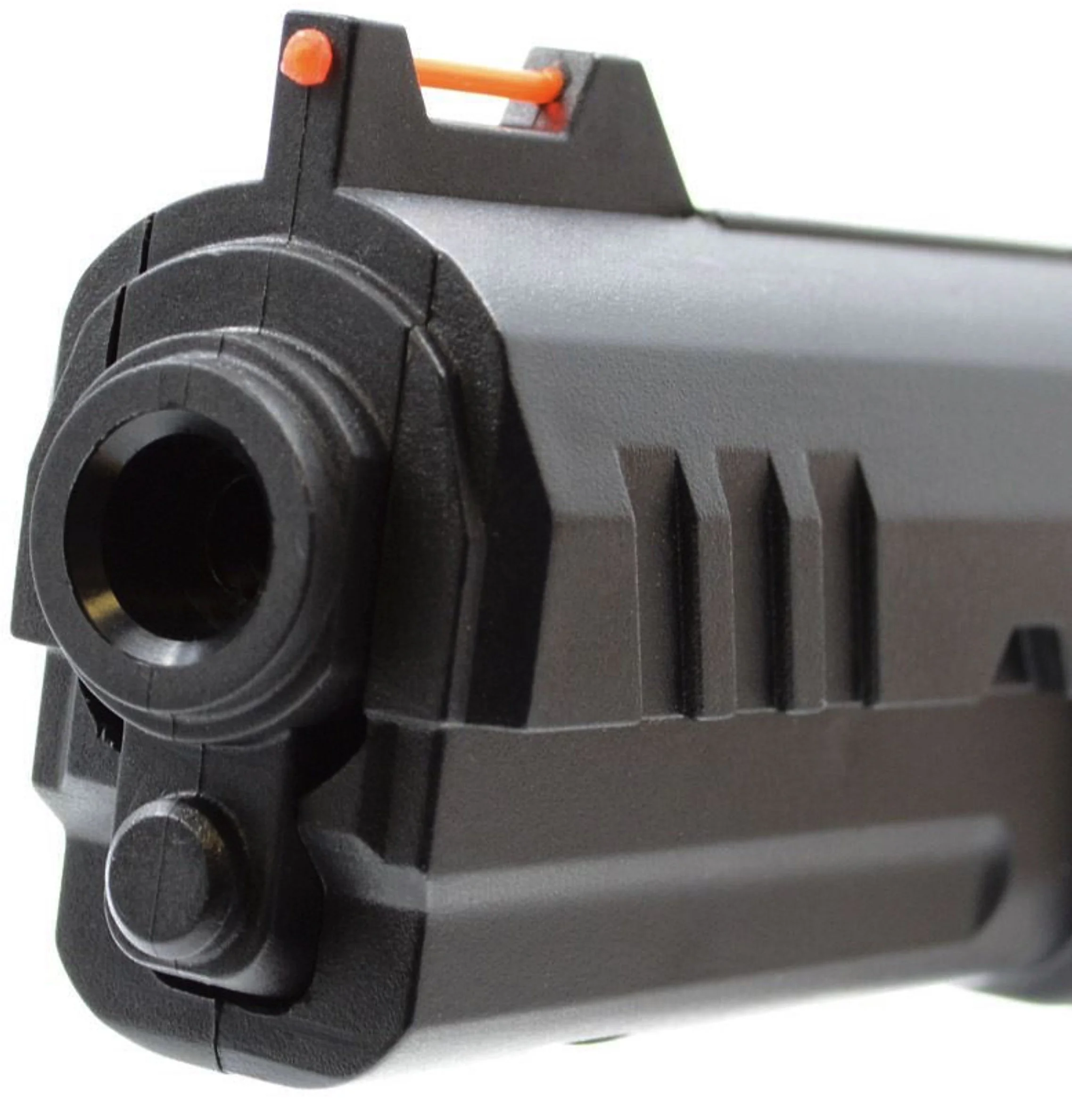
In this table top review, we are taking a close look at the Crosman 2240XL Special Edition, a .22 Caliber CO2 Pellet Pistol. While I haven't shot this exact model yet, I have shot the standard 2240 non-XL version, and they share a very similar firing mechanism. The biggest draw to the XL version is the factory-upgraded metal breech with an 11mm dovetail rail, and the threaded muzzle for added versatility.

Key Specifications:

  • Model: Crosman 2240XL Special Edition

  • Type: Pellet Pistol

  • Caliber: .22 caliber lead pellets

  • Power Source: 12-gram CO2 (1 cartridge)

  • Velocity: Up to 460 FPS

  • Action: Single-Shot Bolt Action

  • Safety: Cross-Bolt Safety

  • Barrel: Rifled Steel Barrel, Threaded muzzle (1/2" x 20 threads)

  • Stock/Grips: Plastic grips

  • Construction: Mostly metal (steel breech, barrel, loading chamber) with plastic grips

  • Weight: 1.8 lbs

  • Overall Length: 12.5 inches

  • Sights: None included

  • Optics Rail: 11mm Dovetail Rail

First Impressions & Build Quality:
The 2240XL brings a much-needed factory upgrade to the legendary 2240 platform: a full steel breech. This alone is a huge addition, making the gun stand out and providing a much higher quality feel. The gun is almost entirely metal, including the barrel, CO2 loading chamber, bolt, and breech. The grips are plastic, which is fairly standard, but one of the best things about the Crosman 2240 platform is how highly customizable it is. There are countless aftermarket parts available, and you can even easily swap out the grips fro wood grips or for a Crosman shoulder stock to turn it into a backpacker-style carbine.

Weighing in at 1.8 pounds and measuring 12.5 inches long, The Crosman 2240XL Special Edition has a solid feel in the hand. The threaded barrel comes with a thread protector and gives you options for adding mock suppressors or other attachments.

How It Works:
This is a single-action, bolt-action pellet pistol. To operate it, you must first cock the bolt and manually load a .22 caliber pellet into the chamber. Once the bolt is pushed forward and locked down, the trigger is engaged and ready to fire. Powered by a single 12-gram CO2 cartridge housed in the lower tube, it is capable of firing up to 460 FPS depending on the weight of the pellets used. Because it's a single-shot bolt action, you'll need to manually load a pellet for every shot, but you won't need to pump it since the CO2 provides the power.

Pros:

  • Upgraded steel breech from the factory provides a robust build and premium look.

  • Built-in 11mm dovetail rail makes adding a red dot or magnified optic easy.

  • Threaded muzzle (1/2" x 20 threads) with an included thread protector for attachments.

  • Solid CO2 power at up to 460 FPS.

  • Highly customizable platform with endless aftermarket parts available.

  • Excellent light single-action trigger with very little take-up.

  • Mostly metal construction ensures long-lasting durability.

Cons:

  • Does not come with any open sights, an optic is required out of the box.

  • Relies on CO2, meaning velocities will fluctuate as the gun cools down during rapid fire and potentially as CO2 volume lowers.

  • Standard plastic grips are somewhat basic.

Final Thoughts:
The Crosman 2240XL Special Edition takes an already proven pistol and adds the features most shooters end up buying aftermarket anyway. Having the steel breech and dovetail rail right out of the box makes mounting an optic straightforward, and the threaded muzzle is a fantastic touch, even if it’s just mainly for looks. If you're looking for a powerful .22 caliber airgun for small pest control that can be modified to your exact liking, the 2240XL is a superb starting point.

Stay tuned for the Field Test Shooting video coming up down the road.

Available at:
Categories: .22 cal, CO2, Comparison, Pellet, Pistol, Scope, Single Shot, Vimeo Video, YouTube Video, Review Tags: Crosman, 2240, 2240XL

Replica Airguns September 2026 Unboxing - Surprise From Crosman Inside

No Comments

We are halfway through September, and another unannounced delivery just showed up at the door. This box was surprisingly compact but incredibly dense, hinting at a hefty amount of possible ammunition inside. Cracking it open revealed a massive 4,000-count bottle of BBs and an updated classic from Crosman.

Gear Stock 4.5mm Copper-Coated Steel BBs

The sheer weight of this package came from a bulk 4,000-round bottle of Gear Stock 4.5mm steel BBs. These specific rounds feature a copper coating, which looks great but comes with a few historical caveats.

  • Copper vs. Zinc: In my experience, copper-coated BBs can tarnish over time. Unlike zinc, which stays relatively clean, older copper coatings can oxidize and leave a dark, powdery residue on your hands and inside your airgun's barrel.

  • Quality Check: If you burn through your ammo quickly, the tarnishing won't be an issue. We will have to see if modern manufacturing has improved the coating durability on this Gear Stock batch, but I typically lean toward zinc-coated BBs for long-term storage and cleaner shooting.

  • Buy Gera Stock BB’s in Canada

  • Buy Gear Stock BB’s in the US

The Crosman 2240 XL .22 Caliber CO2 Pellet Pistol

The main event in this box is the Crosman 2240 XL. The 2240 platform has been a staple in the airgun community for decades, and the XL version finally addresses the most common pain points shooters had with the base model out of the box.

  • Core Specs: The 2240 XL is a CO2-powered, bolt-action, single-shot pistol chambered in .22 caliber. It weighs in at 1.8 pounds, features a rifled steel barrel, and utilizes a standard 12-gram CO2 cartridge.

  • The Metal Breech Upgrade: The standard 2240 and its multi-pump cousin, the 1322, utilize a plastic breech. Mounting an optic on those older models requires clamp-on barrel adapter rings, which can easily twist out of alignment. The 2240 XL ships with an upgraded all-metal breech featuring a milled 11mm dovetail rail, allowing for a rock-solid red dot or scope mount straight from the factory.

  • Threaded Muzzle: The front of the barrel has a threaded muzzle cap. You can unscrew the tip to attach 1/2" UNF aftermarket compensators or moderators, adding another layer of customization.

  • Buy the Crosman 22040 XL .22 Caliber CO2 Pellet Pistol in Canada

  • Buy Pellet Pistols in the US

Customization and Practical Application

Because the 2240 XL features a dovetail rail instead of iron sights, it is built specifically for optics. This plays perfectly into the massive aftermarket support for Crosman’s 22xx and 13xx platforms.

I own a heavily modified "backpacker" setup on one of my personal Crosman .22s, featuring a skeletonized rear shoulder stock and a magnified scope. At sub-500 FPS, a .22 caliber pellet is highly effective for close-range pest control. When dealing with nuisance animals like crows attacking songbirds, an ultra-high-velocity pellet will often pass straight through the target, wasting its kinetic energy. A heavier .22 pellet moving at moderate speeds dumps its full energy upon impact, providing a much more immediate and humane dispatch.

The full tabletop and field test shooting videos for the Crosman 2240 XL are coming up next. Make sure you are subscribed on Rumble, Vimeo, X, Threads, or TikTok to catch the full performance breakdown when it goes live.

Categories: .22 cal, 4.5mm / .177 cal, BB, CO2, Pellet, Pistol, Repeater, Review, Replica Airguns News, Vimeo Video, YouTube Video, Single Shot Tags: Crosman, Gear Stock, 2240, 2240XL

Marksman 1018 Spring BB - Pellet Pistol Field Test Review

No Comments

Today, we are putting the Marksman 1018 Spring-powered BB/Pellet Pistol through its paces in the indoor shooting range. Don't get too excited, this gun isn't going to blow your socks off with crazy power, and I highly doubt we'll be seeing sniper-level accuracy. I also only test it out using standard 4.5mm steel BB’s in this Field Test.

If you're looking for the nitty-gritty details, specifications, and close-up angles, I have already done the dedicated Table Top Video Review for this gun, so be sure to check that out. For this session, we are strictly focused on performance: getting it on the Chrony and seeing how this spring-powered plinker handles when we actually put some 4.5mm BB rounds downrange.

Chronograph and Velocity Testing Starting things off with the chrony test, I wanted to see what kind of speed we could get out of this basic springer. Marksman claims it can shoot up to 200 FPS on the packaging. To test this, I loaded up the built-in BB reservoir to see if it could hit those numbers. Let's see how it performed:

  • Shot 1: 111 FPS

  • Shot 2: 110 FPS

  • Shot 3: 107 FPS

  • Shot 4: 115 FPS

  • Shot 5: 108 FPS

  • Shot 6: 108 FPS

  • Average 110 FPS

As you can see, the numbers were very consistent, hovering right around the 110 FPS mark. While it is incredibly consistent, it falls well short of the 200 FPS claim. Because of this exceptionally low velocity, I decided to scrap my usual 30-foot target test. The gun just doesn't have the power to push BBs effectively at that distance without a massive arc, so I moved closer to the paper target at around 20 feet.

Accuracy Downrange at 20 Feet Next up, from 20 feet out, I took aim to see what kind of grouping the Marksman 1018 could pull off on a fresh paper target.

Shooting the Marksman 1018 Spring-powered BB/Pellet Pistol requires a bit of an adjustment. Out of the box, the fixed sights were shooting rather high and significantly to the left. I was aiming dead center at the bullseye, and the rounds were lofting up and striking far left of the center ring. Because you are dealing with completely fixed sights on a low-velocity plinker, you're going to have to rely heavily on "Kentucky windage", meaning if you want to hit your target, you'll need to aim well to the right and a bit lower to compensate. At 30 feet, those BBs would just be arcing even more dramatically, so 20 feet (or even 10 feet) is definitely the sweet spot for this pistol.

Shooting Feel and Features Despite the low velocity and accuracy quirks, the physical shooting experience has some redeeming qualities. The loading mechanism works flawlessly; it draws from the internal reservoir consistently without missing a single beat while cocking as long as it is fairly full.

Cocking the spring is incredibly easy, and the trigger actually isn't half bad for such a basic, entry-level gun. Since it's spring-powered, there is no need for CO2. This means it will work in absolutely any environment, rain or shine, and it’s incredibly cheap to shot.

Final Thoughts Ultimately, the Marksman 1018 Spring-powered BB/Pellet Pistol is exactly what it looks like: a real basic, inexpensive plinker. It’s not meant for long-range accuracy or high power. It's designed for casually plinking pop cans in your backyard or basement at 10 to 20 feet. For just a few bucks, you can grab a bottle of BBs and have some cheap, casual fun without ever worrying about buying or running out of CO2 cartridges. It is inexpensive to buy, inexpensive to shoot, and incredibly easy to operate.

Where to Buy

Thanks for tuning in! Make sure to head over and follow the Replica Airguns channels on Rumble, Vimeo, and YouTube. We are uploading as much content as possible to Rumble right now, and your support means the world as we keep building up our video community! Until next time, take care.

Categories: 4.5mm / .177 cal, BB, Field Test, Pellet, Pistol, Repeater, Review, Spring Piston, Single Shot, Vimeo Video, YouTube Video Tags: Marksman, 1018

A&K M1873R M-Lock Lever Action Airsoft Gas Rifle Field Test Review

No Comments

Hey everybody, Michael here from Replica Airguns with another field test shooting video! Today, we finally got our hands on another A&K M1873R M-Lock Lever Action Airsoft Gas Rifle. The first one we received had an issue with a leaking valve that someone tried to fix with some goop, so I got a return item to demo instead. For this session, we are strictly focused on performance: seeing how this model handles when we actually put some rounds downrange. I am using .25 gram Airsoft BBs and filling it up with propane gas. We are going to put this gun through its paces, but right out of the gate, we're dealing with some quality control quirks. Also make sure to checkout my Table Top video for the A&K M1873R for details specifications and close up video.

Chronograph and Velocity Testing

Starting things off with the chrony test, I filled the gun up with propane. It's worth noting right away that preparing this gun is frustrating; you cannot fill the gun with gas while the front mock suppressor is attached. You have to take a coin, unscrew it for 30 to 60 seconds, fill the gas, and put it back on. After finally getting it loaded up, let's see how the M1373 R version performed:

  • Shot 1: 340 FPS

  • Shot 2: 320 FPS

  • Shot 3: 335 FPS

  • Shot 4: 328 FPS

  • Shot 5: 337 FPS

  • Shot 6: 335 FPS

As you can see, the numbers were fairly consistent, keeping us comfortably in the 320 to 340 FPS range with a 7 shot average of 331 FPS. It shoots right around where you want it to be for an Airsoft Rifle of this type, though you can hear the gas starting to run a bit low if you push too many rounds through it without topping it off.

Accuracy Downrange at 30 Feet

Next up, I stepped back to my standard 30-foot mark to see what kind of grouping the A&K M1873R M-Lock Lever Action Airsoft Gas Rifle could pull off on a fresh paper target. I put about 10 or 11 rounds through it for this string. Because of the way it was hitting, I intentionally aimed towards the bottom of the target ring to compensate for it shooting high the way the red dot was sighted in.

Shooting this gun requires some effort. The trigger is honestly quite heavy for what is essentially a single-action pull, so you really have to crank it. Despite the heavy trigger, the end result was a fairly decent 2.5 to 3-inch grouping. As long as you know where to aim or have your sights dialed in, it's actually not a bad shooter downrange.

Shooting Feel and Quality Control Issues

The physical shooting experience is where this A&K replica really struggles, largely due to lacking quality control. Out of the box, a small retention spring meant to keep the loading port door closed, fell out of the breech area. Because of this, it misfeeds, and the BB stays in the bottom part of the breech unless you give the lever an intentional, forceful push to load it correctly.

The other major headache is the previously mentioned mock suppressor design. Having to take a tool or coin to remove it just to fill it up with gas makes no sense for field use. They really should have included an open-front mock suppressor or an extender piece so you can reach the valve easily without a teardown process every 20+ shots or so.

Final Thoughts

Ultimately, the A&K M1873R M-Lock Lever Action Airsoft Gas Rifle is a very cool-looking modern lever action rifle, but I really wish it didn't have these out-of-the-box issues. Between the two models I looked at, both had problems, from leaking valves to a finicky loading door. The unnecessary 60-second hassle just to fill the gas tank holds it back from being a great plinker unless you simply do not install the mock suppressor. It definitely shoots well enough and hits good FPS numbers, but you'll have to deal with some frustrating design choices and quality control along the way.

Where to Buy

Thanks for tuning in! Make sure to head over and follow the Replica Airguns channels on Rumble and Vimeo. We are uploading as much content as possible, and your support means the world to us!

Categories: 6mm, Airsoft, Gas, Repeater, Review, Rifle, Vimeo Video, YouTube Video, Field Test Tags: A&K, M1873R

Daisy Woodland Trail Western Carbine 1999 Field Test Review

No Comments

Welcome back for another field test! Today I am taking the Daisy Woodland Trail Western Carbine 1999 out to the range to see what it can do. If you want a deep dive into the specifications, materials, and a close-up look at the hardware, make sure to watch our dedicated Table Top Review. For this video, however, I am focusing entirely on how this lever-action BB rifle performs when putting steel to paper.

Velocity and Chronograph Performance

To get a baseline for power and consistency, I ran a string of shots through the chronograph. The manufacturer claims velocities in the 300+ FPS range. Here is how the Daisy handled right out of the box:

  • Shot 1: 291 FPS

  • Shot 2: 286 FPS

  • Shot 3: 285 FPS

  • Shot 4: 284 FPS

  • Shot 5: 283 FPS

The consistency on this carbine is outstanding. After a slightly higher first shot, it locked right into the high 280s and low 290s and stayed remarkably steady throughout the test string with an average fps of 286.

One quirk to watch out for during operation is the loading system. While cocking the lever, you might occasionally get a "dud" or mis-feed where a BB fails to chamber properly. If this happens, you simply need to (while pointing the barrel up) give the Daisy Woodland Trail Western Carbine 1999 a quick shake to position the ammo and rack the lever again.

Downrange Accuracy at 30 Feet

Moving on to the accuracy portion of the review, I set up a fresh paper target exactly 30 feet downrange.

  • Target Testing: I fired 10 carefully aimed shots. The gun delivered an excellent grouping of about 1.5 inches. The cluster was perfectly centered left-to-right, meaning the windage was completely dialed in straight out of the box which is great since there are no windage adjustments to speak of. It did shoot slightly high on the elevation, but compensating for this is simply a matter of aiming just underneath the bullseye or tweaking your optics if you mounted a red dot or optical sight.

Handling Notes and Optics Fitment

This is an incredibly fun lever-action plinker. One of the best design choices on this specific Daisy Woodland Trail Western Carbine 1999 model is the modernized, bigger loop on the lever, which makes it much more comfortable for shooters with larger hands to cycle the action or if wearing gloves.

You will also find a major upgrade on the top of the receiver. This version features a Picatinny rail, making it extremely easy to mount optics. I actually used the built in open sights rather than installing a red dot sight during this specific accuracy test, and the iron open sights worked very well for me. If you prefer iron sights, the rear sight remains fully adjustable for elevation but not windage.

Final Thoughts

The Daisy Woodland Trail Western Carbine 1999 is a rugged, highly affordable BB gun that backs up its classic lever-action fun with rock-solid consistency and great accuracy on the range. It is incredibly cheap to shoot, making it the perfect backyard plinker for knocking over pop cans or army men. Just remember to always wear your eye protection!

Where to Buy

If you haven't already, please head over to our YouTube, Rumble, and Vimeo channels and hit that subscribe button. We are always working to build our video community back up, and we truly appreciate your support!

Categories: 4.5mm / .177 cal, BB, Field Test, Repeater, Review, Rifle, Vimeo Video, YouTube Video, Spring Piston Tags: Daisy, Woodland Trail Western Carbine, Model 1999, Red Ryder

Daisy Woodland Trail Western Carbine - Model 1999 Table Top Review

No Comments

In this table top review, we are taking a close look at the Daisy Model 1999 Lever Action Spring BB Rifle. While this is technically a “table top” review, lever-action rifles like this are always a bit easier to show off in-hand due to their length and proportions.

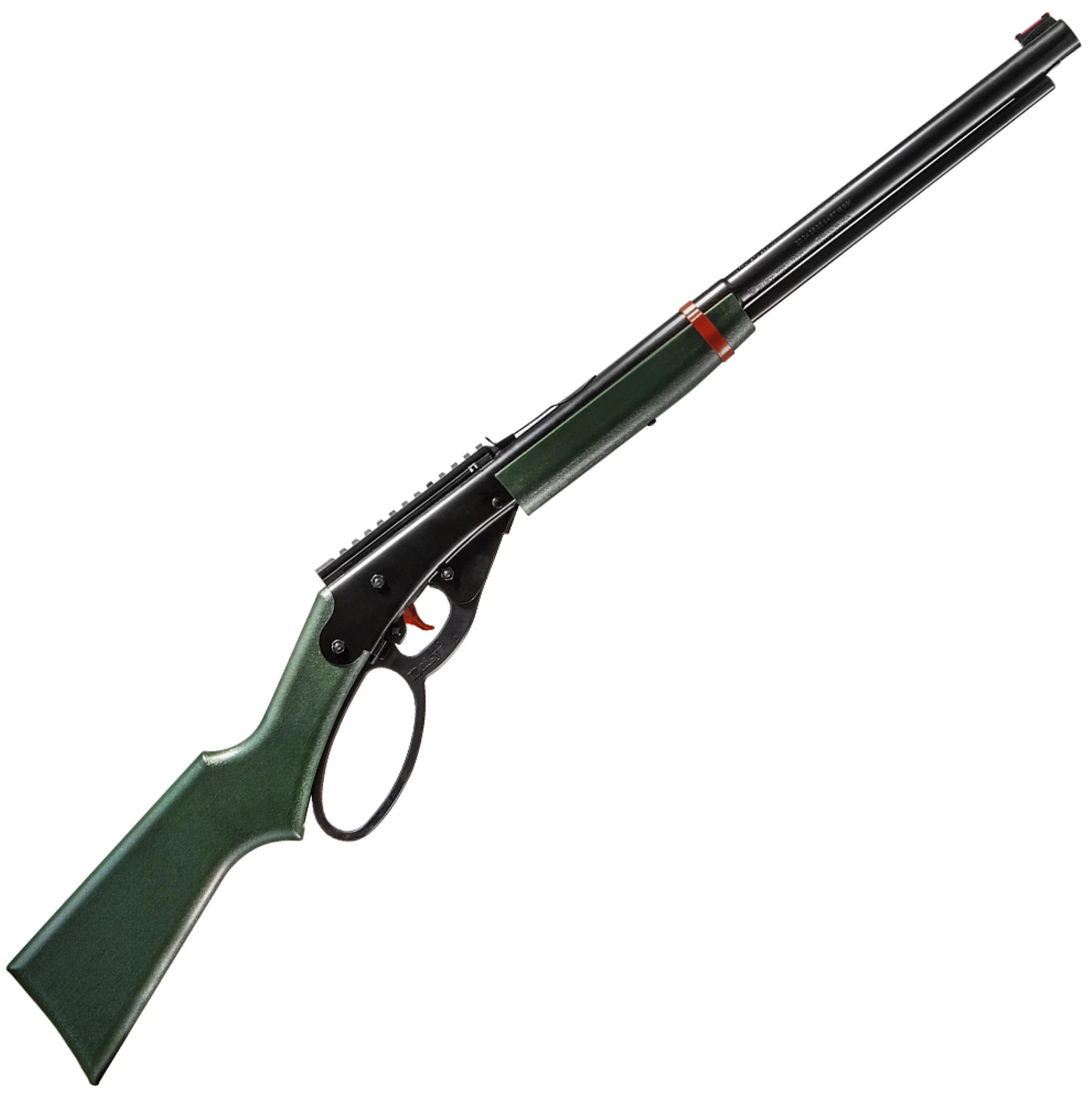
This rifle fits into the long, classic lineage of lever-action BB guns, modeled after traditional Western lever-action carbines like the legendary Daisy Red Ryder. While it shares that iconic spring-piston platform, the Daisy Model 1999 brings a modern aesthetic update with all-weather synthetic furniture, high-visibility fiber optics, and a built-in optics rail.

Key Specifications

  • Model: Daisy Model 1999

  • Type: Lever Action Spring-Piston BB Rifle

  • Caliber: 4.5mm (.177 cal) Steel BBs

  • Power Source: Spring-Piston (No CO2 Required)

  • Velocity: Approx. 350 FPS

  • Magazine Capacity: 650-Round Internal Reservoir (Gravity Fed)

  • Action: Single-Shot Lever Action

  • Safety: Cross-Bolt Safety

  • Barrel: Smoothbore Steel Barrel (inside outer metal barrel shroud)

  • Stock & Forearm: All-Weather Molded Synthetic / Composite Polymer (Green)

  • Construction: Metal Outer Barrel & Receiver with Polymer Stock, Forearm, & Lever

  • Weight: Approx. 2.2 lbs

  • Overall Length: 35.4 inches

  • Sights: High-visibility fiber optic front sight; elevation-adjustable rear sight

  • Optics Rail: Built-in Picatinny rail mount

First Impressions & Build Quality

The Daisy Woodland Trail Model 1999 puts a contemporary spin on the traditional lever-action look, sporting an all-weather green molded synthetic stock and forearm paired with an orange trigger and barrel band accent.

Weighing in at just 2.2 pounds with an overall length of 35.4 inches, it is exceptionally lightweight and compact, making it an ideal entry-level platform for younger shooters and beginners.

The rifle incorporates a solid amount of metal along the outer barrel and receiver casing. While it does use polymer for the stock, forearm, and cocking lever, the build feels sturdy and low-maintenance.

How It Works

The Woodland Trail Model 1999 utilizes the proven spring-piston lever-action mechanism:

  • No CO2 or Gas Required: Every shot is cocked and powered manually via the spring-piston system.

  • Large Loop Lever: Cocking is smooth and easy thanks to the oversized loop lever.

  • Massive Ammo Capacity: It holds up to 650 steel BBs in a top-loading internal reservoir.

  • Gravity Fed: Tilting the rifle cocks and drops a BB into the loading mechanism, visible through a small viewport near the breach so you can confirm a round is chambered before firing.

Sights & Optics

Unlike traditional bare-iron lever guns, the Daisy Model 1999 comes equipped with several optical upgrades:

  • Fiber Optic Front Sight: The bright front fiber optic sight makes target acquisition quick and clear against varying backgrounds.

  • Adjustable Rear Sight: Step-adjustable for elevation (fixed for windage).

  • Built-in Picatinny Rail: A dedicated top rail allows for easy mounting of compact red dot sights or low-power optics without needing custom brackets or adapters.

Pros & Cons

Pros:

  • Extremely lightweight (2.2 lbs) and compact—perfect for youth and beginners.

  • Durable, all-weather synthetic stock is moisture-resistant and low maintenance.

  • Built-in Picatinny rail makes adding red dots or scopes simple.

  • Bright fiber optic front sight aids quick target acquisition.

  • Smooth, easy-cocking lever action with a large loop handle.

  • Huge 650-round gravity-fed BB reservoir means less reloading downtime.

  • 350 FPS velocity is safe and well-suited for supervised backyard plinking.

  • No CO2 or gas cartridges required.

  • Highly affordable entry-level price point.

Cons:

  • Synthetic plastic cocking lever (a metal lever would feel more robust).

  • Lower velocity compared to modern CO2-powered airguns.

  • Rear sight adjusts for elevation only (no windage adjustment).

  • BB ammo only and smoothbore barrel limits pinpoint precision to short plinking ranges.

  • Basic spring action lacks the ultra-realistic shell-ejecting mechanics of higher-end replicas.

Final Thoughts

The Daisy Woodland Trail Model 1999 is a reliable, fun, and accessible take on the classic lever-action spring BB rifle. By blending traditional lever-action shooting with modern polymer furniture, a fiber optic front sight, and a Picatinny optics rail, it offers fantastic value for casual plinking and teaching basic marksmanship while offering some customization.

Stay tuned for our upcoming Field Test Shooting Review, where we’ll put this rifle through its paces on the chronograph and see what kind of target accuracy it delivers!

Available at:

Also check out ReplicaAirguns.com for more written articles, detailed photos, and reviews.

Categories: 4.5mm / .177 cal, BB, Repeater, Review, Rifle, Spring Piston, Vimeo Video, YouTube Video Tags: Dai, Woodland Trail Western Carbine, Red Ryder

Marksman 1018 Spring BB - Pellet Pistol Table Top Review

1 Comment

First Look & Overview In this table top review, we are taking a look at the Marksman Spring BB / Pellet / Dart Pistol, an inexpensive and versatile option for backyard and basement plinking. This model is primarily constructed with a plastic exterior shell, housing a single-stroke spring-piston power plant. Coming in at around $50 CAD, this is not a high-end replica, but it offers a highly accessible shooting experience with the ability to handle multiple types of ammunition.

Specifications

  • Caliber: 4.5mm Steel BBs, .177 Caliber Pellets, & Darts

  • Action: Single-stroke spring piston, break-barrel style loading

  • Magazine: 18-round BB reservoir (single-shot for pellets and darts)

  • Power Source: Spring piston

  • FPS: Maximum 200 FPS

  • Weight: ~1 lb (454 grams)

  • Overall Length: 9 inches

  • Construction: Mostly plastic exterior with internal metal components

  • Sights: Fixed fiber optic sights (front and rear)

  • Safety: Cross-bolt safety

Build Quality & Design The Marksman Spring BB / Pellet / Dart Pistol features a lightweight, predominantly plastic external construction. While it lacks the substantial heft of full-metal replicas, weighing in at just 1 pound, it feels quite comfortable in the hand. The grip has a nice texture and isn't overly thick, making it suitable for shooters with smaller hands even though the pistol maintains a slightly bulky, blocky 1911-style appearance. Despite the external plastic shell, the internal spring piston system and critical mechanical components are made of metal.

Magazine & Loading System Loading this pistol is a unique process. It features a built-in 18-shot internal reservoir for 4.5mm steel BBs. To fire, the rear section of the slide is pulled back to activate the spring piston. Pushing the top portion forward opens the breech in a break-barrel fashion, allowing access to the loading bay. When using BBs, they drop in from the internal reservoir. If you are shooting pellets or darts, you will load them one at a time directly into the breech. An included rubber speed-loader accessory lets you easily drop BBs into the reservoir by simply pinching it, a convenient feature that saves loading time.

Handling & Controls Operating this spring piston pistol requires manual cocking before every shot. The slide is used to cock the internal spring, and the trigger features a skeletonized design within a built-in fairly heavy trigger guard. The trigger pull is decent but requires a deliberate press. The cross-bolt safety effectively locks the trigger, ensuring that the pistol cannot be fired once cocked and loaded until you have disengaged it. (Mine did have an issue)

Sights & Optics The Marksman Spring BB / Pellet / Dart Pistol comes equipped with fixed fiber optic sights on both the front and the rear. This makes target acquisition noticeably easier, especially against various backgrounds or in lower light conditions. The sights are fixed and non-adjustable, and the pistol even though it looks like it does, it does not include accessory rails for mounting aftermarket optics or lasers.

Performance Expectations This airgun is not built for shattering power records, boasting a maximum velocity of around 200 FPS. Because of its low power output, it is very quiet to operate, making it ideal for close-range indoor plinking or backyard target shooting where noise is a concern. The spring piston action means there is no CO2 to buy, keeping your operating costs extremely low.

Pros

  • Very affordable (around $50 CAD)

  • No CO2 required; low ongoing operating cost

  • Versatile ammo compatibility (shoots BBs, pellets, and darts)

  • 18-round internal BB reservoir

  • Included quick-load pinch accessory for BBs

  • Fiber optic sights front and rear

  • Lightweight and easy to handle for various hand sizes

  • Quiet operation ideal for indoor or backyard shooting

Cons

  • Low velocity (max 200 FPS)

  • Predominantly plastic exterior construction

  • Requires manual cocking for every single shot

  • Fixed, non-adjustable sights

  • No accessory rails

Final Thoughts The Marksman Spring BB / Pellet / Dart Pistol isn't about raw power or ultra-realistic blowback action. It's an accessible, budget-friendly airgun that doesn't require extra CO2 purchases. With the ability to shoot multiple types of ammo and a convenient included BB loader, it delivers straightforward, simple fun. Stay tuned for the upcoming field test shooting video to see exactly how this performs down range.

Be sure to check out our exclusive long-form video content on YouTube, Vimeo and Rumble and connect with us on Facebook, Twitter and Instagram.

Categories: 4.5mm / .177 cal, BB, Break Barrel, Pellet, Pistol, Repeater, Review, Single Shot, Spring Piston, Vimeo Video, YouTube Video Tags: Marksman, 1018, 1911

Replica Airguns August 2026 Unboxing - 4 New Products to Review

No Comments

We’ve got yet another box on the table today for our August Mystery Unboxing. It took a while to arrive, but it was absolutely worth the wait. We’re diving into four highly anticipated products across the BB, Pellet, and Airsoft categories.

Here is a quick first look at what’s hitting the review table soon!

Marksman Model 1018 .177 Caliber Air Pistol

First out of the box is the Marksman 1018. This is a very budget-friendly (around $50), 1911-inspired spring-actuated pistol. It features fiber-optic sights on the front and back, making it an excellent, quiet option for basement or backyard plinking. While it can technically shoot darts and bolts, we'll be sticking to BBs and pellets for our tests.

Basic Specifications:

  • Action: Single-stroke spring piston

  • Caliber: .177 Caliber (BBs and Pellets)

  • Capacity: 18-shot internal BB reservoir

  • Velocity: Up to 200 FPS

  • Weight & Length: 1 lb / 9.0 inches

Umarex Glock 17 Gen 5 MOS CO2 Blowback BB Pistol

Next up is a beauty from Umarex, the Glock 17 Gen 5 MOS. If you love ultra-realistic replicas, this is it. It features a heavy full-metal slide spring, a recessed barrel, and classic white dot sights. The "MOS" means it comes ready with all the mounting plates you need to attach your favorite red dot sights. It runs on a full-size, drop-out 17-round metal magazine and utilizes a full blowback system for ultra realistic blowback operation.

Basic Specifications:

  • Action: Semi-auto full blowback, single CO2 cartridge

  • Caliber: 4.5mm (.177) steel BBs

  • Capacity: 17-round drop-out metal magazine

  • Velocity: Approximately 300 FPS

  • Weight & Length: 1.5 lbs / 7.95 inches

A&K M1873R M-LOK Lever Action Airsoft Gas Rifle

I'm incredibly excited to finally do a proper field test on this one. This is a replacement for a previous model that had a leaky loading valve. This gas-operated, "Mares Leg" style lever-action rifle is heavily modernized. It features a gorgeous real wood stock, an enlarged lever loop, a Picatinny top rail, an M-LOK handguard for accessories, and a mock suppressor on the front.

Basic Specifications:

  • Action: Gas Non-Blowback Lever Action (Green Gas)

  • Caliber: 6mm Airsoft BBs

  • Capacity: 25-round internal magazine

  • Velocity: 360 - 390 FPS (with 0.20g BBs)

  • Weight & Length: 3.7 lbs / 24.5 inches

Specna Arms SA-E10 PDW Edge AEG Airsoft Rifle

Finally, we have an absolute powerhouse in a tiny package: the Specna Arms SA-E10 PDW. This is a super-compact AR-style AEG with a polymer-metal build and a telescopic stock. Specna Arms goes above and beyond with the box contents on this one. Along with the rifle, you get two S-MAG mid-cap magazines, an additional M90 drop-in spring to easily lower your FPS for indoor fields, a Deans adapter, and a vertical foregrip.

Basic Specifications:

  • Action: Electric (AEG) with Pre-installed MOSFET

  • Capacity: Includes two 125-round mid-cap S-MAG magazines

  • Velocity: 375-390 FPS (Drops to ~310-320 FPS with included M90 spring)

  • Length: Minimum 505 mm (approx. 19.8 inches)

  • Inner Barrel: 160 mm precision 6.03mm barrel

Stay tuned to the Replica Airguns channel, as I'll be doing dedicated tabletop and field test shooting videos for all of these very soon.

Categories: 4.5mm / .177 cal, 6mm, AEG, Airsoft, BB, Blowback, CO2, Full Auto, Gas, Pellet, Pistol, Review, Rifle, Semi Auto, Single Shot, Spring Piston, YouTube Video, Vimeo Video Tags: A&K, Marksman, Umarex, Specna Arms, Specna Arms Edge, Glock 17, Glock, Glock MOS, Glock 17 MOS, SA-E10, SA-E10 PDW, M1873R, 1018

Steambow B08 .68 Caliber Tactical Crossbow Field Test Review

No Comments

The Steambow B08 .68 Caliber Tactical Crossbow offers a unique and entertaining option for target shooting. In this field test review, I tested the Steambow B08, a .68 caliber launcher that is designed to shoot paintballs, rubber balls, or foam balls. I wanted to test this 35-pound bow to see how it performs in terms of velocity and real-world accuracy at 30 feet downrange.

For ammunition, I tested two different types of projectiles: black rubber balls and soft yellow foam balls. These projectiles are very light, which means firing them feels almost like you are dry-firing the bow all the time. However, using them makes for a cheap way to have some fun plinking around, and you can easily collect and reuse the ammo.

Velocity testing through the chronograph produced some incredibly consistent, albeit unusual, numbers. I fired six shots in total, using three rubber balls followed by three foam balls. The Steambow B08 delivered readings of exactly 129 FPS for all six shots. Seeing six duplicate velocity readings in a row across two different types of ammo is something I don't think I've ever seen before! This suggests that the projectile weight is less important here, as the bow string only moves so fast. For those looking to get more energy downrange, you will definitely want to use heavier projectiles, like a steel ball, and swap out for a heavier limb. (The Steambow B08 comes with a 35 pound limb for reference).

Accuracy testing was performed from 30 feet downrange on a fresh paper target. I loaded the eight-round magazine with four black rubber balls and four soft foam balls. The Steambow B08 .68 Caliber Tactical Crossbow was hitting quite low at this 30-foot distance, forcing me to aim up at the top of the target just to get the shots on paper. The grouping was somewhat scattered all over the place, indicating that this is a launcher you probably want to be working with a little closer in, at around 20 feet would be better in terms of accuracy. Aiming is done using a built-in little green dot at the front, but there is no real sight adjustment to dial it in or change it. Optimally I would sugest putting a simple red dot sight on the picatinny rail.

Overall, the 35-pound Steambow B08 is built primarily for target shooting and is a great way to have fun with your buddies outside or even inside a garage. I definitely wouldn't want to shoot this for pest control unless you plan to upgrade to a heavier limb and denser ammo. For anyone looking for a cheap, fun plinker with reusable ammo, this launcher is a very entertaining choice.

You can find the Steambow B08 and other Airguns, BB guns, Airsoft guns, Pellet guns, Blank guns, and accessories at:

Categories: .68 cal, Crossbow, Field Test, Paintball, Repeater, Review, Vimeo Video, YouTube Video Tags: Steambow, B08, Crossbow

Annie Oakley Lil' Sure Shot Spring BB Rifle Field Test Review

No Comments

Today, we are checking out the second-generation Lil' Sure Shot Annie Oakley BB Rifle. This is essentially a Red Ryder-styled, spring-powered BB rifle.

If you are interested in seeing how this looks up close along with the specifications and details, make sure to check out the table-top video. Today is going to be all about shooting it.

Chronograph Velocity Test

To get started, I needed to warm up the chrony, which took a little bit of troubleshooting. I had an ongoing voltage issue with my chronograph lighting and had to use a voltage regulator set to almost exactly 7 volts to get it to work properly without a proper adapter.

Once the chrony was up and running, I put several rounds through the rifle to test the velocity. The velocity remained pretty consistent in the mid-300s, with shots recording at 341, 340, 333, 329, 334, and 332 fps. averaging out at 334.

Target Accuracy Performance

For the accuracy portion of the test, I set up a paper target 30 feet down range. Here is how the rifle performed:

  • Grouping: After firing about 10 shots, the rifle got just over a two-inch grouping.

  • Placement: The shots were well-centered from left to right, though it shot a little high even when aiming just under the bullseye. I noticed a few stray BBs came back, which happens if they hit metal instead of the cloth backboard, causing some high flyers. (This could of been me as the bulk of the shots all grouped really nicely)

  • Sights & Adjustability: It can be a little tough on the eyes aiming black front and rear sights on a target when you need readers for most things, which may have contributed to some of those shots hitting slightly higher. You can adjust the elevation slightly by moving a little piece on the sight backward and forward to raise or lower it. The rifle also features a dovetail, allowing you to mount a nice optical sight or a red dot.

Trigger Pull & Feel

  • Pull Weight: The trigger pull comes in at around 5 to 6 pounds.

  • Action: It is fairly short with a pretty predictable break.

  • Usability: It requires a little effort, but it is not a super hair trigger, making it perfect for youngsters who are just starting out with shooting.

Conclusion

Overall, the Annie Oakley Lil' Sure Shot delivers exactly what you want out of a classic, Red Ryder-styled spring-powered BB rifle: it's straightforward, reliable, and just plain fun to shoot. While you aren't going to get competition-level precision out of a smoothbore BB gun, holding a solid two-inch grouping at 30 feet and putting out very consistent mid-300s fps velocities proves that it is more than capable of handling your everyday plinking or indoor target practice.

What really makes this rifle shine is its accessibility. With a predictable 5 to 6-pound trigger pull that requires deliberate effort without being a super hair trigger, it is a fantastic option for youngsters who are just learning the fundamentals of shooting. Plus, the inclusion of a dovetail mount means there is room to grow with the shooter, you can easily slap a red dot on there if the standard black iron sights prove a bit too tough on the eyes against various target. If you are looking for an entry-level plinker that performs right where it should, this second-generation Lil' Sure Shot is a great place to start.

If you want to pick one of these up, links are in the description to buy in both Canada and the US.

Categories: 4.5mm / .177 cal, BB, Field Test, Repeater, Review, Rifle, Spring Piston, Vimeo Video, YouTube Video Tags: Annie Oakley Lil Sure Shot, Air Venturi

Sig Sauer P320 Spectre Comp CO2 Blowback Pellet Pistol Field Test Review

No Comments

The Sig Sauer P320 Spectre Comp CO2 Blowback Pellet Pistol takes the already popular P320 platform and adds a more tactical, competition-inspired look with the Spectre Comp styling. In this Field Test Review, I focused mainly on real-world shooting performance including velocity, accuracy, trigger feel, blowback action, and overall handling. If you want all the detailed specifications and close-up overview footage, make sure to also check out my Table Top Review video for this model.

For this test I used standard Sig Sauer lead pellets, estimated around 7–8 grains rather than lightweight alloy pellets, giving a more realistic idea of what shooters can expect during normal use. Despite some chronograph frustrations during testing, the pistol delivered fairly consistent velocities once everything settled down. Average readings for my five shots through the Chronograph came in at 270 FPS, with highs reaching about 286 FPS during the initial shots and my slowest shot was 260 FPS. Considering the cooling effect common with CO2-powered airguns, the consistency was actually quite respectable for a blowback pellet pistol.

Accuracy testing was performed at 30 feet using a standard paper target. I fired a full 10-shot group and overall results were solid for a blowback pellet pistol with a higher-capacity belt-fed magazine system. Most shots grouped within roughly 2 inches, although the full spread opened up closer to 2.5–3 inches when including a couple lower shots likely caused by slight velocity variation from CO2 cooldown. Horizontal consistency was very good, with only a slight tendency to drift left. For a rapid-fire capable CO2 pistol with blowback, the accuracy was more than acceptable.

One thing worth mentioning is the trigger feelof the Sig Sauer Spectre Comp. Since the trigger system also advances the pellet belt during firing, there is naturally a bit more friction and a slightly longer pull compared to some rotary magazine designs. Even so, the trigger never felt excessively heavy or unpleasant. Rapid follow-up shots were still easy to manage, and the realistic blowback action adds a lot to the shooting experience.

The 20-round belt-fed magazine system is one of the biggest advantages of the Spectre Comp over many traditional rotary magazine pellet pistols. Instead of dealing with smaller 8-shot or flip-around style magazines, you get a much more enjoyable shooting session with fewer reload interruptions. Combined with the realistic weight, solid balance, and satisfying blowback recoil impulse, this pistol ends up being a very fun and practical option for target shooting and action-style plinking.

If you are looking for a realistic training-style pellet pistol that combines blowback action, higher magazine capacity, and solid handling characteristics, the Sig Sauer P320 Spectre Comp CO2 Blowback Pellet Pistol is definitely worth checking out. It offers a nice balance between realism and shooting fun while still delivering respectable accuracy and consistency for casual target shooting.

You can find more information about Airguns, BB guns, Pellet guns, Airsoft guns, Blank guns, and accessories over at Replica Airguns Canada and Replica Airguns US.

Categories: 4.5mm / .177 cal, Blowback, CO2, Field Test, Pellet, Pistol, Review, Semi Auto, Vimeo Video, YouTube Video Tags: Sig, Sig Sauer, P320, Sig Sauer P320, Spectre Comp

Sig Sauer P320 Spectre Comp CO2 Blowback Pellet Pistol Table Top Review

No Comments

First Look & Overview

In this table top review, taking a detailed look at the Sig Sauer P320 Spectre Comp CO2 Blowback Pellet Pistol, a modern, competition-style airgun replica that closely mirrors its real steel counterpart. This model stands out with its aggressive styling, compensated muzzle, and optics-ready slide, making it one of the more premium-looking pellet pistols currently available.

This is a pellet-only airgun with blowback action, designed more for realism and handling than raw velocity. If already familiar with the Sig Sauer M17 pellet pistol, this one shares a lot of mechanical similarities, including the magazine system.

Specifications

  • Caliber: .177 Pellet

  • Action: Semi-auto, blowback

  • Magazine: 20-round belt-fed rotary system

  • Power Source: 12g CO2 (tool-free cam lever system)

  • FPS: Claimed 340 FPS

  • Weight: ~2.3 lbs

  • Overall Length: 8.5 inches

  • Barrel Length: 4.6 inches (rifled)

  • Construction: Metal slide, polymer frame

  • Sights: Fixed white dot front and rear

  • Optics Ready: Yes (SIG Air RMR compatible)

  • Rail: Picatinny accessory rail

  • Safety: Ambidextrous manual safety

Build Quality & Design

The Sig Sauer P320 Spectre Comp CO2 Blowback Pellet Pistol delivers a solid mix of metal and polymer construction. The metal slide gives it realistic weight and feel, while the polymer frame helps keep things balanced. At around 2.3 pounds, it has a substantial presence in hand without feeling overly heavy.

The grip features enhanced texturing along with a flared magwell, adding to both aesthetics and usability. The slide includes light porting and is optics-ready, allowing for easy installation of a SIG Air RMR red dot.

One standout visual element is the compensated muzzle, which adds to the competition-style look. However, it also impacts field stripping, you’ll need to remove it to fully disassemble the slide.

Magazine & CO2 System

This pistol uses a 20-round belt-fed rotary magazine, which is housed within a drop-out mag body. Loading is straightforward:

  • Remove the rotary belt insert

  • Load pellets into each chamber

  • Reinsert into the mag

CO2 is loaded using a tool-free cam lever system, which is fast and convenient compared to traditional screw-in designs.

Important note: the magazine needs to be firmly seated. A light insertion may not lock it properly, and due to the weight, it could fall out if not fully engaged.

Also worth noting, while the outer mag housing has some polymer components, the internal structure is mostly metal. Still, avoid dropping it on hard surfaces.

Handling & Controls

  • Ambidextrous safety works from both sides, though visual indicators are only clearly marked on one side

  • Trigger feels closer to double-action due to the rotary magazine indexing

  • Slide cycles with blowback but does not lock back when empty

  • Takedown lever is present, but full disassembly is limited by the compensator

The trigger has a solid feel and requires deliberate pull due to the indexing mechanism. This is normal for belt-fed pellet systems.

Sights & Optics

The pistol comes with fixed white dot sights, which are effective for quick target acquisition. However, they are not adjustable.

For those wanting more precision, the pistol supports SIG Air RMR optics, replacing the rear sight with an included plate.

Performance Expectations

The claimed velocity is 340 FPS, which is typical for blowback pellet pistols. Expect slightly lower speeds with lead pellets (recommended) compared to alloy pellets.

Blowback operation will also consume more CO2 than non-blowback models, trading efficiency for realism.

If looking for a performance reference, similar results can be expected to the Sig Sauer M17 pellet pistol due to shared internals.

Pros

  • Excellent replica accuracy of the P320 Spectre Comp

  • Realistic blowback with metal slide

  • Good weight and balance (~2.3 lbs)

  • 20-round high-capacity pellet magazine

  • Tool-free CO2 cam lever system

  • Rifled barrel optimized for pellet shooting

  • Optics-ready (SIG Air RMR compatible)

  • Flared magwell and enhanced grip texture

  • Picatinny rail for accessories

  • Magazine compatibility with M17

Cons

  • Lower FPS compared to non-blowback pellet pistols

  • Higher CO2 consumption due to blowback

  • Fixed (non-adjustable) sights

  • Pellet-only (no BB capability, though this protects rifling)

  • Slide does not lock back when empty

  • Field stripping requires compensator removal

Final Thoughts

The Sig Sauer P320 Spectre Comp pellet pistol is a strong option for anyone prioritizing realism, handling, and modern styling over raw power. It delivers a premium look with solid functionality, especially for training, backyard shooting, or collectors wanting a high-end replica.

While not the most powerful pellet pistol available, it excels in design, usability, and realism, especially if already a fan of the P320 platform.

For those in Canada, availability may already be live, with US availability likely to follow.

Categories: 4.5mm / .177 cal, Blowback, CO2, Comparison, Pellet, Pistol, Review, Semi Auto, Vimeo Video, YouTube Video Tags: Sig, Sig Sauer, Sig Sauer ASP, P320, Spectre Comp

May 2026 Replica Airguns Tiny Mystery Box Unboxing

No Comments

A surprise “tiny box” delivery turned out to be a solid addition to the lineup, the SIG Sauer P320 Spectre Comp Pellet Pistol. Despite the small packaging, this is a full-featured CO2-powered pellet pistol with a strong focus on realism and competition-style design.

Right out of the box, the Spectre Comp feels substantial, coming in at around 2.29 lbs with a metal slide and polymer frame. It features a semi-auto blowback action and uses a 20-round belt-style pellet magazine, typical of SIG’s higher-capacity pellet systems.

Key highlights include:

  • CO2 powered (.177 caliber pellet)

  • Blowback action (semi-auto)

  • 20-round belt magazine

  • Approx. 340 FPS velocity

  • Optics-ready slide (RMR plate compatible)

  • Ambidextrous safety and controls

  • Flared magwell for faster reloads

  • Picatinny accessory rail

  • Field-strip capable design (with compensator removal)

The pistol leans toward a competition-style setup, featuring a skeletonized trigger, ported slide, and a compensated front end for aesthetics. While the slide does not lock back (common for belt-fed pellet systems), the blowback adds to the overall shooting realism.

Loading is straightforward thanks to the tool-free CO2 system and two-piece magazine design. The trigger pull feels more like a double-action due to the belt cycling, which is typical for this platform.

Overall, the P320 Spectre Comp CO2 Blowback Pellet Pistol looks to be a well-built, feature-rich option for those wanting a realistic training pistol with added competition styling. A full tabletop review and field test shooting results will follow once it’s put through proper testing.

Categories: 4.5mm / .177 cal, Blowback, CO2, Pellet, Pistol, Review, Vimeo Video, YouTube Video Tags: SIg Sauer, P320, Spectre Comp

Steambow M10 vs CenterPoint AT400 Crossbow Comparison Review

No Comments

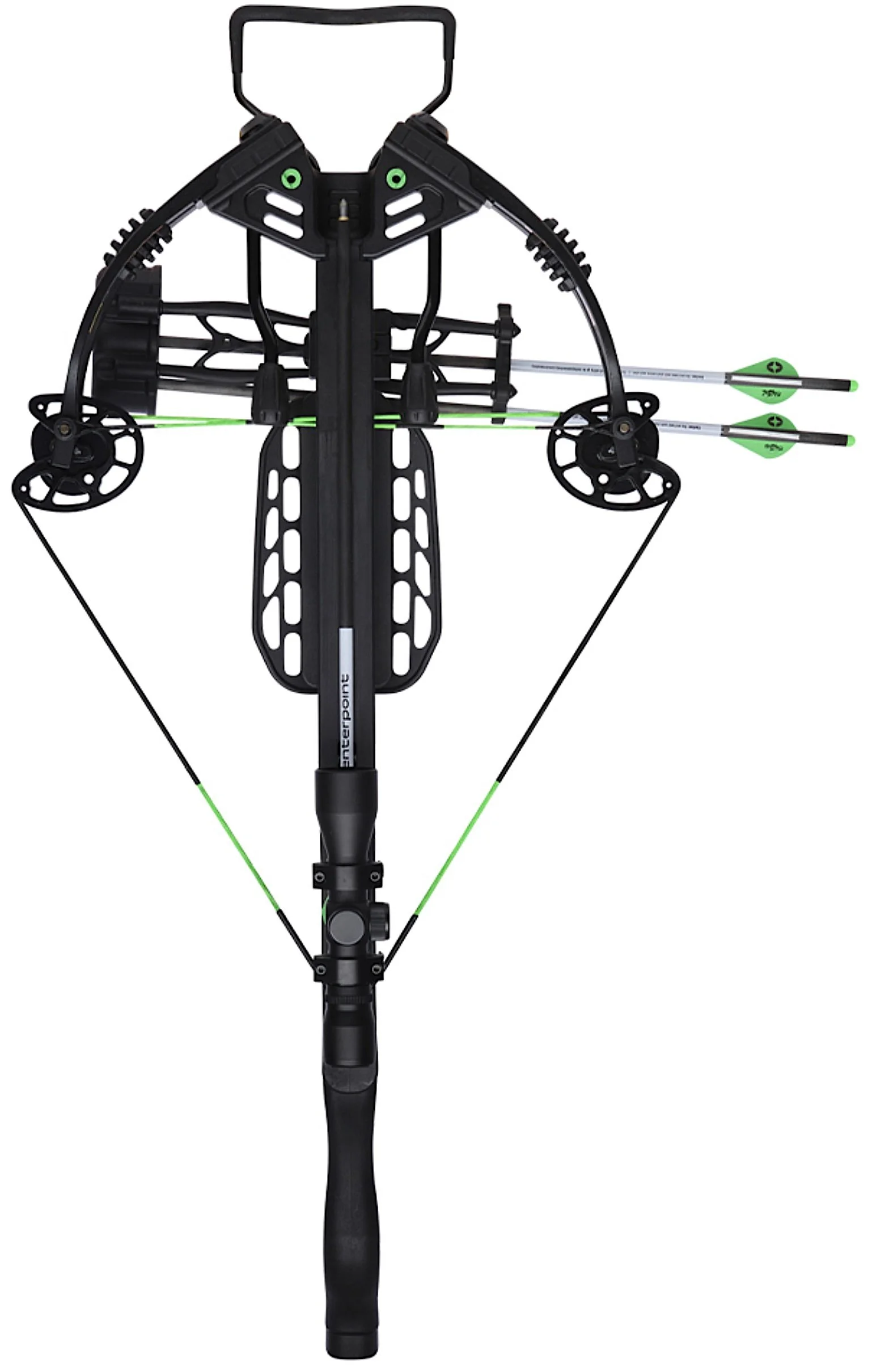
In this review, we are looking at two crossbows that honestly shouldn’t really be compared, but that’s exactly why this comparison is interesting. On one end, we have the Steambow M10, a compact, magazine-fed, fast-shooting crossbow built for fun, training, and high repetition shooting. On the other, the CenterPoint AT400, a full-size, high-powered compound crossbow designed for serious hunting applications.

Aside from both launching bolts/arrows, these two platforms sit at completely opposite ends of the spectrum. The goal here is not to declare a winner, but to help you decide which one actually fits your use case, or if you might want both.

Key Differences Overview:

Steambow M10

The Steambow M10 is a compact repeating crossbow designed more for fun, training, and high-volume shooting. It uses a magazine-fed system that can hold 10 bolts, allowing for very fast follow-up shots. Depending on the limb setup, it can reach speeds of up to around 200 FPS and produce approximately 10 to 15 foot-pounds of energy. Its lighter draw weight options and easy cocking system make it beginner-friendly and much less physically demanding to use. Overall, the M10 is best suited for target shooting, casual use, and potentially small game with the right setup.

CenterPoint AT400

The CenterPoint AT400 is a full-size compound hunting crossbow built for serious power and hunting use. Unlike the M10, it is a single-shot platform that focuses on accuracy, penetration, and range rather than fast repeat shooting. It sends arrows downrange at about 400 FPS and delivers close to 150 foot-pounds of energy, putting it in an entirely different class. With its roughly 200-pound draw weight, it requires much more effort to cock and reload, usually with a rope or crank system. This makes it better suited for medium to large game hunting, where power and shot placement matter far more than speed.

Side-by-Side Summary

If you want something lightweight, compact, fast, and easy to shoot often, the Steambow M10 is the better fit. If your main goal is hunting and you need maximum power, longer range, and serious downrange performance, then the CenterPoint AT400 is clearly the more appropriate choice. Even though both are crossbows, they are built for very different types of users and very different shooting experiences.

Power & Performance

The biggest separation between these two comes down to raw power.

  • The Steambow M10 delivers up to about 10–15 foot-pounds of energy, depending on limb configuration and bolt weight. It’s comparable to higher-end airguns or paintball-level power.

  • The CenterPoint AT400, by contrast, produces close to 150 foot-pounds of energy and launches arrows at around 400 FPS.

That’s not a small difference, it’s an entirely different category.

Real-world comparison:

  • M10 = backyard shooting, small game potential

  • AT400 = deer, and potentially even elk with proper shot placement

This is essentially the difference between a BB gun vs a hunting rifle in terms of role and impact.

Shooting Experience:

Steambow M10

  • Magazine-fed (10 bolts)

  • Extremely fast follow-up shots

  • Break-action style cocking (very quick)

  • Great for drills, repetition, and skill building

  • Minimal effort required

You can realistically fire 10 shots in about 10 seconds, making it a very engaging and fun platform.

CenterPoint AT400

  • Single-shot system

  • Requires rope cocking or crank system

  • Significant physical effort (200 lb draw)

  • Slow reload (often 30–60+ seconds)

This is a deliberate shooting experience, not something designed for volume or speed.

Use Case Breakdown:

Steambow M10 – Best For…

  • Backyard shooting (with proper backstop)

  • Target practice

  • Tactical-style drills

  • High repetition training

  • Casual and frequent use

  • Lower-cost shooting (especially with rubber ball version)

You can even use:

  • Rubber balls (low cost, reusable)

  • Lightweight bolts

  • Indoor-friendly setups (with proper safety)

CenterPoint AT400 – Best For…

  • Hunting (deer and potentially larger game)

  • Long-range accuracy

  • Maximum penetration and power

  • Purpose-driven shooting

This is not a casual-use product, you typically bring it out when it matters.

Ease of Use & Physical Demand:

Steambow M10

  • Very easy to cock (even at lower draw weights)

  • Beginner-friendly

  • Lightweight (~compact platform)

  • Minimal fatigue

CenterPoint AT400

  • High effort required

  • Needs cocking tools (rope or crank)

  • Physically demanding

  • Slower workflow between shots

Key takeaway:
Anyone can pick up and use the M10 easily. The AT400 requires more commitment, strength, and practice.

Size & Portability

Steambow M10

  • Compact and lightweight

  • Can be partially disassembled easily

  • Backpack-friendly

  • Ideal for mobile use

CenterPoint AT40

  • Large, fixed structure

  • Not easily transportable without a case

  • Designed for field carry, not casual portability

Ammo & Cost of Ownership:

Steambow M10

  • Bolts are smaller and cheaper

  • Rubber ball version = extremely low cost

  • Less wear and tear overall

  • High reusability

CenterPoint AT40

  • Arrows are larger and more expensive

  • More prone to damage/loss at high speeds

  • Requires maintenance and replacement over time

Value Consideration:

Interestingly, both fall into a similar price range (~$400–$500), but value depends on usage frequency:

  • M10 → Likely used often → Higher practical value

  • AT400 → Used less frequently unless hunting regularly

If something sits unused, its value drops regardless of price.

Who Should Buy Each?

Choose the Steambow M10 if you…

  • Want fun, fast shooting

  • Plan to shoot frequently

  • Prefer low effort and ease of use

  • Don’t need high power

  • Enjoy tactical or training-style shooting

Choose the CenterPoint AT400 if you…

  • Are hunting (especially deer or larger game)

  • Need high power and penetration

  • Value accuracy and range

  • Don’t mind slower reload times

  • Are comfortable with physical effort

Final Thoughts

These two crossbows are not competitors—they are tools for completely different jobs.

  • The Steambow M10 is about frequency, fun, and versatility

  • The CenterPoint AT400 is about power, precision, and purpose

If anything, this comparison highlights that you may not need to choose one over the other, you might actually benefit from having both ends of the spectrum covered.

If neither fits perfectly, then the real answer may be to look for something in the middle.

Where to Buy

Both of these crossbows (or similar models) are typically available through:

Categories: Crossbow, Comparison, Non Airguns, Review, Rifle, Vimeo Video, YouTube Video, Repeater, Single Shot Tags: Steambow, CenterPoint, AT400, M10 Tactical, Crossbow

Air Venturi Annie Oakley Lil’ Sure Shot Spring BB Rifle Table Top Review

No Comments

In this table top review, we’re taking a close look at the Air Venturi Annie Oakley Lil’ Sure Shot Spring BB Rifle. While this is technically a “table top” review, lever-action rifles like this are always a bit easier to show off in-hand due to their length and proportions.

This model fits into a long lineage of classic lever-action BB rifles, alongside well-known options like the Daisy Red Ryder and the Marlin variants from Crosman and Umarex. These rifles all share a similar concept, simple, spring-powered, lever-action BB guns designed for training, plinking, and beginner shooters, but each brings its own subtle differences in materials, styling, and features.

Key Specifications

  • Model: Air Venturi Annie Oakley Lil’ Sure Shot

  • Type: Lever Action Spring Piston BB Rifle

  • Caliber: 4.5mm Steel BB

  • Power Source: Spring (No CO2 Required)

  • Velocity: Up to 350 FPS

  • Magazine Capacity: 550 Round Internal Reservoir (Gravity Fed)

  • Action: Lever Action

  • Safety: Cross Bolt Safety

  • Barrel: Smoothbore

  • Stock: Stained Solid Wood

  • Construction: Primarily Metal with Some Plastic Components

  • Weight: Approx. 3.3 lbs

  • Overall Length: ~36.25 inches

  • Optics Rail: Removable Weaver/Picatinny Style Mount

First Impressions & Build Quality

The Annie Oakley Lil’ Sure Shot stands out with its classic Western styling, enhanced by engraved Annie Oakley branding on the wood stock. It’s a step above many entry-level BB rifles thanks to its real wood stock and metal lever, giving it a more authentic and durable feel compared to fully plastic alternatives.

Most of the rifle is metal and wood, though there are a few plastic components:

  • Trigger

  • Front sight (on the newer version)

  • Adjustable portion of the rear sight

  • Removable scope rail

Overall, it feels solid in the hands, lightweight, and well-balanced, especially for younger shooters or anyone new to lever-action rifles.

How It Works

This is a spring-piston, lever-action BB rifle, meaning:

  • No CO2 or gas is required

  • Each shot is powered by cocking the lever

  • BBs are stored in a large internal reservoir

  • You must tilt the rifle upward to gravity-feed BBs into position

With a 550-round capacity, you can shoot for quite a while before needing to reload, your arm will likely get tired before you run out of ammo.

Handling & Usability

This rifle is clearly designed with accessibility in mind:

  • Lightweight (3.3 lbs) makes it easy to handle

  • Shorter length and pull fits smaller shooters well

  • Moderate cocking effort is manageable for beginners

  • Lever action slows firing rate, adding a safety advantage for new users

Rifles like this are excellent for training because:

  • They are easier to aim than pistols

  • They encourage controlled shooting

  • They are not overly powerful

Even for experienced shooters, these are simply fun and inexpensive for backyard plinking.

Sights & Optics

Out of the box, the Air Venturi Annie Oakley Lil’ Sure Shot Spring BB Rifle includes:

  • Fixed front sight (plastic on newer version)

  • Adjustable rear sight (elevation only)

One notable feature is the removable Weaver-style rail, allowing you to:

  • Mount a red dot or scope

  • Or remove it for a more traditional look

Keep in mind the rail is plastic, so care should be taken when mounting optics.

Comparison to Similar BB Rifles

This rifle sits in the same category as:

  • Daisy Red Ryder – The original classic

  • Umarex Marlin Lever Action – Slightly more adult-oriented design

  • Crosman Marlin (older models) – Direct Red Ryder competitor

All of these:

  • Use lever-action spring systems

  • Have internal BB reservoirs

  • Shoot in the ~300–350 FPS range

The Annie Oakley version distinguishes itself with:

  • Better visual styling

  • Wood and metal construction

  • Optional optics mounting

New vs Older Annie Oakley Version (Key Differences)

If you come across different versions, here are the main distinctions:

Newer Version:

  • Longer barrel

  • Plastic front sight

  • Larger loading port (easier to load)

  • Metal Lever

  • Brighter, more polished wood finish

Older Version:

  • Shorter barrel

  • Metal front loading system (rotating port)

  • Metal front sight (more durable)

  • Plastic Lever

  • Slightly darker, more matte wood

Both should perform similarly, but the newer version is a bit more refined with that quality all metal lever.

Pros

  • Lightweight and easy to handle

  • Real wood stock and metal lever construction

  • Large 550-round capacity

  • No CO2 required (low maintenance and inexpensive to shoot)

  • Removable optics rail for flexibility

  • Classic Western styling with Annie Oakley branding

  • Great for beginners and younger shooters

Cons

  • Plastic front sight (new version)

  • Lower power compared to CO2 rifles

  • Rear sight only adjustable for elevation

  • Slightly higher price than some entry-level similar BB rifles

  • Less realistic than shell-ejecting lever-action models

Final Thoughts

The Air Venturi Annie Oakley Lil’ Sure Shot is a well-built, visually appealing lever-action BB rifle that blends classic styling with modern usability.

It’s ideal for:

  • Beginners and younger shooters

  • Backyard plinking

  • Anyone wanting a simple, reliable and fun BB rifle

While it doesn’t aim for full realism like higher-end shell-ejecting models, it delivers where it matters, ease of use, affordability, durability, and fun factor.

Available at:

Also check out ReplicaAirguns.com for additional articles, photos, and video reviews.

Categories: 4.5mm / .177 cal, BB, Comparison, Repeater, Review, Rifle, Spring Piston, Vimeo Video, YouTube Video Tags: Air Venturi, Annie Oakley Lil Sure Shot, Red Ryder

Steambow B08 .68 Caliber Tactical Crossbow Table Top Review

No Comments

In this table top review, we take a close look at the Steambow B08 .68 Caliber Tactical Crossbow, a compact and versatile system designed for shooting rubber balls, paintballs, or foam projectiles. This model is particularly suited for controlled environments like indoor ranges (such as a sea can setup or even basement or backyard), thanks to its relatively moderate power and flexible ammunition options.

A full shooting test will follow separately, but for now, let’s break down the specifications, features, and what comes in the box.

Specifications

  • Model: Steambow B08

  • Caliber: .68 (rubber balls, paintballs, foam balls, etc.)

  • System Type: Recurve crossbow

  • Draw Weight: 35 lbs (standard included limb)

  • Velocity: Up to 260 FPS (manufacturer claim)

  • Energy: Approx. 7 ft-lbs (up to ~15 ft-lbs with stronger limbs)

  • Magazine Capacity: 8 rounds (removable)

  • Weight: Just under 4 lbs

  • Length: 24.2 inches

  • Width: 3.15 inches (body, excluding limb span)

  • Height: 8.3 inches

  • Materials: Fiberglass, metal, and polymer construction

  • Stock: AR-style adjustable (6-position) with cheek rest and rubber butt pad

The B08 is distributed by Steambow GmbH (Austria) and is built on a modular platform compatible with other Steambow systems like the M10.

Key Features

Modular Platform

One of the standout aspects of the B08 is its modular design. The lower receiver is identical to the Steambow M10, meaning you can swap uppers to shoot either:

  • .68 caliber balls (B08 upper)

  • Crossbow bolts (M10 upper)

This gives users flexibility to adapt the platform for different uses.

Quick Change Limb System

The included 35 lb limb is easy to swap out:

  • Secured by a single bolt

  • Can be upgraded up to heavier options (up to ~120 lbs available)

  • Allows tuning for power vs. ease of cocking

Magazine-Fed Repeater System

  • 8-round removable magazine

  • Spring-fed system with follower

  • Auto-loading mechanism (not semi-auto, but fast cycling)

The system works by “breaking” or pulling back the stock, which:

  • Cocks the string

  • Loads the next round

  • Prepares the trigger

Cocking Mechanism

  • Shoulder-supported operation

  • Pull stock inward to cock

  • Very easy with 35 lb limb

  • Allows relatively fast follow-up shots once familiar

Sighting System

  • Fiber optic front sight

  • Rear alignment via top trough channel

While simple, it works well for close-range shooting. However, the included Picatinny rails (top and bottom) allow for:

  • Red dots

  • Scopes

  • Tactical accessories

Build & Ergonomics

  • Polymer lower with reinforced components

  • AR-style adjustable stock

  • Adjustable cheek rest

  • Rubber butt pad

  • Included foregrip (user-installed)

Overall, the Steambow B08 .68 Caliber Tactical Crossbow has a solid, lightweight feel while still maintaining good handling characteristics.

What’s Included in the Box

The B08 comes well-packaged with multiple internal boxes and includes:

  • Steambow B08 main unit

  • 35 lb limb

  • Foregrip

  • 8-round magazine

  • 25 “foam” balls (closer to hard nylon in feel)

  • Protective shooting glasses

  • Allen keys (for assembly and adjustments)

  • String wax

  • Extra string

  • Mounting hardware

  • Instruction manual

Note:
A small locking component for the upper assembly may come separate and is not clearly explained in the manual, but is required for proper function.

Operation Overview

  • Load magazine with up to 8 rounds

  • Insert magazine into front housing

  • Cock by pulling stock inward

  • Fire using single-action trigger

The ball is held in place by a simple groove and string system, guiding it forward during firing.

Performance Notes (Initial Impressions)

  • Smooth and reliable operation

  • Easy to cock with 35 lb limb

  • Suitable for indoor shooting environments

  • Compatible with various projectile types

Heavier limbs will:

  • Increase velocity and energy

  • Require more effort to cock

Pros

  • Lightweight and compact (under 4 lbs)

  • Modular system (compatible with M10 platform)

  • Magazine-fed repeater design

  • Easy cocking with included limb

  • Quick-change limb system

  • Picatinny rails for accessories

  • Comes with useful extras

  • Quiet operation

  • Reusable ammunition options

Cons

  • Higher price point

  • No traditional rear sight included

  • Learning curve for efficient operation

  • Included limb may feel underpowered for some users

Final Thoughts

The Steambow B08 offers a unique blend of crossbow mechanics and tactical styling, combined with modular flexibility and relatively safe indoor usability. It’s especially appealing for users who want:

  • A reusable ammo platform

  • Quick follow-up shots

  • Expandability with other Steambow systems

While the included 35 lb limb keeps it easy to use and accessible, upgrading the limb will unlock more performance potential for those looking for higher energy output.

Availability

Available through Replica Airguns:

A full shooting test and performance breakdown will follow in a separate review.

Categories: .68 cal, Break Barrel, Crossbow, Non Airguns, Paintball, Review, Vimeo Video, YouTube Video, Repeater Tags: Steambow, B08

Sig Sauer P229 CO2 Blowback .177 Pellet Pistol Field Test Review

No Comments

In this Video I perform the field test shooting review for the SIG Sauer P229 pellet pistol. If you’re interested in the full specifications, features, and a closer look at the pistol itself, make sure to check out my tabletop review where I go over all the details on this gun.

For today’s test I’m going to be shooting SIG Sauer lead pellets, roughly 7–8 grains. Because these are standard lead pellets and not lightweight alloy pellets, they’re not going to produce the highest velocity numbers this pistol can achieve. With lighter alloy pellets you will definitely see faster readings.

You could also shoot steel BBs through this gun, but BBs sometimes don’t seal quite as tightly in the barrel as pellets do. When that happens, some of the CO₂ can slip around the BB as it travels down the barrel which can actually reduce velocity slightly. BBs also generally don’t carry energy to the target as well as pellets, so pellets are usually the better option for accuracy and performance.

With these pellets, I’m expecting roughly around the 300 FPS range, so let’s see how it actually performs.

Velocity Test

For the velocity portion I’m going to put five shots through the chronograph to see what kind of numbers we get.

Chronograph Results:

Shot Velocities: 320 FPS - 296 FPS - 303 FPS - 286 FPS - 277 FPS (Average of 296 FPS)

As you can see, the readings are right about where expected, generally around the 300 FPS mark, with a slight drop toward the last shot. That’s fairly typical for CO₂ powered blowback pistols, since some of the gas is being used to cycle the slide.

Accuracy Test:

For the accuracy portion I’ve set up my paper targets at 30 feet downrange.

The SIG Sauer P229 pellet pistol uses a dual rotary 8-round magazine, so instead of the usual 10 shots I normally use in these tests, I’m going to fire eight shots to keep things simple and consistent.

One thing I like about this pistol is the trigger operation. When you start the trigger pull, the first stage rotates the rotary magazine. This part of the pull is very light and smooth, so there’s very little double-action feel. Once that’s done, you reach the single-action hammer release, which is nice and predictable.

To keep the trigger as light as possible I’m going to pre-cock the hammer, which eliminates most of that initial rotation effort and gives you a much lighter break.

Accuracy Results:

After eight shots at 30 feet, the group measured approximately 1.5 inches.

That’s actually pretty good accuracy for a blowback pellet pistol.

The pistol was shooting slightly low out of the box, roughly about two inches low and just a little to the left at this distance. My aim point was just underneath the bullseye so I could see the target above the sights.

The sights on this pistol are fixed, so you can’t adjust them directly. The easiest solution is simply to aim slightly higher and a bit to the right if you want to hit the bullseye consistently at this range.

Sight Upgrade Options:

If you want more precise adjustment, you do have a couple of options:

  • Install a slide-mounted red dot using the removable optics plate

  • Add a laser to the accessory rail under the barrel

Either of those options would allow you to dial in your point of aim exactly where you want it, which is a nice upgrade path for this pistol.

Shooting Impression

The trigger feels really good, and the blowback action is solid and snappy, though not overly fast.

The slide actually has a bit of that heavier, slightly slower 1911-style blowback feel, which I personally like. Some blowback pistols cycle extremely quickly and can feel a bit artificial, but this one feels more substantial because of the heavier slide weight.

The pistol itself also has good weight and balance, coming in a bit over two pounds, giving it a very realistic feel in the hand.

Overall, it’s a solid, well-built pellet pistol, and like many of the SIG Sauer Airgun products, it feels like a lot of attention went into the design.

SIG doesn’t actually manufacture these Airguns themselves, they design them and partner with manufacturers to produce them, but the quality across their pellet pistols and rifles has generally been very good.

Final Thoughts

The SIG Sauer P229 CO₂ blowback pellet pistol delivers:

  • Around 300 FPS velocity with lead pellets

  • Realistic blowback action

  • Good weight and handling

  • Approximately 1.5 inch accuracy at 30 feet

  • Multiple options for optic or laser upgrades

Overall, it’s a very enjoyable pistol to shoot and a solid option if you’re looking for a realistic blowback pellet pistol.

Don’t forget to subscribe, and check us out on Facebook, Twitter, and Instagram.

If you’re interested in buying Airguns, BB guns, Airsoft guns, Pellet guns, Blank guns, and Accessories, be sure to visit our online Canada and US Stores.

Available in our Canada Replica Airguns Store. Also check out:

Categories: 4.5mm / .177 cal, BB, CO2, Field Test, Blowback, Pellet, Pistol, Review, Semi Auto, Vimeo Video, YouTube Video Tags: Sig Sauer, Sig Sauer P229

Sig Sauer P229 CO2 Blowback .177 Caliber Pellet Pistol Table Top Review

1 Comment

In this Table Top Review we’re taking a close look at the Sig Sauer P229 CO2 Blowback Pellet Pistol. This is the tabletop portion only, no shooting in this review as my Field Test Shooting Video will follow later on.

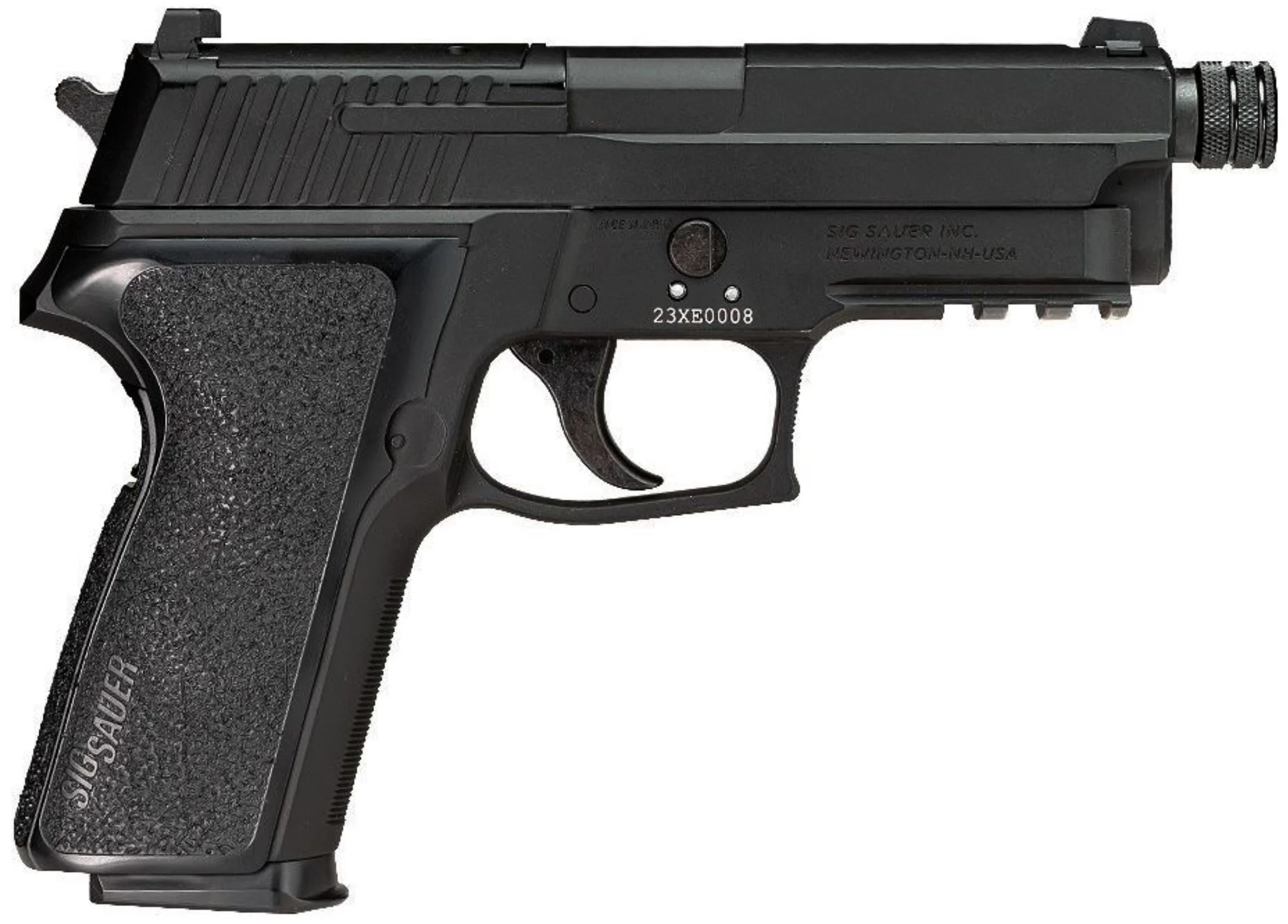
If you’re familiar with the Sig Sauer ASP P226 platform, the P229 version is the same general system in a more compact package, with one major upgrade: it’s optics-ready!

Specifications

  • Manufacturer: SIG SAUER

  • Power Source: 12g CO2

  • Ammunition: .177 pellets (also supports steel BBs)

  • Action: Semi-auto, blowback

  • Trigger: DA/SA (double action / single action)

  • Magazine: 16 rounds (twin 8-shot rotary clips, loaded on both ends)

  • Barrel: Rifled inner barrel

  • Sights: White dot sights

  • Safety: Manual safety lever with de-cocker function

  • Claimed Velocity: up to ~380 fps (real-world varies with temperature and cadence)

  • Shots per CO2: roughly 50–60 (varies with temperature/cadence)

  • Weight: 35.2 oz / 1.0 kg (2.2 lb)

  • Overall Length: 7.7 in (P229)

  • Optics: optics-ready slide / SIG AIR reflex-sight mounting provision

  • Muzzle threads: M14x1 CCW

In the Box

  • P229 CO2 blowback pellet pistol

  • Manual

  • Sight/plate parts for the SIG AIR reflex mounting setup (for red dot use)

P226 vs P229 - What’s Different?

These two share the same general operating system (CO2 blowback, DA/SA, rotary-mag that works with pellets/BBs), but the P229 version changes a few important things:

Key Differences

  • Size: P229 is shorter (7.7 in) vs P226 (8.25 in).

  • Weight: P229 is lighter (35.2 oz / 2.2 lb) vs P226 (~39.1 oz).

  • Optics: P229 is optics-ready (SIG AIR reflex mounting provision); P226 platform is typically not.

  • Muzzle threads: P229 uses M14x1 CCW (P226 commonly uses a different thread direction/size).

Bottom line: if you liked how the P226 handled and performed, the P229 should feel very familiar, just more compact, with the bonus of being set up for a dot.

Walk-Around & Handling

The P229 has that classic SIG profile and a very “real pistol” feel in the hand, helped by the mostly-metal build and full weight.

Notable features and controls:

  • DA/SA trigger system: long/heavier first pull in double-action, then lighter single-action after the slide cycles.

  • Safety + de-cocker lever: functions like the real-steel concept — you can decock the hammer and run it DA/SA.

  • Accessory rail: for a light/laser (training-style setup).

  • Optics-ready slide: set up to accept the SIG AIR reflex-style mounting system (sight sold separately).

CO2 System and Magazine Notes

One of the standout features on this platform is SIG’s cam-lever, tool-less CO2 loading system, designed to make cartridge swaps quick and easy.

The magazine is a 16-shot design using twin 8-shot rotary clips. Practical tip: make sure pellets are seated properly in the rotary clip so they don’t hang up during cycling.

Pros

  • Mostly metal build with realistic weight and solid feel

  • Compact P229 size (shorter than the P226)

  • DA/SA trigger + functional safety/de-cocker system

  • Blowback action for realism/training value

  • Rifled inner barrel (pellet accuracy potential)

  • Tool-less cam-lever CO2 loading system

  • Optics-ready slide (big upgrade over older-style setups)

  • Accessory rail for light/laser

Cons

  • Fixed/non-adjustable sights

  • CO2 performance is temperature + cadence sensitive (rapid fire cools the system and drops power)

  • No last-round hold-open on this style of rotary-mag system

  • Rotary clips require good pellet seating to avoid occasional feeding issues

Final Thoughts

The Sig Sauer P229 blowback pellet pistol is a very “SIG-like” training/plinking platform: realistic controls, DA/SA operation, snappy blowback, and a compact duty-pistol footprint. The biggest tabletop takeaway is the optics-ready slide, which makes this version feel more modern than older CO2 pellet pistol designs.

Field test shooting (chronograph + accuracy) will follow in the next video.

Available in our Canada Replica Airguns Store. Also check out:

Categories: 4.5mm / .177 cal, BB, Blowback, CO2, Comparison, Pellet, Pistol, Review, Semi Auto, Vimeo Video, YouTube Video Tags: Sig Sauer ASP, Sig Sauer, Sig Sauer P229

Replica Airguns Feb 2026 Mystery Box Unboxing

No Comments

It’s been a little while since I’ve done an unboxing, so we’ll call this the February 2026 Mystery Box Unboxing Video.

First up: SHOT Show is officially wrapped on my end, interviews, teaser, the whole run. There should be a playlist available so you can binge everything in one place. Now that the heavy editing grind is done, I’m getting back into regular reviews, unboxings, tabletop breakdowns, and full field tests.

Also: we’re back on YouTube and I’m uploading like crazy. I’m moving the library over from Vimeo one-by-one (lots of clicks, lots of time). We’ve got roughly 1,300 videos total, and I’m already around 500 videos in, so if you’re hunting for something specific, use playlists and search because new uploads can get buried fast. If you can, subscribe and share the channel with other Airgun enthusiasts so we can build momentum again.

What was in the box?

1) SIG P229 (.177 Pellet, blowback)

I initially called it a P226, but it’s the P229 (compact). This is a pellet version (not BB), with:

  • 16-round rotary stick magazine (8 per side)

  • Blowback, semi-auto

  • Claimed 380 FPS

  • 3.9" barrel, 7.7" overall length

  • 2.2 lb, hefty all-metal feel (mag is plastic)

No slide lock-back due to the rotary setup, but it looks great in-hand. Tabletop and field test videos are coming, and I’ll run it on typical lead pellets to see real-world performance.

2) T4E TC68 (.68 cal, CO2/HPA capable)

This is the TC68 trainer that shoots .68 caliber rounds (rubber, powder, paint, pepper ball options depending on what you choose). Specs and highlights:

  • Claimed 330 FPS and 16 joules

  • 20-round magazine-fed setup

  • Supports dual 12g CO2, 88g CO2, and HPA options

  • Includes multiple configurations (stocks/adapters) plus a hopper-fed option

I’ll confirm operating modes, setup options, and performance in the upcoming tabletop and field tests.

Categories: .68 cal, 4.5mm / .177 cal, Airgun News, BB, Blowback, CO2, Bulk Air, Full Auto, Paintball, PCP, Pellet, Pistol, Review, Rifle, Semi Auto, Vimeo Video, YouTube Video Tags: Sig Sauer ASP, Sig Sauer, Sig Sauer P226, Umarex, T4E TC 68

Replica Airguns SHOT Show 2026 Umarex Booth

No Comments

I caught up with Mark at the Umarex booth to check out a stack of new releases for 2026, ranging from backyard BB “fun guns,” to a major upgrade for the Thompson, plus a dual-fuel hunting/pest-control PCP concept and some serious less-lethal / training options.

  • Storm Line BB Rifle (dual CO2, full auto): A traditional, “tamer-looking” BB rifle that’s anything but tame.

    • Capacity: 400-round main reservoir + 25-round ready magazine

    • Action: Full auto

    • Vibe: Affordable, high-volume backyard fun, while keeping the styling less “tactical,” which could help for markets like Canada.

  • Ridge Tech Lever Action (CO2): Lever actions are hot, and this one leans modern while staying simple and budget-friendly.

    • Feed system: 8-round magazine + 120-round reservoir built into the mag

    • Use case: Tin-can plinking and family backyard sessions, “CO2 Red Ryder for adults” energy.

  • Thompson M1A1 Drum Magazine Upgrade: The #1 request finally landed: a drum mag for the Thompson.

    • Capacity: 400 BBs

    • How it runs: Wind as needed to keep feeding similar to Airsoft High cap magazines

    • Best part: The drum magazine is planned to be sold separately and should work with the older stick-mag Thompson versions too, so existing owners can upgrade without buying the whole gun again.

  • Outpost (25 cal) “Dual Fuel” PCP Concept: One of the most interesting items in the booth, a platform aimed at practical use over pure plinking.

    • Power source: Runs on a nitrogen cartridge or as a traditional PCP-style setup out of the box

    • Caliber: .25 only

    • Design notes: Side lever, folding stock for compact carry, onboard spare-mag storage (prototype shown)

    • Positioning: Built for small game / pest work and “preparedness” minded buyers

    • Canada angle: CO2 use (if supported) could drop velocity, but in this form it sounded like it may currently be on the “too fast for Canada” side, so detuned / CO2-focused variants were discussed as a possibility.

  • S68 (68 cal, CO2, ~16J): Compact launcher format with real punch for its size.

    • Power: 12g CO2

    • Magazine: 6-shot standard, extended option mentioned

    • Ballistics talk: Roughly ~360–380 fps with a ~46-grain projectile (as recalled in the interview)

    • Ammo pairing: Steel-core “core defense” style rounds were emphasized for hard impact; pepper options depend heavily on local rules.

  • HDX 68 “Shotgun Style” (68 cal): A higher-capacity, higher-energy format.

    • Capacity: 16 rounds

    • Energy: ~36 joules mentioned

    • Use case: Home / business defense in jurisdictions where these products and ammo types are legal.

  • HDC 68 (M4/Rifle Style, CO2, adjustable): A configurable platform that can run mag-fed or hopper-fed.

    • Tuning: Adjustable velocity

    • Feeding: Magazine or hopper (round ammo works well; shaped rounds can be used depending on orientation)

    • CO2 options: 88g CO2 or adapters for 12g

    • Why not nitrogen (yet): Too much pressure without regulation, risk of damaging projectiles in the barrel.

  • New Ruger-Branded 1911 (CO2 blowback): A dressed-up 1911 variant with extra detail.

    • Notable features: Flared magwell, two-tone finish, extended beavertail, competition-style touches

    • Appeal: A strong trainer option for 1911 fans, great feel, realistic handling, and that classic 1911 cycling character.

  • Competition-Style CO2 Pistol (single-shot): A purpose-built target/competition format with modern mounting options.

    • Loading: Single-shot

    • Ergonomics: Competition grip + competition styling

    • Mounting: Built-in rail (no “upgrade it just to mount stuff” hassle)

    • Caliber shown: .177, with the obvious question of a future .22 variant.

Watch the Full Interview Video:

Categories: Airsoft, AEG, Airsoft News, Airgun News, BB, CO2, Blowback, Break Barrel, Bulk Air, Full Auto, Gas, GBB, Multi-pump, Paintball, PCP, Pellet, Pistol, Pump, Repeater, Replica Airguns News, Revolver, Rifle, Semi Auto, Single Shot, Spring Piston, Vimeo Video, YouTube Video Tags: SHOT Show 2026, SHOT Show, Umarex