

In this review, we are looking at two crossbows that honestly shouldn’t really be compared, but that’s exactly why this comparison is interesting. On one end, we have the Steambow M10, a compact, magazine-fed, fast-shooting crossbow built for fun, training, and high repetition shooting. On the other, the CenterPoint AT400, a full-size, high-powered compound crossbow designed for serious hunting applications.
Aside from both launching bolts/arrows, these two platforms sit at completely opposite ends of the spectrum. The goal here is not to declare a winner, but to help you decide which one actually fits your use case, or if you might want both.
Key Differences Overview:
Steambow M10
The Steambow M10 is a compact repeating crossbow designed more for fun, training, and high-volume shooting. It uses a magazine-fed system that can hold 10 bolts, allowing for very fast follow-up shots. Depending on the limb setup, it can reach speeds of up to around 200 FPS and produce approximately 10 to 15 foot-pounds of energy. Its lighter draw weight options and easy cocking system make it beginner-friendly and much less physically demanding to use. Overall, the M10 is best suited for target shooting, casual use, and potentially small game with the right setup.
CenterPoint AT400
The CenterPoint AT400 is a full-size compound hunting crossbow built for serious power and hunting use. Unlike the M10, it is a single-shot platform that focuses on accuracy, penetration, and range rather than fast repeat shooting. It sends arrows downrange at about 400 FPS and delivers close to 150 foot-pounds of energy, putting it in an entirely different class. With its roughly 200-pound draw weight, it requires much more effort to cock and reload, usually with a rope or crank system. This makes it better suited for medium to large game hunting, where power and shot placement matter far more than speed.
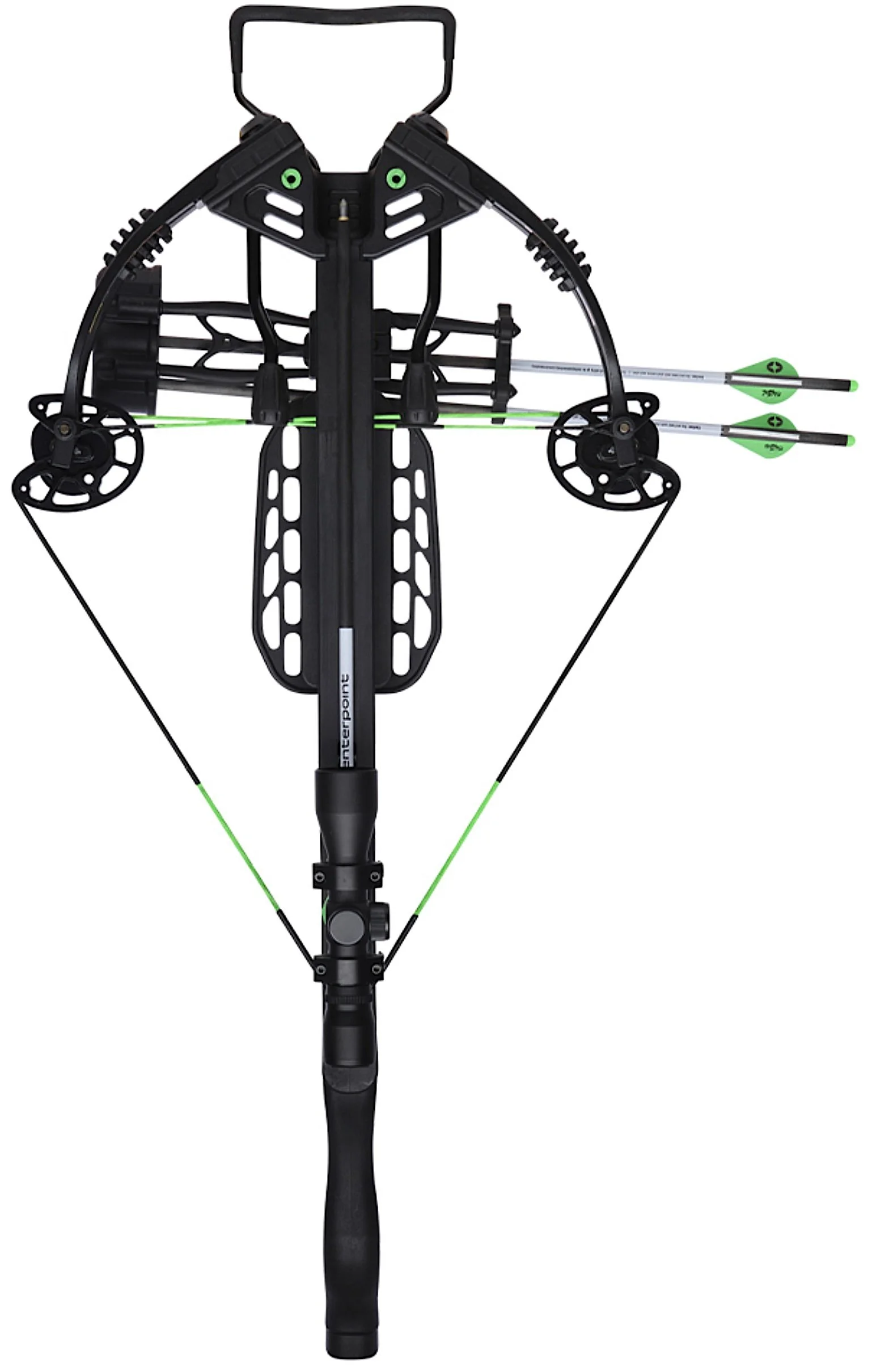
Side-by-Side Summary
If you want something lightweight, compact, fast, and easy to shoot often, the Steambow M10 is the better fit. If your main goal is hunting and you need maximum power, longer range, and serious downrange performance, then the CenterPoint AT400 is clearly the more appropriate choice. Even though both are crossbows, they are built for very different types of users and very different shooting experiences.
Power & Performance
The biggest separation between these two comes down to raw power.
The Steambow M10 delivers up to about 10–15 foot-pounds of energy, depending on limb configuration and bolt weight. It’s comparable to higher-end airguns or paintball-level power.
The CenterPoint AT400, by contrast, produces close to 150 foot-pounds of energy and launches arrows at around 400 FPS.
That’s not a small difference, it’s an entirely different category.
Real-world comparison:
M10 = backyard shooting, small game potential
AT400 = deer, and potentially even elk with proper shot placement
This is essentially the difference between a BB gun vs a hunting rifle in terms of role and impact.
Shooting Experience:
Steambow M10
Magazine-fed (10 bolts)
Extremely fast follow-up shots
Break-action style cocking (very quick)
Great for drills, repetition, and skill building
Minimal effort required
You can realistically fire 10 shots in about 10 seconds, making it a very engaging and fun platform.
CenterPoint AT400
Single-shot system
Requires rope cocking or crank system
Significant physical effort (200 lb draw)
Slow reload (often 30–60+ seconds)
This is a deliberate shooting experience, not something designed for volume or speed.
Use Case Breakdown:
Steambow M10 – Best For…
Backyard shooting (with proper backstop)
Target practice
Tactical-style drills
High repetition training
Casual and frequent use
Lower-cost shooting (especially with rubber ball version)
You can even use:
Rubber balls (low cost, reusable)
Lightweight bolts
Indoor-friendly setups (with proper safety)
CenterPoint AT400 – Best For…
Hunting (deer and potentially larger game)
Long-range accuracy
Maximum penetration and power
Purpose-driven shooting
This is not a casual-use product, you typically bring it out when it matters.
Ease of Use & Physical Demand:
Steambow M10
Very easy to cock (even at lower draw weights)
Beginner-friendly
Lightweight (~compact platform)
Minimal fatigue
CenterPoint AT400
High effort required
Needs cocking tools (rope or crank)
Physically demanding
Slower workflow between shots
Key takeaway:
Anyone can pick up and use the M10 easily. The AT400 requires more commitment, strength, and practice.
Size & Portability
Steambow M10
Compact and lightweight
Can be partially disassembled easily
Backpack-friendly
Ideal for mobile use
CenterPoint AT40
Large, fixed structure
Not easily transportable without a case
Designed for field carry, not casual portability
Ammo & Cost of Ownership:
Steambow M10
Bolts are smaller and cheaper
Rubber ball version = extremely low cost
Less wear and tear overall
High reusability
CenterPoint AT40
Arrows are larger and more expensive
More prone to damage/loss at high speeds
Requires maintenance and replacement over time
Value Consideration:
Interestingly, both fall into a similar price range (~$400–$500), but value depends on usage frequency:
M10 → Likely used often → Higher practical value
AT400 → Used less frequently unless hunting regularly
If something sits unused, its value drops regardless of price.
Who Should Buy Each?
Choose the Steambow M10 if you…
Want fun, fast shooting
Plan to shoot frequently
Prefer low effort and ease of use
Don’t need high power
Enjoy tactical or training-style shooting
Choose the CenterPoint AT400 if you…
Are hunting (especially deer or larger game)
Need high power and penetration
Value accuracy and range
Don’t mind slower reload times
Are comfortable with physical effort
Final Thoughts
These two crossbows are not competitors—they are tools for completely different jobs.
The Steambow M10 is about frequency, fun, and versatility
The CenterPoint AT400 is about power, precision, and purpose
If anything, this comparison highlights that you may not need to choose one over the other, you might actually benefit from having both ends of the spectrum covered.
If neither fits perfectly, then the real answer may be to look for something in the middle.
Where to Buy
Both of these crossbows (or similar models) are typically available through: