

Entries in PCP

Entries in T4E

Umarex T4E TC 68 Less Lethal Paintball Rifle Field Test Review

No Comments

In this Field Test Shooting Review I’m taking a look at the Umarex T4E TC68 .68 caliber paintball / less-lethal marker to see how it performs in terms of velocity, accuracy, and overall shooting experience.

I have already done a Table Top Review covering the specifications, features, and overall purpose of the TC68, so make sure to check that video out if you want the full breakdown of the gun itself. This field test review is focused strictly on real-world performance.

For this test the TC68 has been de-restricted, meaning the adjustment screw has been modified slightly so it can reach its full potential. Even with this adjustment it should still remain legally compliant here in Canada, since the velocity will remain under the 500 fps threshold.

For ammunition I used .68 caliber nylon rounds:

  • Black rounds: approximately 2.8 grams

  • Yellow rounds: approximately 2.6 grams

The TC68 in this test is powered using dual 12-gram CO2 cartridges, rather than the larger 88-gram CO2 cylinder, which will affect both shot consistency and total shot count.

Velocity Testing

For the velocity portion of the test I fired several shots through my chronograph.

Chronograph readings were somewhat tricky to capture at first, but once everything started working correctly I was able to record several shots.

Example readings included:

  • 476 fps

  • 463 fps

  • 453 fps

  • 445 fps

The velocity dropped slightly during the test, which is expected when using dual 12-gram CO2 cartridges, as they cool down fairly quickly during rapid shooting.

The slightly heavier 2.8-gram black rounds were also used for some of the shots, which can contribute to minor changes in velocity compared to the lighter 2.6-gram rounds.

Even with that drop, performance was still strong and suggests the TC68 could likely reach high-400 fps velocities with a fresh CO2 setup or an 88-gram CO2 cylinder, which provides much greater gas capacity and improved consistency.

Accuracy Testing

For the accuracy portion of the test I set up a paper target down range and loaded roughly 20 rounds into the magazine.

The first test consisted of 10 shots in semi-automatic mode using the heavier black nylon rounds. A red-dot optic was installed on the TC68 for aiming, though it had not been sighted in or adjusted beforehand.

Results were quite respectable for a marker shooting heavy .68 caliber rounds.

  • Overall grouping was approximately 4 inches

  • Most shots landed within a 2.5–3 inch cluster

  • One shot landed slightly low outside the main group

Considering the optic was not adjusted and this was essentially a right-out-of-the-box test, the accuracy was quite good.

Full-Auto Shooting Test

After the semi-auto accuracy test I attempted a full-auto burst test, but quickly discovered the CO2 had been depleted.

After installing fresh CO2 cartridges, the full-auto test was repeated with approximately 20 rounds loaded.

The TC68 does not have an extremely fast rate of fire, but it still delivers a solid stream of rounds when the trigger is held down.

During full-auto fire:

  • The gun remained fairly controllable

  • Rate of fire was moderate but effective

  • CO2 cooling became noticeable during sustained bursts

A fresh target confirmed that the TC68 was still accurate enough for defensive-style shooting, keeping the majority of rounds within the main target area even during burst fire.

Power and Energy

Using approximately 2.8-gram nylon rounds traveling around 475 fps, the TC68 is producing significantly more energy than its factory-rated 16-joule output. Closer to 30 joules!

The modification performed simply allows the power adjustment screw to reach its full depth, allowing the marker to operate closer to its maximum potential.

While exact energy figures will depend on projectile weight and velocity, the TC68 in this configuration appears capable of producing considerably higher energy levels than stock, while still remaining under the 500 fps legal limit in Canada.
Shooting Impressions

Overall the Umarex T4E TC68 proved to be a solid and reliable platform during testing.

Some observations from the field test:

What I liked

  • Strong velocity potential

  • Good accuracy for a .68 caliber marker

  • Full-auto capability for rapid follow-up shots

  • Compatible with multiple CO2 power options

Things to consider

  • Dual 12-gram CO2 cartridges cool down quickly

  • Larger 88-gram CO2 cylinders will provide better consistency

  • The gun includes multiple safety mechanisms that require familiarity

The TC68 includes three levels of safety, which helps prevent accidental discharge but does require some practice to become comfortable with the controls.

Final Thoughts

The Umarex T4E TC68 performed well in this field test.

Velocity was strong, accuracy was respectable for a .68 caliber marker, and the full-auto capability adds an interesting dimension to the platform.

With proper setup and a fresh CO2 source, the TC68 has the potential to deliver high-energy shots while still remaining within Canadian legal limits.

Overall it’s a very capable paintball / less-lethal marker and definitely an interesting option for those looking for a high-power .68 caliber platform.

Categories: .68 cal, CO2, Bulk Air, Field Test, Full Auto, Paintball, PCP, Review, Rifle, Semi Auto, Vimeo Video, YouTube Video Tags: Umarex, T4E, T4E TC 68

Umarex T4E TC 68 Less Lethal Paintball Rifle Table Top Review

No Comments

Type: .68 Cal Paintball / Training Marker Rifle /Less Lethal
Manufacturer: Umarex (T4E / Training for Engagement)
Model: T4E TC68
Made In: Taiwan
Materials: Polymer exterior with internal metal components (metal flash hider + various metal controls)
Weight: 2.5 kg (5.52 lb)
Overall Length: 84 cm (33")
Barrel: Approx. 31 cm (12") smoothbore (.68 cal)
Power Source: 2x12g CO2 (in-stock dual system), 88g CO2, or HPA (via included adapter)
Action: Semi-auto and full-auto
Ammo Type: .68 Cal paintballs, rubber balls (including heavier core types), powder/dust/chalk balls, glass balls, pepper balls (where legal), and First Strike–style shaped rounds (magazine-fed)
Ammo Capacity: 20-round spring-assisted magazine (plus hopper-fed option with included adapter)
Claimed Velocity Range: 240–480 fps (adjustable; depends heavily on ammo weight and air source)
Energy (Context): Marketed around 16J “out of the box,” with higher output possible via the built-in adjustment system (jurisdiction-dependent and often tamper-restricted)

Trigger Pull
The TC68 uses a semi-auto style trigger that feels closer to a single-action pull (it needs to work this way to support full-auto). The break is straightforward and predictable, and it suits the “training marker / utility” role well.

Accuracy

This table top review is focused on features, build, and usability. Accuracy testing and chronograph results are better handled in a field test once ammo weight is confirmed (rubber vs. paintball vs. hard plastic rounds will all change results). Initial “gut feel” shooting suggests the factory setting is already pushing hard for a training marker, with performance feeling consistent with the advertised 16J class.

Build Quality

The TC68 is largely polymer on the outside, but it doesn’t feel like a toy. The weight is substantial, controls feel solid, and the overall package is clearly built for training and repeated handling. You’re getting a robust platform designed to run multiple air sources and a wide range of .68 caliber projectiles without needing a bunch of aftermarket parts just to get started.

Realism / Ergonomics / Controls

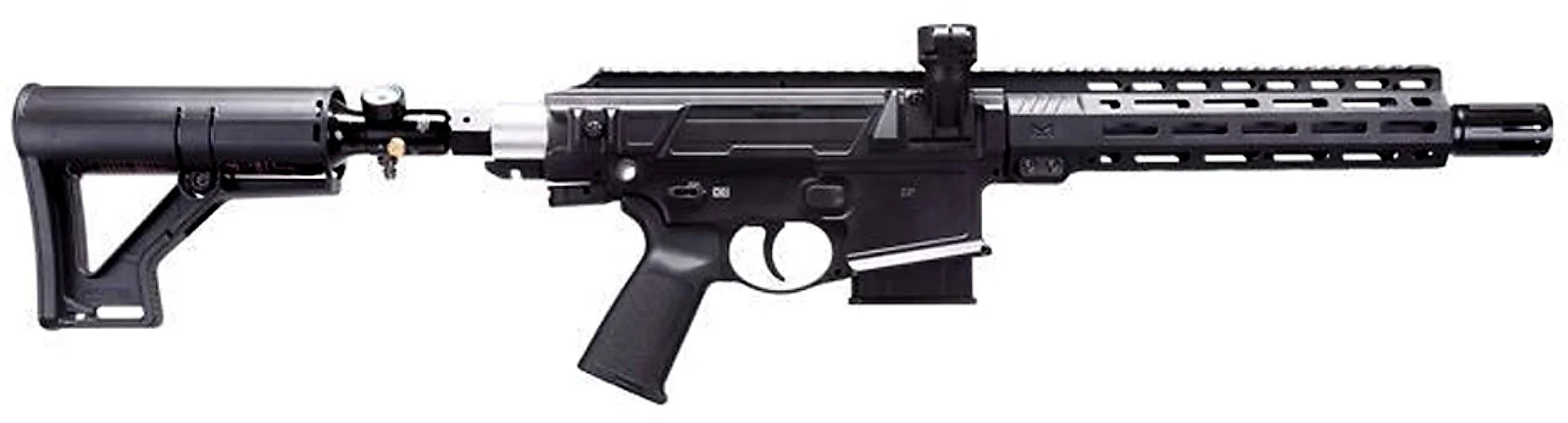
Visually and ergonomically the TC68 leans into an AR-style layout:

  • AR-style grip geometry (and AR-compatible grip fitment style)

  • Full-length Picatinny top rail

  • M-LOK on the handguard (sides and bottom) for lights, foregrips, etc.

  • Ambidextrous selector (Safe / Semi / Full)

  • Ambidextrous magazine release

It does not have real-steel operating controls like a charging handle or functional bolt/dust cover, this is a marker, not a firearm replica mechanism, but from a distance it reads like a modern sporting rifle pattern, which matters for training applications and general “presence.”

Safety systems are layered:

  1. A “quick pierce / activation” setup (pressurizes the marker only when you choose)

  2. A cross-bolt style safety that controls readiness to fire and can also depressurize when switched back (you’ll hear it vent)

  3. Standard safe selector switch position

Air Source Flexibility (CO2 + HPA) and Included Hardware

This is one of the biggest selling points: it ships with a lot of the “bits and pieces” that usually cost extra.

You can run:

  • Dual 12g CO2 (the configuration shown in the review)

  • 88g CO2 (full-length stock configuration)

  • HPA via included adapter (plus an alternate stock option that works well with compact tanks)

The included quick-pierce style setup is practical: you can stage the marker with CO2 installed without continuously bleeding gas, then activate it only when needed.

Feeding Options: Magazine-Fed or Hopper-Fed

Out of the box you get:

  • A 20-round spring-assisted magazine designed to load easily (the spring can be held back during loading, then feeds when inserted)

  • A hopper adapter system (hopper not included, but the adapter is), letting you run higher-capacity paintball-style feeding for volume use, especially relevant if you pair HPA + full auto

The magazine also supports First Strike–style shaped rounds (magazine-fed only), expanding the use-case options for training and scenario work.

Sights / Optics

No sights are included, no irons, no basics, nothing. That’s the odd omission on an otherwise “complete” kit. Plan on adding:

  • a red dot (often easiest), and/or

  • irons that sit higher, or a riser setup, depending on your preferred cheek weld and optic height.

Pros

  • Multiple air source support (2x12g CO2, 88g CO2, or HPA via included adapters/stocks)

  • Quick-pierce / staged-gas concept is practical for readiness without constant leaking

  • Semi-auto and full-auto capability

  • Adjustable power/velocity range to suit different training and ammo types

  • Magazine-fed or hopper-fed flexibility (adapter included)

  • Accepts First Strike–style shaped rounds (magazine)

  • AR-style ergonomics and lots of accessory mounting (Picatinny + M-LOK)

  • Strong “presence” and serious performance feel for a .68 platform

  • In Canada especially, it fills a niche many users are actively looking for (training/marker/home safety versatility)

Cons

  • Pricey in Canada (around the ~$600 CAD range at the time of the review)

  • No sights included (you must budget for at least basic aiming equipment)

  • Maximum performance potential may be restricted by factory tamper measures and local rules (and you should not assume higher settings are legal where you live)

Comments

If you want a .68 caliber platform that can legitimately be configured for multiple roles, paintball, training, scenario use, home safety use, the Umarex T4E TC68 stands out because it’s versatile right out of the box. The “complete kit” nature (CO2/HPA readiness + mag and hopper options) is rare at this price point.

The Umarex T4E TC68 is in probably one of the most powerful “Rubber Ball”Airguns you can get here in Canada right now with the ability to even turn it up a notch (at your own discretion). With Canadian legal gun owners losing their rights to own regulated Firearms more and more each day, being able to acquire something that is not regulated may be the best option for non-Firearms Licensed holders and Firearms Licensed holders.

Field test follow-up (chronograph + practical shooting) will matter a lot with this one, because performance varies dramatically with projectile type and weight. That’s where it will be most interesting to quantify real fps and estimated energy across a couple common round types.

Categories: .68 cal, CO2, Bulk Air, Full Auto, Paintball, PCP, Review, Rifle, Semi Auto, Vimeo Video, YouTube Video Tags: Umarex, T4E, T4E TC 68