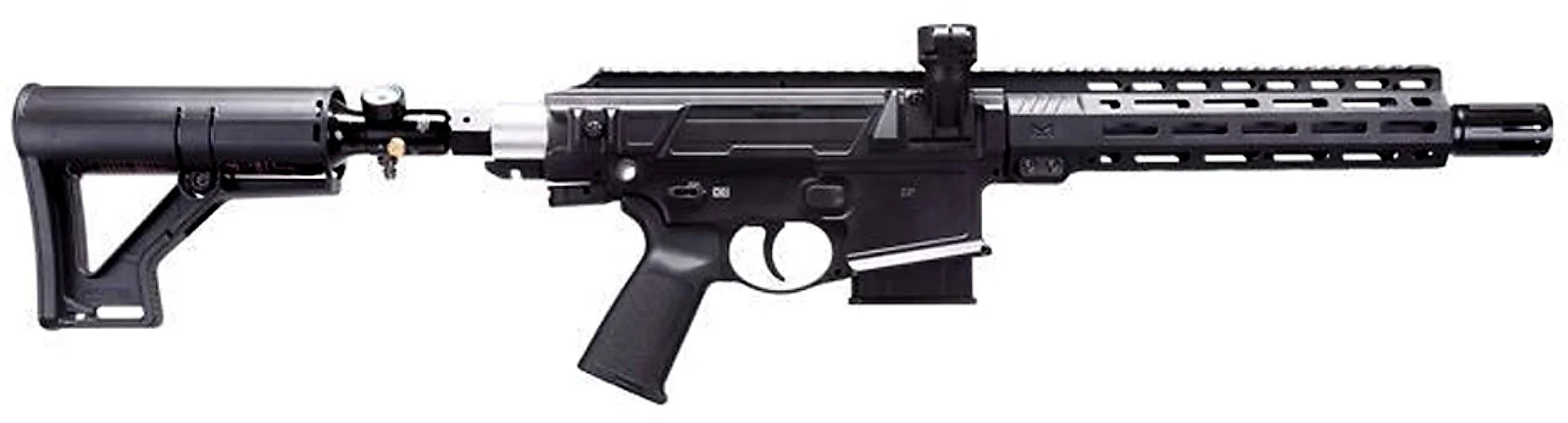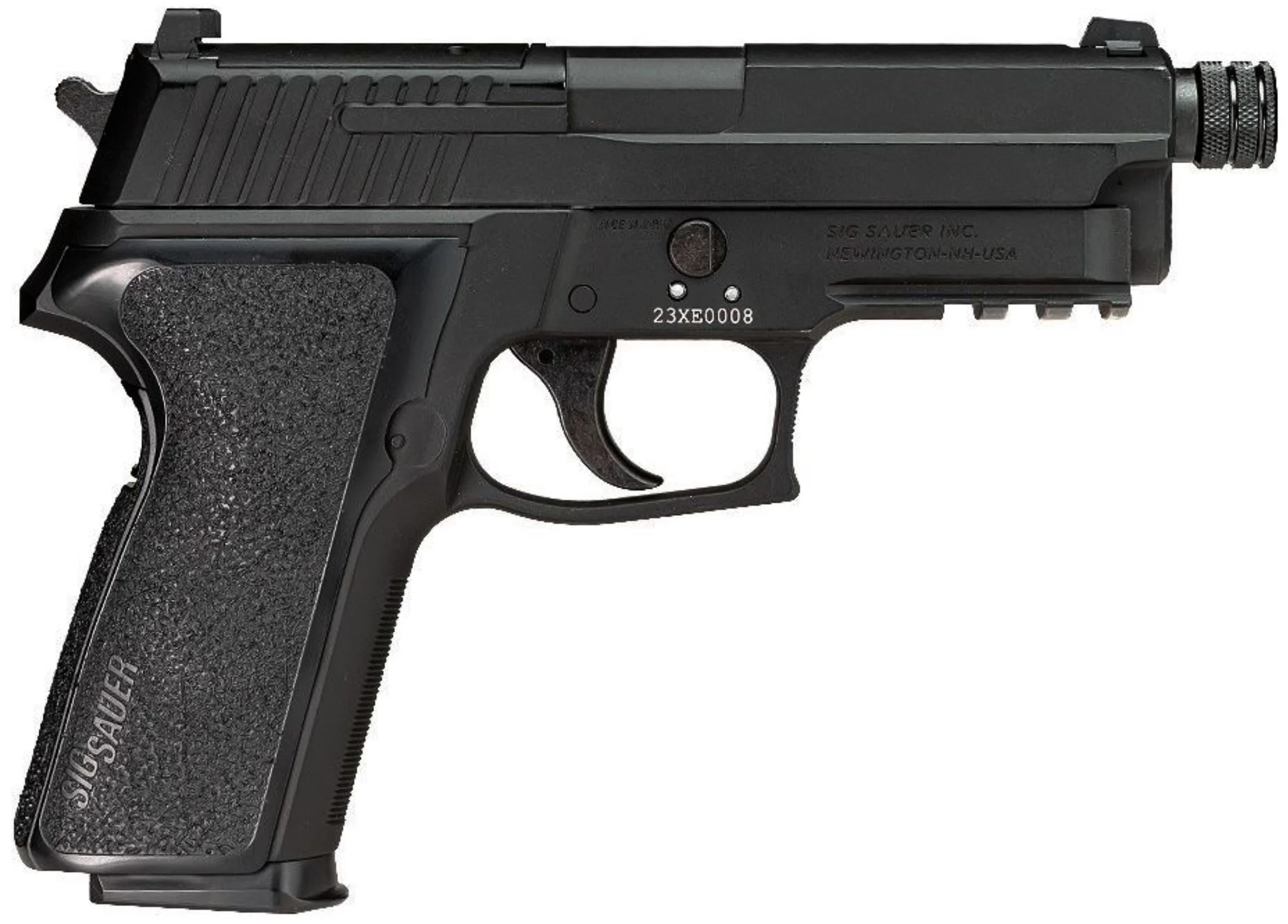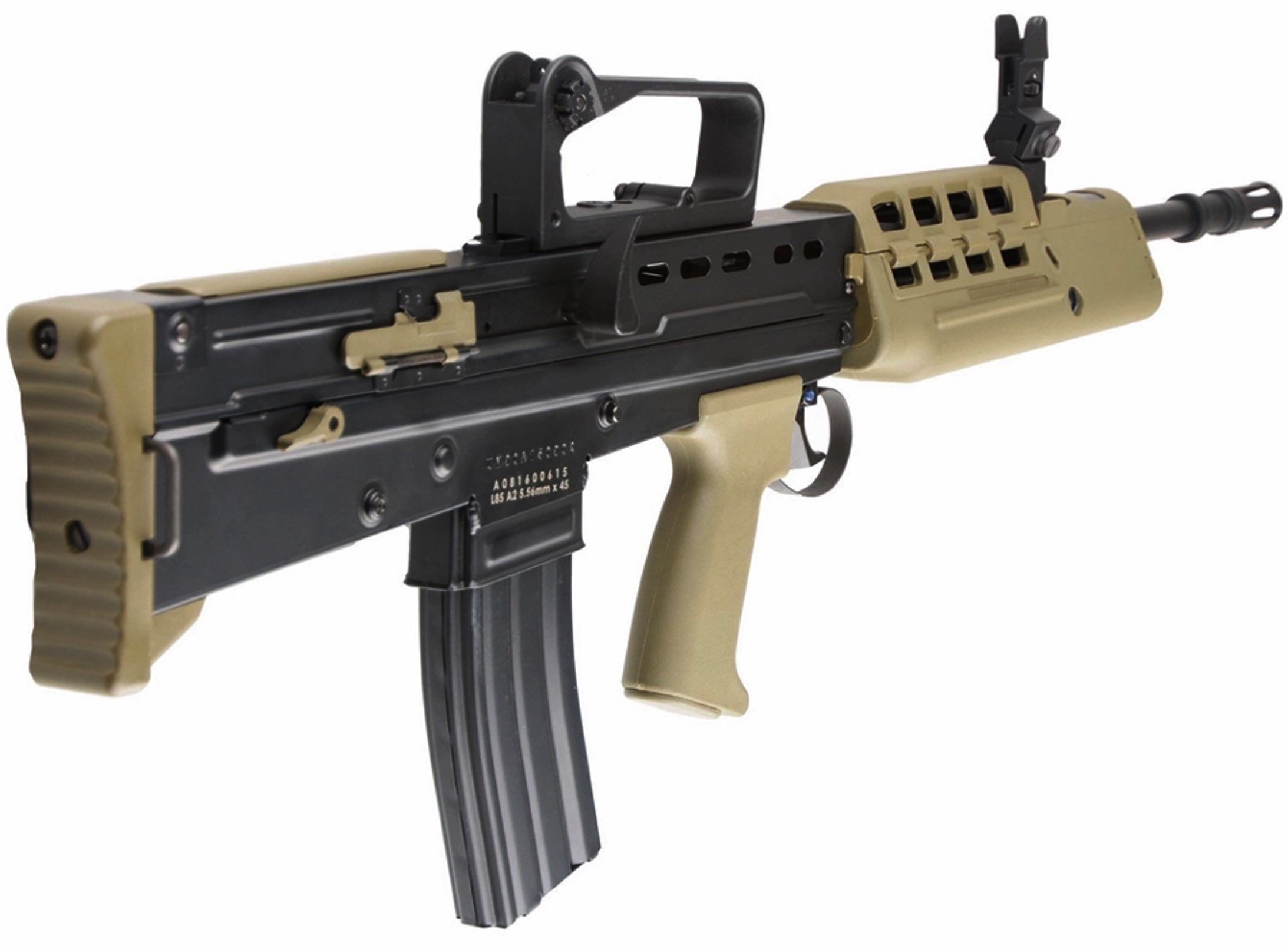

Entries in Comparison,Bulk Air

Barra 1866 Tactical CO2 .22 Caliber Lever Action Pellet Rifle Table Top Review

No Comments

In this table top review, we are taking a close look at the Barra 1866 Tactical CO2 Lever Action .22 Caliber Pellet Rifle. While the original classic version featured a gold receiver and faux wood stock, this updated model brings a modern tactical aesthetic to the classic Winchester 1866 platform. The biggest draw to the Tactical version is the black synthetic stock, the M-LOK handguard, and the multiple Picatinny rail options for adding modern accessories.

Key Specifications:

  • Model: Barra 1866 Tactical.

  • Type: Pellet Rifle.

  • Caliber: .22 caliber pellets.

  • Power Source: Dual 12-gram CO2 cartridges (housed in the rear buttstock).

  • Velocity: Claimed 450 FPS.

  • Action: Single-Action Lever Action Repeater.

  • Safety: Thumb safety behind the hammer and a secondary grip safety built into the lever.

  • Barrel: 18-inch rifled steel octagonal barrel.

  • Construction: Mostly all-metal construction with a black synthetic stock and handguard.

  • Weight: 6.5 lbs (2.9 kg).

  • Overall Length: 38.5 inches (90.7 cm).

  • Sights: Flip-up rear iron sight (featuring a peep notch and a lower notch).

  • Optics Rail: Removable short Picatinny rail over the receiver and a long continuous Picatinny rail on the handguard.

  • Magazine Capacity: 10-shot tube magazine (comes with 10 silver shells designed specifically for the .22 caliber version).

Handling & How It Works: Weighing in at 6.5 pounds and measuring 38.5 inches long, the Barra 1866 Tactical has an incredibly solid feel thanks to its heavy metal receiver and barrel. This is a single-action lever action repeater, meaning you must manually cycle the lever to cock the hammer and load a shell into the breach for every shot. To fire, you load the individual shells into the tube magazine, rack the paracord-wrapped lever downwards to chamber a round, ensure the lever is squeezed snug against the stock to disengage the secondary safety, and pull the metal trigger. When you rack the lever again, the empty shell ejects straight out the top of the action just like the real deal.

Pros:

  • Excellent heavy weight and realistic feel thanks to the nearly all-metal construction.

  • The sleek black synthetic stock and M-LOK handguard completely update the classic platform into a modern tactical rifle.

  • Very few replica rifles are available in .22 caliber, which offers fantastic downrange energy and impact.

  • Abundant mounting options: M-LOK slots and multiple Picatinny rails make it incredibly easy to add red dots, flashlights, lasers, or bipods.

  • The custom paracord-wrapped lever handle looks great and improves grip comfort during cycling.

  • Dual 12-gram CO2 system provides a very cost-effective power source with less cool-down effect than a single cartridge, allowing for extended shooting sessions.

  • Operating the lever and watching the empty casings eject vertically makes this gun incredibly rewarding and fun to shoot.

  • The claimed 450 fps gives you plenty of power for mid-range target shooting and small pest control.

Cons:

  • Because the empty shells eject vertically straight out of the top, you cannot easily mount a traditional magnified rifle scope directly over the receiver; an offset red dot or long eye-relief pistol scope mounted further forward is required.

  • You will inevitably lose some of the ejecting shells if you shoot outdoors in the grass, so picking up a spare set is highly recommended.

  • The lever must be held firmly snug against the stock while shooting, otherwise the built-in secondary safety will prevent the trigger from pulling.

If you are looking for a fun, realistic lever-action repeater that combines nostalgic shell-ejecting operation with modern tactical accessory compatibility, the Barra 1866 Tactical is a fantastic option. Stay tuned for the Field Test Shooting video coming up shortly.

Available at:

🇨🇦 Buy the Barra 1866 Tactical in the Canada Replica Airguns Store
🇺🇸 Buy the Barra 1866 in the US Replica Airguns Store

Categories: .22 cal, CO2, Comparison, Pellet, Review, Vimeo Video, YouTube Video, Rifle, Repeater Tags: Barra, Barra 1866 Tactical, Tactical

Real-Steel Training with Replica Airguns - Pros & Cons

No Comments

A lot of folks look at Replica Airguns and write them off as just toys or backyard plinkers. Spoiler alert: they are far from toys. In fact, Replica Airguns are some of the most practical, cost-effective, and accessible firearm training tools available on the market today. Whether you're running a full-blowback 4.5 mm steel BB pistol, a gas blowback Airsoft sidearm, or even a 43 caliber rubber ball trainer, these platforms offer real-world training benefits that transfer directly to live firearms.

Below, we break down how Replica Airguns stack up against real steel across the core fundamentals of shooting.

1. Holster Draw & Presentation

  • The Comparison: High-end replica pistols feature 1:1 scale dimensions and realistic weight compared to their firearm counterparts. They fit into standard duty, concealed carry, and competition holsters with zero fuss.

  • The Training Advantage: Practicing draw stroke and presentation from a holster requires massive repetition to build muscle memory. Replica Airguns give you that identical feel, but with a massive safety buffer. If you suffer an accidental discharge during a high-speed draw-and-fire drill, an Airsoft BB or steel BB might leave a bruise or require a minor patch-up, but it won't cost you a limb or your life.

2. Trigger Control & Grip Technique

  • Trigger Feel: Full-blowback Replica Pistols replicate single-action/double-action trigger weights, pulls, and resets very closely to real steel guns. (Keep in mind that non-blowback or partial-blowback models often have heavier, double-action-only trigger pulls due to internal indexing).

  • The Grip Technique: Building a solid modern shooting grip transfers 100% to Airguns.

    • Your strong hand pushes forward slightly into the backstrap with relaxed finger tension so you don't jerk the trigger.

    • Your support hand clamps down hard like a vise, pulling backward to lock the pistol into place.

  • Practicing this push-pull clamping technique on an Airgun builds clean muscle memory without introducing flinching.

3. Recoil Management & Sight Transition

  • Where Airguns Differ: While full-blowback Airguns provide a snappy mechanical cycling sensation, they don’t generate the sharp muzzle rise and concussive kick of a live 9mm or .45 ACP round. An Airgun slide tends to cycle and dip forward quickly, whereas a real gun snaps violently upward.

  • The Takeaway: You won't get identical recoil impulse, but your eyes and hands still have to track the sights as the slide moves. It teaches rapid target acquisition, sight alignment, and consistent presentation between shots at a fraction of the physical fatigue.

4. Reloads & Malfunction Drills

  • Clearing Drills: You can practice tap-rack-bang, speed reloads, and slide manipulations just like on the range.

  • Important Safety Tip: If you are practicing slide-racking drills with an airgun, do it dry without BBs loaded in the magazine. Unlike live firearms (which eject the unfired cartridge when racked), cycling an Airgun slide repeatedly will often chamber multiple BBs into the breech.

  • Practicing stoppages and magazine drops with Airguns lets you run fast drills at home without the hazards of live ammo.

5. Cost & Durability

  • Operating Cost: Real ammunition adds up fast, a single box of 50 rounds of 9mm often runs $30 to $50. With an Airgun, that same round count in CO2 and BBs costs literally a couple of dollars. You can shoot 10 to 20 times more rounds on an Airgun budget.

  • Build Quality: Real firearms are built from hardened steels and durable polymers meant to withstand thousands of high-pressure explosions. Replica Airguns are engineered for lower internal pressures, often utilizing aluminum alloys and cast metals. While they last for thousands of rounds, dropping an Airgun on concrete can damage components more easily than a live firearm. Treat them with care!

6. Training Environment & Accessibility

  • No Range Trip Required: Live firearms require dedicated range time, travel, fees, and strict transport regulations (especially here in Canada with transport permits and licensing).

  • Backyard & Basement Friendly: With an appropriate trap and backstop, Airsoft and rubber-ball guns are perfect for indoor garage or basement practice, while steel BBs excel in safe outdoor home setups. You can get quality reps in during 15 minutes of free time after dinner without ever packing up a range bag.

The Verdict

Are replica airguns a complete 100 %$ replacement for live-fire training? No, you still need live range time to master heavy recoil management and acoustic discipline.

However, for mastering the holster draw, establishing sight alignment, refining trigger pulls, and building consistent grip mechanics, Replica Airguns are second to none. They make high-frequency shooting training safe, cheap, and convenient.

What's Next?

Stay tuned next week, we have a mystery box unboxing arriving at the table with some brand-new product or products lined up for comprehensive reviews!

  • Make sure to subscribe to the channel on YouTube, Vimeo, and Rumble.

  • Follow our community updates on Instagram, Facebook, and Twitter.

  • Ready to gear up? Visit ReplicaAirguns.ca (Canada) or ReplicaAirguns.us (USA) for pistols, rifles, CO2$ and training accessories.

Categories: Airsoft, BB, CO2, Blowback, Comparison, Gas, GBB, Gun Safety, How To, Pistol, Real Gun, Semi Auto, Vimeo Video, YouTube Video Tags:

Blowback versus Non-Blowback Replica Airguns Tutorial

No Comments

While waiting for new guns to arrive for field and tabletop testing, it is the perfect time for an educational breakdown of blowback versus non-blowback Replica Airguns. When choosing between these styles, the core decision comes down to a trade-off: do you want the ultimate realism, or do you want maximum power and gas efficiency?

Full Blowback: The Ultimate Training Tool

Full blowback airguns are designed for the shooter who wants a true trainer with the most realistic functionality and breakdown.

  • The slide cycles completely back with every single shot to provide simulated recoil.

  • These models generally feature a true single-action trigger, which gives the shooter a lighter and shorter trigger pull.

  • When the magazine is out of ammunition and the follower reaches the top, the slide will lock back just like a real firearm.

  • They typically use full-size drop-out metal magazines that hold both the BBs or Airsoft BB’s and the CO2 cartridge.

  • The main downside is that they require a massive amount of CO2 to simultaneously propel the ammunition and aggressively cycle the slide.

  • This high gas usage causes the gun to cool down much quicker, which noticeably lowers the velocity of your shots.

  • If the gun gets too cold during rapid fire, the CO2 valve can become sluggish and even lock open.

Non-Blowback: Power and Efficiency

Non-blowback airguns are built for the shooter who wants the most power and the highest number of shots to break targets downrange.

  • The slide remains completely fixed in place and does not cycle when the gun is fired.

  • Because there is no slide to cock the internal hammer, they rely on a true double-action trigger, resulting in a heavier and longer pull.

  • While some models have full-size drop-out magazines, it is very common for non-blowback guns to use thinner stick magazines.

  • They are significantly more efficient because all the CO2 is dedicated solely to firing the ammunition out of the barrel.

  • The lack of blowback action means the gun does not cool down nearly as fast.

  • They deliver higher overall shot velocities and can operate much more reliably in slightly colder temperatures.

Partial Blowback: The Middle Ground

For those who cannot decide between the two extremes, partial blowback models offer a compromise between realism and efficiency.

  • The slide still cycles to provide simulated recoil, but it only travels part of the way back.

  • The trigger feel sits somewhere between a true double-action and a single-action pull.

  • They consume less gas than a full blowback model, but they still use more than a non-blowback model.

  • They usually come equipped with full-size drop-out metal magazines.

  • Many newer partial blowbacks feature a system where pulling the trigger pushes the BB directly into the barrel to create a tight seal, resulting in excellent CO2 efficiency and higher velocities than a full blowback Airgun.

Whether you are looking for Airguns, Airsoft rifles, Pellet guns, Blank guns, or Accessories, Canadians can shop at replicaairguns.ca and US customers can shop at replicaairguns.us. You can also explore thousands of past video reviews and connect on Facebook, Twitter, Instagram, Rumble, YouTube, and Vimeo.

Categories: 4.5mm / .177 cal, 6mm, Airsoft, BB, Blowback, CO2, Comparison, Gas, GBB, Pistol, Semi Auto, Vimeo Video, YouTube Video Tags:

Plastic - Steel - Lead or Rubber? The Ultimate Ammo Breakdown

No Comments

Welcome back to Replica Airguns. I get asked all the time about which airguns hit the hardest, but a lot of people focus on the wrong attributes. They often look strictly at velocity instead of the raw energy and blunt force required for different tasks.

In this guide, we are breaking down the four main types of airgun ammunition: Airsoft, steel BBs, lead pellets, and rubber balls. The goal is to show you exactly what each ammo type excels at and where they fall short so you can choose the right tool for your specific needs.

6mm Airsoft: Safe Training and Plinking

Airsoft guns fire 6mm round balls, which are generally made of plastic, though you can find copper or zinc-coated variants. Because these are some of the lightest projectiles, ranging from 0.20 to 0.45 grams, they have the lowest overall energy and often lower velocities.

  • Best For: Airsoft is ideal for force-on-force skirmishes (with proper eye protection) because the lightweight rounds sting but do not penetrate the skin.

  • Practical Uses: They are great for safe indoor garage shooting without the risk of breaking windows, or for humanely chasing nuisance crows or vermin out of your yard without causing them permanent harm.

  • Platform Tech: Heavier airsoft rounds utilize backspin, or "hop-up", to float straight through the air for better accuracy, and they are typically fired from highly realistic, full-blowback gas or CO2 replica pistols. Most rifle Airsoft guns are AEG’s using a battery and spring setup which allows for easy semi and full auto operation.

  • Worst For: These are entirely ineffective for pest control (extermination) or any scenario requiring deep penetration or high impact energy.

4.5mm Steel BBs: Fast-Action Shooting

Steel BBs are 4.5mm in diameter, which translates to a .177 caliber round ball. Weighing in at approximately 5.3 grains, they are much denser than Airsoft rounds.

  • Best For: Steel BBs are fantastic for fast-action plinking, breaking glass bottles, and tearing up pop cans.

  • Platform Features: These are often used in 1-to-1 replica blowback pistols with drop-out full size magazines, giving shooters an authentic firearm feel for tactical manipulation practice.

  • The Dangers: Steel does not deform upon impact, meaning these BBs are highly prone to dangerous ricochets if you shoot at hard surfaces indoors or up close.

  • Worst For: Steel BBs lack the blunt force for home defense and are unethical for pest control as trey are a bit under powered and generally not as accurate as similar pellet guns.

Lead Pellets (.177 and .22 Caliber): Precision and Pests

Unlike round BBs, pellets are designed to be fired through a rifled barrel. Common sizes include .177 caliber (4.5mm, weighing 5 to 10 grains) and the much heavier .22 caliber (5.5mm, weighing 12 to 16 grains).

  • Best For: The soft lead engages the spiral grooves in a rifled barrel, providing unmatched precision and accuracy.

  • Terminal Ballistics: Because lead is soft, it expands and flattens upon impact, transferring its heavy kinetic energy directly into the target.

  • Practical Uses: This improved energy transfer makes pellets the ethical choice for small pest control.

  • Worst For: Pellet platforms are rarely designed as rapid-fire action shooters; they typically utilize slower single-shot (bolt actions) or rotary magazines that can require a bit of trigger finger strength to shoot quickly.

Rubber Balls (.43, .50, and .68 Caliber): Less-Lethal Blunt Force

This category represents the heavy hitters, firing massive projectiles that range from soft sponge rubber to dense steel-core balls, dust balls, and pepper balls.

  • The Power Factor: A .68 caliber home defense marker can produce upwards of 20-50 Joules (or roughly 15-35 foot-pounds) of energy with dedicated home defense styled Rubber Ball Guns.

  • Best For: The .68 caliber and high-powered .50 caliber options are explicitly designed for less-lethal home defense.

  • How They Work: Instead of penetrating, these massive projectiles dump incredible raw energy and blunt force directly onto the target, effectively stopping threats through extreme pain.

  • Training Options: The smaller .43 caliber variants are frequently chambered in realistic blowback replica pistols, making them excellent for tactical and paintball-style force-on-force training.

At the end of the day, picking the right Airgun comes down to matching the ammunition mass and energy to your target. You can find all the gear discussed here, from Airsoft replicas to less-lethal launchers, at the Replica Airguns Canada and US stores. Make sure you are subscribed to our channels across Rumble, YouTube, Vimeo, Instagram, X and Facebook for more detailed reviews and field tests.

Categories: .22 cal, .43 cal, .50 cal, .68 cal, 4.5mm / .177 cal, 6mm, BB, Pellet, Paintball, Airsoft, Comparison Tags: Airgun 101

Crosman 2240XL CO2 .22 Caliber Pellet Pistol Table Top Review

No Comments

In this table top review, we are taking a close look at the Crosman 2240XL Special Edition, a .22 Caliber CO2 Pellet Pistol. While I haven't shot this exact model yet, I have shot the standard 2240 non-XL version, and they share a very similar firing mechanism. The biggest draw to the XL version is the factory-upgraded metal breech with an 11mm dovetail rail, and the threaded muzzle for added versatility.

Key Specifications:

  • Model: Crosman 2240XL Special Edition

  • Type: Pellet Pistol

  • Caliber: .22 caliber lead pellets

  • Power Source: 12-gram CO2 (1 cartridge)

  • Velocity: Up to 460 FPS

  • Action: Single-Shot Bolt Action

  • Safety: Cross-Bolt Safety

  • Barrel: Rifled Steel Barrel, Threaded muzzle (1/2" x 20 threads)

  • Stock/Grips: Plastic grips

  • Construction: Mostly metal (steel breech, barrel, loading chamber) with plastic grips

  • Weight: 1.8 lbs

  • Overall Length: 12.5 inches

  • Sights: None included

  • Optics Rail: 11mm Dovetail Rail

First Impressions & Build Quality:
The 2240XL brings a much-needed factory upgrade to the legendary 2240 platform: a full steel breech. This alone is a huge addition, making the gun stand out and providing a much higher quality feel. The gun is almost entirely metal, including the barrel, CO2 loading chamber, bolt, and breech. The grips are plastic, which is fairly standard, but one of the best things about the Crosman 2240 platform is how highly customizable it is. There are countless aftermarket parts available, and you can even easily swap out the grips fro wood grips or for a Crosman shoulder stock to turn it into a backpacker-style carbine.

Weighing in at 1.8 pounds and measuring 12.5 inches long, The Crosman 2240XL Special Edition has a solid feel in the hand. The threaded barrel comes with a thread protector and gives you options for adding mock suppressors or other attachments.

How It Works:
This is a single-action, bolt-action pellet pistol. To operate it, you must first cock the bolt and manually load a .22 caliber pellet into the chamber. Once the bolt is pushed forward and locked down, the trigger is engaged and ready to fire. Powered by a single 12-gram CO2 cartridge housed in the lower tube, it is capable of firing up to 460 FPS depending on the weight of the pellets used. Because it's a single-shot bolt action, you'll need to manually load a pellet for every shot, but you won't need to pump it since the CO2 provides the power.

Pros:

  • Upgraded steel breech from the factory provides a robust build and premium look.

  • Built-in 11mm dovetail rail makes adding a red dot or magnified optic easy.

  • Threaded muzzle (1/2" x 20 threads) with an included thread protector for attachments.

  • Solid CO2 power at up to 460 FPS.

  • Highly customizable platform with endless aftermarket parts available.

  • Excellent light single-action trigger with very little take-up.

  • Mostly metal construction ensures long-lasting durability.

Cons:

  • Does not come with any open sights, an optic is required out of the box.

  • Relies on CO2, meaning velocities will fluctuate as the gun cools down during rapid fire and potentially as CO2 volume lowers.

  • Standard plastic grips are somewhat basic.

Final Thoughts:
The Crosman 2240XL Special Edition takes an already proven pistol and adds the features most shooters end up buying aftermarket anyway. Having the steel breech and dovetail rail right out of the box makes mounting an optic straightforward, and the threaded muzzle is a fantastic touch, even if it’s just mainly for looks. If you're looking for a powerful .22 caliber airgun for small pest control that can be modified to your exact liking, the 2240XL is a superb starting point.

Stay tuned for the Field Test Shooting video coming up down the road.

Available at:

Categories: .22 cal, CO2, Comparison, Pellet, Pistol, Scope, Single Shot, Vimeo Video, YouTube Video, Review Tags: Crosman, 2240, 2240XL

Umarex P2P Secure 68P Less Lethal .68 Cal Impact Pistol Table Top Review

No Comments

Today, we are focusing on a heavy hitter in the home defense category: the Umarex P2P Secure 68P Less Lethal Impact Pistol. As is standard for our Table Top videos, we won't be doing any actual firing today, that’s saved for the upcoming Field Test, but we are going to dive deep into the design, features, and feel of this .68 caliber device.

Built around the paintball concept but strictly intended as a less-lethal deterrent, the Secure 68P is designed to handle everything from nylon and heavy rubber rounds to pepper, powder, and glass-breaker balls. Umarex also includes a fantastic zippered soft-shell case to keep the pistol and all your included starter ammo neatly organized.

Specifications

  • Projectile Size: .68 Caliber.

  • Firing Mechanism: Double-action only trigger.

  • Gas System: 12-gram CO2 (housed inside the drop-out magazine).

  • Capacity: 6-round removable metal magazine. (Available 9 round extended magazines)

  • Muzzle Velocity: Approximately 350 FPS (pushing around 19 Joules or 14 ft-lbs of energy).

  • Materials: Durable plastic/polymer outer frame and slide; solid metal internal housing, barrel, and magazine.

  • Sights: High-visibility, non-adjustable fiber optic sights (front and rear).

Build Quality & Design

When you pick up the Secure 68P, the first thing you'll notice is its sheer size. It has a much chunkier, bulkier footprint compared to standard 1:1 replica sidearms, but that extra mass gives it a commanding presence. While the outer frame and the slide itself are constructed from a tough, lightweight plastic, Umarex didn't skimp where it counts. The internal framework, the barrel, the trigger mechanism, and the fully removable magazine are all forged from solid metal, giving the pistol a very balanced, sturdy feel in the hand.

Handling & Controls

Operating this less-lethal device is straightforward and geared toward high-stress scenarios. Everything centers around the full-metal drop-out magazine, which houses your six rounds of .68 caliber ammunition. The 12-gram CO2 cartridge sites right under the barrel built into the slide loaded from the front (by the way the Magazine doubles as the CO2 tightening tool). Because the gun relies entirely on a double-action trigger and lacks a blowback feature, 100% of the CO2 pressure is channeled directly into launching the heavy projectiles making it worth the slightly heavier trigger pull.

The trigger pull itself is relatively smooth, though you will definitely notice a heavier initial pull on that very first shot once the CO2 is pierced. For added utility, there is a standard Picatinny rail located beneath the muzzle, making it incredibly easy to attach a tactical flashlight or laser to help you navigate dark areas.

Sights & Optics

To assist with aiming in low-light environments, the Secure 68P is outfitted with bright fiber-optic sights on both the front and the back. While they are fixed and cannot be adjusted for windage or elevation, they do an excellent job of gathering ambient light, ensuring you can acquire your target quickly when you need to most.

Performance Expectations

This impact pistol is built for raw stopping power. Pushing a massive .68 caliber projectile at roughly 350 FPS yields an impressive 19 Joules of energy. Whether you load it with dense nylon balls or heavy rubber rounds, you can expect significant blunt-force trauma upon impact. I am incredibly eager to get this beast into the indoor shooting range to test its actual chrony numbers and accuracy on a paper target. Perhaps there will also be a future penetration test on a variety of object.

Pros

  • Outstanding less-lethal alternative for home defense and property protection.

  • Huge .68 caliber bore size delivers maximum energy transfer.

  • Produces an intimidating 19 Joules of raw power.

  • Heavy-duty metal drop-out magazine adds to the overall weight and feel while allowing for quick reloading .

  • Bright fiber-optic sights are perfect for dimly lit environments.

  • Under-barrel Picatinny rail allows for quick mounting of tactical lights and lasers.

  • Ships with a high-quality zippered case and a starter pack of CO2 and various impact rounds.

Cons

  • The overall profile is quite large and bulky compared to standard firearm replicas.

  • The double-action trigger pull can feel a bit long and heavy especially on the initial shot.

  • Fixed sights offer no adjustability.

  • The lack of a blowback slide means it won't simulate the realistic recoil of a traditional firearm or have that single action easy trigger.

Final Thoughts

If you are in the market for a dedicated home-defense tool that you can comfortably keep in a nightstand, the Umarex P2P Secure 68P deserves a serious look. It trades the intricate realism of a 1:1 blowback replica for raw, unadulterated stopping power. The combination of its massive .68 caliber projectiles and 19 Joules of energy makes it a highly effective deterrent.

Before I sign off, I want to take a quick second to thank our amazing community. We are nearing 1000 subscribers and getting close to a quarter million views over on YouTube which we only just relaunched a few moths ago! Your continued support makes all of these reviews possible.

Categories: .68 cal, CO2, Comparison, Paintball, Pistol, Review, Semi Auto, Vimeo Video, YouTube Video Tags: Umarex, P2P, P2P Secure, P2P 68P

Sig Sauer P320 Spectre Comp CO2 Blowback Pellet Pistol Table Top Review

No Comments

First Look & Overview

In this table top review, taking a detailed look at the Sig Sauer P320 Spectre Comp CO2 Blowback Pellet Pistol, a modern, competition-style airgun replica that closely mirrors its real steel counterpart. This model stands out with its aggressive styling, compensated muzzle, and optics-ready slide, making it one of the more premium-looking pellet pistols currently available.

This is a pellet-only airgun with blowback action, designed more for realism and handling than raw velocity. If already familiar with the Sig Sauer M17 pellet pistol, this one shares a lot of mechanical similarities, including the magazine system.

Specifications

  • Caliber: .177 Pellet

  • Action: Semi-auto, blowback

  • Magazine: 20-round belt-fed rotary system

  • Power Source: 12g CO2 (tool-free cam lever system)

  • FPS: Claimed 340 FPS

  • Weight: ~2.3 lbs

  • Overall Length: 8.5 inches

  • Barrel Length: 4.6 inches (rifled)

  • Construction: Metal slide, polymer frame

  • Sights: Fixed white dot front and rear

  • Optics Ready: Yes (SIG Air RMR compatible)

  • Rail: Picatinny accessory rail

  • Safety: Ambidextrous manual safety

Build Quality & Design

The Sig Sauer P320 Spectre Comp CO2 Blowback Pellet Pistol delivers a solid mix of metal and polymer construction. The metal slide gives it realistic weight and feel, while the polymer frame helps keep things balanced. At around 2.3 pounds, it has a substantial presence in hand without feeling overly heavy.

The grip features enhanced texturing along with a flared magwell, adding to both aesthetics and usability. The slide includes light porting and is optics-ready, allowing for easy installation of a SIG Air RMR red dot.

One standout visual element is the compensated muzzle, which adds to the competition-style look. However, it also impacts field stripping, you’ll need to remove it to fully disassemble the slide.

Magazine & CO2 System

This pistol uses a 20-round belt-fed rotary magazine, which is housed within a drop-out mag body. Loading is straightforward:

  • Remove the rotary belt insert

  • Load pellets into each chamber

  • Reinsert into the mag

CO2 is loaded using a tool-free cam lever system, which is fast and convenient compared to traditional screw-in designs.

Important note: the magazine needs to be firmly seated. A light insertion may not lock it properly, and due to the weight, it could fall out if not fully engaged.

Also worth noting, while the outer mag housing has some polymer components, the internal structure is mostly metal. Still, avoid dropping it on hard surfaces.

Handling & Controls

  • Ambidextrous safety works from both sides, though visual indicators are only clearly marked on one side

  • Trigger feels closer to double-action due to the rotary magazine indexing

  • Slide cycles with blowback but does not lock back when empty

  • Takedown lever is present, but full disassembly is limited by the compensator

The trigger has a solid feel and requires deliberate pull due to the indexing mechanism. This is normal for belt-fed pellet systems.

Sights & Optics

The pistol comes with fixed white dot sights, which are effective for quick target acquisition. However, they are not adjustable.

For those wanting more precision, the pistol supports SIG Air RMR optics, replacing the rear sight with an included plate.

Performance Expectations

The claimed velocity is 340 FPS, which is typical for blowback pellet pistols. Expect slightly lower speeds with lead pellets (recommended) compared to alloy pellets.

Blowback operation will also consume more CO2 than non-blowback models, trading efficiency for realism.

If looking for a performance reference, similar results can be expected to the Sig Sauer M17 pellet pistol due to shared internals.

Pros

  • Excellent replica accuracy of the P320 Spectre Comp

  • Realistic blowback with metal slide

  • Good weight and balance (~2.3 lbs)

  • 20-round high-capacity pellet magazine

  • Tool-free CO2 cam lever system

  • Rifled barrel optimized for pellet shooting

  • Optics-ready (SIG Air RMR compatible)

  • Flared magwell and enhanced grip texture

  • Picatinny rail for accessories

  • Magazine compatibility with M17

Cons

  • Lower FPS compared to non-blowback pellet pistols

  • Higher CO2 consumption due to blowback

  • Fixed (non-adjustable) sights

  • Pellet-only (no BB capability, though this protects rifling)

  • Slide does not lock back when empty

  • Field stripping requires compensator removal

Final Thoughts

The Sig Sauer P320 Spectre Comp pellet pistol is a strong option for anyone prioritizing realism, handling, and modern styling over raw power. It delivers a premium look with solid functionality, especially for training, backyard shooting, or collectors wanting a high-end replica.

While not the most powerful pellet pistol available, it excels in design, usability, and realism, especially if already a fan of the P320 platform.

For those in Canada, availability may already be live, with US availability likely to follow.

Categories: 4.5mm / .177 cal, Blowback, CO2, Comparison, Pellet, Pistol, Review, Semi Auto, Vimeo Video, YouTube Video Tags: Sig, Sig Sauer, Sig Sauer ASP, P320, Spectre Comp

Steambow M10 vs CenterPoint AT400 Crossbow Comparison Review

No Comments

In this review, we are looking at two crossbows that honestly shouldn’t really be compared, but that’s exactly why this comparison is interesting. On one end, we have the Steambow M10, a compact, magazine-fed, fast-shooting crossbow built for fun, training, and high repetition shooting. On the other, the CenterPoint AT400, a full-size, high-powered compound crossbow designed for serious hunting applications.

Aside from both launching bolts/arrows, these two platforms sit at completely opposite ends of the spectrum. The goal here is not to declare a winner, but to help you decide which one actually fits your use case, or if you might want both.

Key Differences Overview:

Steambow M10

The Steambow M10 is a compact repeating crossbow designed more for fun, training, and high-volume shooting. It uses a magazine-fed system that can hold 10 bolts, allowing for very fast follow-up shots. Depending on the limb setup, it can reach speeds of up to around 200 FPS and produce approximately 10 to 15 foot-pounds of energy. Its lighter draw weight options and easy cocking system make it beginner-friendly and much less physically demanding to use. Overall, the M10 is best suited for target shooting, casual use, and potentially small game with the right setup.

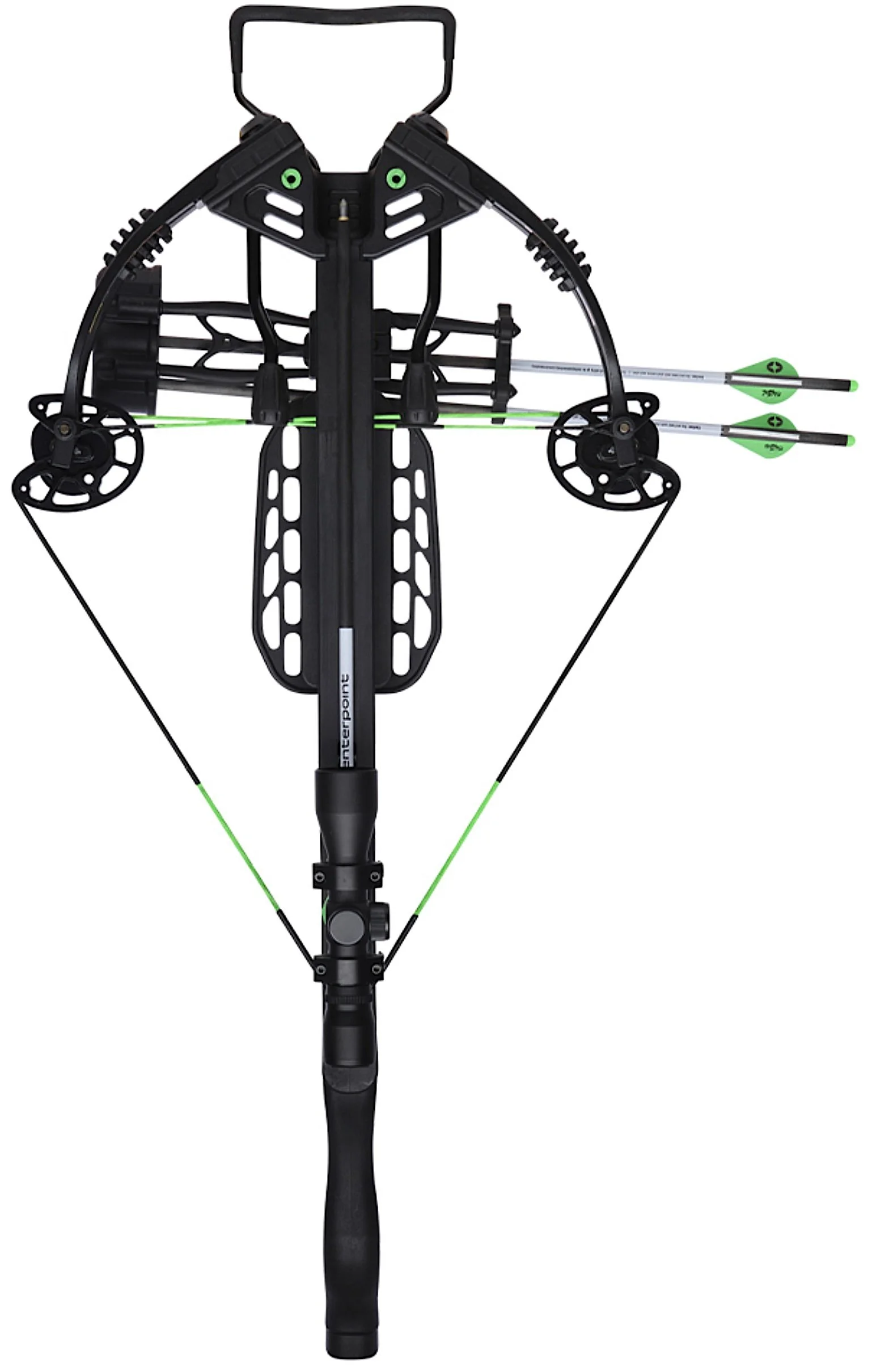
CenterPoint AT400

The CenterPoint AT400 is a full-size compound hunting crossbow built for serious power and hunting use. Unlike the M10, it is a single-shot platform that focuses on accuracy, penetration, and range rather than fast repeat shooting. It sends arrows downrange at about 400 FPS and delivers close to 150 foot-pounds of energy, putting it in an entirely different class. With its roughly 200-pound draw weight, it requires much more effort to cock and reload, usually with a rope or crank system. This makes it better suited for medium to large game hunting, where power and shot placement matter far more than speed.

Side-by-Side Summary

If you want something lightweight, compact, fast, and easy to shoot often, the Steambow M10 is the better fit. If your main goal is hunting and you need maximum power, longer range, and serious downrange performance, then the CenterPoint AT400 is clearly the more appropriate choice. Even though both are crossbows, they are built for very different types of users and very different shooting experiences.

Power & Performance

The biggest separation between these two comes down to raw power.

  • The Steambow M10 delivers up to about 10–15 foot-pounds of energy, depending on limb configuration and bolt weight. It’s comparable to higher-end airguns or paintball-level power.

  • The CenterPoint AT400, by contrast, produces close to 150 foot-pounds of energy and launches arrows at around 400 FPS.

That’s not a small difference, it’s an entirely different category.

Real-world comparison:

  • M10 = backyard shooting, small game potential

  • AT400 = deer, and potentially even elk with proper shot placement

This is essentially the difference between a BB gun vs a hunting rifle in terms of role and impact.

Shooting Experience:

Steambow M10

  • Magazine-fed (10 bolts)

  • Extremely fast follow-up shots

  • Break-action style cocking (very quick)

  • Great for drills, repetition, and skill building

  • Minimal effort required

You can realistically fire 10 shots in about 10 seconds, making it a very engaging and fun platform.

CenterPoint AT400

  • Single-shot system

  • Requires rope cocking or crank system

  • Significant physical effort (200 lb draw)

  • Slow reload (often 30–60+ seconds)

This is a deliberate shooting experience, not something designed for volume or speed.

Use Case Breakdown:

Steambow M10 – Best For…

  • Backyard shooting (with proper backstop)

  • Target practice

  • Tactical-style drills

  • High repetition training

  • Casual and frequent use

  • Lower-cost shooting (especially with rubber ball version)

You can even use:

  • Rubber balls (low cost, reusable)

  • Lightweight bolts

  • Indoor-friendly setups (with proper safety)

CenterPoint AT400 – Best For…

  • Hunting (deer and potentially larger game)

  • Long-range accuracy

  • Maximum penetration and power

  • Purpose-driven shooting

This is not a casual-use product, you typically bring it out when it matters.

Ease of Use & Physical Demand:

Steambow M10

  • Very easy to cock (even at lower draw weights)

  • Beginner-friendly

  • Lightweight (~compact platform)

  • Minimal fatigue

CenterPoint AT400

  • High effort required

  • Needs cocking tools (rope or crank)

  • Physically demanding

  • Slower workflow between shots

Key takeaway:
Anyone can pick up and use the M10 easily. The AT400 requires more commitment, strength, and practice.

Size & Portability

Steambow M10

  • Compact and lightweight

  • Can be partially disassembled easily

  • Backpack-friendly

  • Ideal for mobile use

CenterPoint AT40

  • Large, fixed structure

  • Not easily transportable without a case

  • Designed for field carry, not casual portability

Ammo & Cost of Ownership:

Steambow M10

  • Bolts are smaller and cheaper

  • Rubber ball version = extremely low cost

  • Less wear and tear overall

  • High reusability

CenterPoint AT40

  • Arrows are larger and more expensive

  • More prone to damage/loss at high speeds

  • Requires maintenance and replacement over time

Value Consideration:

Interestingly, both fall into a similar price range (~$400–$500), but value depends on usage frequency:

  • M10 → Likely used often → Higher practical value

  • AT400 → Used less frequently unless hunting regularly

If something sits unused, its value drops regardless of price.

Who Should Buy Each?

Choose the Steambow M10 if you…

  • Want fun, fast shooting

  • Plan to shoot frequently

  • Prefer low effort and ease of use

  • Don’t need high power

  • Enjoy tactical or training-style shooting

Choose the CenterPoint AT400 if you…

  • Are hunting (especially deer or larger game)

  • Need high power and penetration

  • Value accuracy and range

  • Don’t mind slower reload times

  • Are comfortable with physical effort

Final Thoughts

These two crossbows are not competitors—they are tools for completely different jobs.

  • The Steambow M10 is about frequency, fun, and versatility

  • The CenterPoint AT400 is about power, precision, and purpose

If anything, this comparison highlights that you may not need to choose one over the other, you might actually benefit from having both ends of the spectrum covered.

If neither fits perfectly, then the real answer may be to look for something in the middle.

Where to Buy

Both of these crossbows (or similar models) are typically available through:

Categories: Crossbow, Comparison, Non Airguns, Review, Rifle, Vimeo Video, YouTube Video, Repeater, Single Shot Tags: Steambow, CenterPoint, AT400, M10 Tactical, Crossbow

Umarex T4E TP50 Gen 2 CO2 Paintball Pistol Table Top Review

No Comments

In this table top review, we’re taking a look at the Umarex T4E TP50 Gen 2 CO2 Paintball Pistol, part of Umarex’s T4E (Training for Engagement) lineup. This version is marketed more as a tactical training pistol, while its nearly identical counterpart, the HDP50, is positioned toward home defense.

At first glance, the TP50 and HDP50 look almost identical. The main visual difference is that the TP50 comes in an all-black finish, while the HDP50 features an orange slide. Beyond that, the functionality, performance, and specs are essentially the same.

Key Features and Specifications

  • Manufacturer: Umarex

  • Model: T4E TP50 Gen 2

  • Caliber: .50 caliber

  • Power Source: 12g CO2 (quick piercing system)

  • Action: Semi-auto, double action trigger

  • Magazine Capacity: 6 rounds (internal inline magazine)

  • Velocity: Rated up to 465 FPS

  • Energy: Claimed 11 joules (can be higher depending on ammo)

  • Barrel Length: ~4 inches

  • Overall Length: ~8 inches

  • Weight: ~1.5 lbs (0.7 kg)

  • Construction: Polymer frame and slide with metal internals and barrel

  • Safety: Integrated trigger safety

  • Rail: Under-barrel Picatinny rail

  • Sights: Fiber optic front and rear

Overview and First Impressions

The TP50 Gen 2 is a compact, .50 caliber paintball-style pistol designed for training, recreational shooting, and less-lethal applications. It has a solid feel in the hand, not too heavy, not too light, and resembles a full-size handgun profile, similar in size to a large-frame pistol.

Despite its polymer exterior, the internal components that matter, especially around the CO2 system—are metal, giving it durability where needed.

CO2 System (Quick Piercing Feature)

One of the standout features is the quick piercing CO2 system:

  • Insert the CO2 cartridge (butt-first)

  • Tighten the cap until snug

  • When ready to use, give the bottom a firm “whack”

  • A pin pops out on the back where you can see it to indicate the system is pressurized

This allows you to keep the pistol loaded but not activated, which is useful for storage or readiness situations.

Ammo Compatibility

The Umarex T4E TP50 Gen 2 CO2 Paintball Pistol supports a wide range of .50 caliber ammunition, including:

  • Rubber balls

  • Powder balls

  • Paintballs

  • Steel/rubber hybrid balls

  • Pepper balls (limited availability in Canada)

Performance varies significantly depending on the weight of the projectile:

  • Lighter rubber balls: ~450 FPS / ~13–15 joules

  • Heavier projectiles: lower energy (down to ~7–11 joules)

What’s Included

  • TP50 Gen 2 pistol

  • Two tubes of 10 rounds each (powder + rubber balls)

  • Barrel cleaning squeegee

  • Instruction manual

  • Cardboard packaging (blue “tactical pistol” branding)

Walkaround Highlights

  • Fiber optic sights make target acquisition easy in various lighting conditions

  • Textured grip and slide for solid handling

  • Metal trigger with integrated safety

  • Wide open barrel design

  • Picatinny rail for adding lights or lasers

  • Clear “Strike” marking for CO2 activation point

Overall, it’s a clean, functional design with a tactical look, especially in the all-black version.

Pros

  • Compact size compared to other .50 cal pistols

  • Wide variety of compatible ammo types

  • Quick piercing CO2 system (very practical)

  • Good power for its size (~11–15 joules range)

  • Fiber optic sights improve usability

  • Picatinny rail for accessories

  • Realistic all-black tactical appearance

Cons

  • Only 6-round capacity before reload

  • Limited shots per CO2 (~3–4 reloads)

  • Internal magazine (no quick mag swaps)

  • Pepper ball ammo difficult to source in Canada

  • Efficiency trades off for higher power

TP50 vs HDP50 (Quick Comparison)

  • TP50: All black, marketed as tactical training

  • HDP50: Orange slide, marketed for home defense

  • Performance: Essentially identical

This difference is largely cosmetic and marketing-driven, so choosing between them comes down to preference and intended use.

Final Thoughts

The Umarex T4E TP50 Gen 2 CO2 Paintball Pistol is a solid, compact .50 caliber CO2 pistol that delivers respectable power in a manageable platform. It’s not designed for high-capacity shooting or efficiency, but rather for impact, simplicity, and versatility in ammo choice.

If you’re looking for a less-lethal option or a training pistol with realistic handling and solid performance, the TP50 fits that role well, especially if you prefer the more discreet all-black tactical look.

Where to Buy

Categories: .50 cal, CO2, Comparison, Paintball, Pistol, Review, Semi Auto, Vimeo Video, YouTube Video Tags: Umarex, T4E, T4E TP50, TP50

Air Venturi Annie Oakley Lil’ Sure Shot Spring BB Rifle Table Top Review

No Comments

In this table top review, we’re taking a close look at the Air Venturi Annie Oakley Lil’ Sure Shot Spring BB Rifle. While this is technically a “table top” review, lever-action rifles like this are always a bit easier to show off in-hand due to their length and proportions.

This model fits into a long lineage of classic lever-action BB rifles, alongside well-known options like the Daisy Red Ryder and the Marlin variants from Crosman and Umarex. These rifles all share a similar concept, simple, spring-powered, lever-action BB guns designed for training, plinking, and beginner shooters, but each brings its own subtle differences in materials, styling, and features.

Key Specifications

  • Model: Air Venturi Annie Oakley Lil’ Sure Shot

  • Type: Lever Action Spring Piston BB Rifle

  • Caliber: 4.5mm Steel BB

  • Power Source: Spring (No CO2 Required)

  • Velocity: Up to 350 FPS

  • Magazine Capacity: 550 Round Internal Reservoir (Gravity Fed)

  • Action: Lever Action

  • Safety: Cross Bolt Safety

  • Barrel: Smoothbore

  • Stock: Stained Solid Wood

  • Construction: Primarily Metal with Some Plastic Components

  • Weight: Approx. 3.3 lbs

  • Overall Length: ~36.25 inches

  • Optics Rail: Removable Weaver/Picatinny Style Mount

First Impressions & Build Quality

The Annie Oakley Lil’ Sure Shot stands out with its classic Western styling, enhanced by engraved Annie Oakley branding on the wood stock. It’s a step above many entry-level BB rifles thanks to its real wood stock and metal lever, giving it a more authentic and durable feel compared to fully plastic alternatives.

Most of the rifle is metal and wood, though there are a few plastic components:

  • Trigger

  • Front sight (on the newer version)

  • Adjustable portion of the rear sight

  • Removable scope rail

Overall, it feels solid in the hands, lightweight, and well-balanced, especially for younger shooters or anyone new to lever-action rifles.

How It Works

This is a spring-piston, lever-action BB rifle, meaning:

  • No CO2 or gas is required

  • Each shot is powered by cocking the lever

  • BBs are stored in a large internal reservoir

  • You must tilt the rifle upward to gravity-feed BBs into position

With a 550-round capacity, you can shoot for quite a while before needing to reload, your arm will likely get tired before you run out of ammo.

Handling & Usability

This rifle is clearly designed with accessibility in mind:

  • Lightweight (3.3 lbs) makes it easy to handle

  • Shorter length and pull fits smaller shooters well

  • Moderate cocking effort is manageable for beginners

  • Lever action slows firing rate, adding a safety advantage for new users

Rifles like this are excellent for training because:

  • They are easier to aim than pistols

  • They encourage controlled shooting

  • They are not overly powerful

Even for experienced shooters, these are simply fun and inexpensive for backyard plinking.

Sights & Optics

Out of the box, the Air Venturi Annie Oakley Lil’ Sure Shot Spring BB Rifle includes:

  • Fixed front sight (plastic on newer version)

  • Adjustable rear sight (elevation only)

One notable feature is the removable Weaver-style rail, allowing you to:

  • Mount a red dot or scope

  • Or remove it for a more traditional look

Keep in mind the rail is plastic, so care should be taken when mounting optics.

Comparison to Similar BB Rifles

This rifle sits in the same category as:

  • Daisy Red Ryder – The original classic

  • Umarex Marlin Lever Action – Slightly more adult-oriented design

  • Crosman Marlin (older models) – Direct Red Ryder competitor

All of these:

  • Use lever-action spring systems

  • Have internal BB reservoirs

  • Shoot in the ~300–350 FPS range

The Annie Oakley version distinguishes itself with:

  • Better visual styling

  • Wood and metal construction

  • Optional optics mounting

New vs Older Annie Oakley Version (Key Differences)

If you come across different versions, here are the main distinctions:

Newer Version:

  • Longer barrel

  • Plastic front sight

  • Larger loading port (easier to load)

  • Metal Lever

  • Brighter, more polished wood finish

Older Version:

  • Shorter barrel

  • Metal front loading system (rotating port)

  • Metal front sight (more durable)

  • Plastic Lever

  • Slightly darker, more matte wood

Both should perform similarly, but the newer version is a bit more refined with that quality all metal lever.

Pros

  • Lightweight and easy to handle

  • Real wood stock and metal lever construction

  • Large 550-round capacity

  • No CO2 required (low maintenance and inexpensive to shoot)

  • Removable optics rail for flexibility

  • Classic Western styling with Annie Oakley branding

  • Great for beginners and younger shooters

Cons

  • Plastic front sight (new version)

  • Lower power compared to CO2 rifles

  • Rear sight only adjustable for elevation

  • Slightly higher price than some entry-level similar BB rifles

  • Less realistic than shell-ejecting lever-action models

Final Thoughts

The Air Venturi Annie Oakley Lil’ Sure Shot is a well-built, visually appealing lever-action BB rifle that blends classic styling with modern usability.

It’s ideal for:

  • Beginners and younger shooters

  • Backyard plinking

  • Anyone wanting a simple, reliable and fun BB rifle

While it doesn’t aim for full realism like higher-end shell-ejecting models, it delivers where it matters, ease of use, affordability, durability, and fun factor.

Available at:

Also check out ReplicaAirguns.com for additional articles, photos, and video reviews.

Categories: 4.5mm / .177 cal, BB, Comparison, Repeater, Review, Rifle, Spring Piston, Vimeo Video, YouTube Video Tags: Air Venturi, Annie Oakley Lil Sure Shot, Red Ryder

Umarex T4E TC 68 Less Lethal Paintball Rifle Field Test Review

No Comments

In this Field Test Shooting Review I’m taking a look at the Umarex T4E TC68 .68 caliber paintball / less-lethal marker to see how it performs in terms of velocity, accuracy, and overall shooting experience.

I have already done a Table Top Review covering the specifications, features, and overall purpose of the TC68, so make sure to check that video out if you want the full breakdown of the gun itself. This field test review is focused strictly on real-world performance.

For this test the TC68 has been de-restricted, meaning the adjustment screw has been modified slightly so it can reach its full potential. Even with this adjustment it should still remain legally compliant here in Canada, since the velocity will remain under the 500 fps threshold.

For ammunition I used .68 caliber nylon rounds:

  • Black rounds: approximately 2.8 grams

  • Yellow rounds: approximately 2.6 grams

The TC68 in this test is powered using dual 12-gram CO2 cartridges, rather than the larger 88-gram CO2 cylinder, which will affect both shot consistency and total shot count.

Velocity Testing

For the velocity portion of the test I fired several shots through my chronograph.

Chronograph readings were somewhat tricky to capture at first, but once everything started working correctly I was able to record several shots.

Example readings included:

  • 476 fps

  • 463 fps

  • 453 fps

  • 445 fps

The velocity dropped slightly during the test, which is expected when using dual 12-gram CO2 cartridges, as they cool down fairly quickly during rapid shooting.

The slightly heavier 2.8-gram black rounds were also used for some of the shots, which can contribute to minor changes in velocity compared to the lighter 2.6-gram rounds.

Even with that drop, performance was still strong and suggests the TC68 could likely reach high-400 fps velocities with a fresh CO2 setup or an 88-gram CO2 cylinder, which provides much greater gas capacity and improved consistency.

Accuracy Testing

For the accuracy portion of the test I set up a paper target down range and loaded roughly 20 rounds into the magazine.

The first test consisted of 10 shots in semi-automatic mode using the heavier black nylon rounds. A red-dot optic was installed on the TC68 for aiming, though it had not been sighted in or adjusted beforehand.

Results were quite respectable for a marker shooting heavy .68 caliber rounds.

  • Overall grouping was approximately 4 inches

  • Most shots landed within a 2.5–3 inch cluster

  • One shot landed slightly low outside the main group

Considering the optic was not adjusted and this was essentially a right-out-of-the-box test, the accuracy was quite good.

Full-Auto Shooting Test

After the semi-auto accuracy test I attempted a full-auto burst test, but quickly discovered the CO2 had been depleted.

After installing fresh CO2 cartridges, the full-auto test was repeated with approximately 20 rounds loaded.

The TC68 does not have an extremely fast rate of fire, but it still delivers a solid stream of rounds when the trigger is held down.

During full-auto fire:

  • The gun remained fairly controllable

  • Rate of fire was moderate but effective

  • CO2 cooling became noticeable during sustained bursts

A fresh target confirmed that the TC68 was still accurate enough for defensive-style shooting, keeping the majority of rounds within the main target area even during burst fire.

Power and Energy

Using approximately 2.8-gram nylon rounds traveling around 475 fps, the TC68 is producing significantly more energy than its factory-rated 16-joule output. Closer to 30 joules!

The modification performed simply allows the power adjustment screw to reach its full depth, allowing the marker to operate closer to its maximum potential.

While exact energy figures will depend on projectile weight and velocity, the TC68 in this configuration appears capable of producing considerably higher energy levels than stock, while still remaining under the 500 fps legal limit in Canada.

Shooting Impressions

Overall the Umarex T4E TC68 proved to be a solid and reliable platform during testing.

Some observations from the field test:

What I liked

  • Strong velocity potential

  • Good accuracy for a .68 caliber marker

  • Full-auto capability for rapid follow-up shots

  • Compatible with multiple CO2 power options

Things to consider

  • Dual 12-gram CO2 cartridges cool down quickly

  • Larger 88-gram CO2 cylinders will provide better consistency

  • The gun includes multiple safety mechanisms that require familiarity

The TC68 includes three levels of safety, which helps prevent accidental discharge but does require some practice to become comfortable with the controls.

Final Thoughts

The Umarex T4E TC68 performed well in this field test.

Velocity was strong, accuracy was respectable for a .68 caliber marker, and the full-auto capability adds an interesting dimension to the platform.

With proper setup and a fresh CO2 source, the TC68 has the potential to deliver high-energy shots while still remaining within Canadian legal limits.

Overall it’s a very capable paintball / less-lethal marker and definitely an interesting option for those looking for a high-power .68 caliber platform.

Categories: .68 cal, CO2, Bulk Air, Field Test, Full Auto, Paintball, PCP, Review, Rifle, Semi Auto, Vimeo Video, YouTube Video Tags: Umarex, T4E, T4E TC 68

Sig Sauer P229 CO2 Blowback .177 Caliber Pellet Pistol Table Top Review

1 Comment

In this Table Top Review we’re taking a close look at the Sig Sauer P229 CO2 Blowback Pellet Pistol. This is the tabletop portion only, no shooting in this review as my Field Test Shooting Video will follow later on.

If you’re familiar with the Sig Sauer ASP P226 platform, the P229 version is the same general system in a more compact package, with one major upgrade: it’s optics-ready!

Specifications

  • Manufacturer: SIG SAUER

  • Power Source: 12g CO2

  • Ammunition: .177 pellets (also supports steel BBs)

  • Action: Semi-auto, blowback

  • Trigger: DA/SA (double action / single action)

  • Magazine: 16 rounds (twin 8-shot rotary clips, loaded on both ends)

  • Barrel: Rifled inner barrel

  • Sights: White dot sights

  • Safety: Manual safety lever with de-cocker function

  • Claimed Velocity: up to ~380 fps (real-world varies with temperature and cadence)

  • Shots per CO2: roughly 50–60 (varies with temperature/cadence)

  • Weight: 35.2 oz / 1.0 kg (2.2 lb)

  • Overall Length: 7.7 in (P229)

  • Optics: optics-ready slide / SIG AIR reflex-sight mounting provision

  • Muzzle threads: M14x1 CCW

In the Box

  • P229 CO2 blowback pellet pistol

  • Manual

  • Sight/plate parts for the SIG AIR reflex mounting setup (for red dot use)

P226 vs P229 - What’s Different?

These two share the same general operating system (CO2 blowback, DA/SA, rotary-mag that works with pellets/BBs), but the P229 version changes a few important things:

Key Differences

  • Size: P229 is shorter (7.7 in) vs P226 (8.25 in).

  • Weight: P229 is lighter (35.2 oz / 2.2 lb) vs P226 (~39.1 oz).

  • Optics: P229 is optics-ready (SIG AIR reflex mounting provision); P226 platform is typically not.

  • Muzzle threads: P229 uses M14x1 CCW (P226 commonly uses a different thread direction/size).

Bottom line: if you liked how the P226 handled and performed, the P229 should feel very familiar, just more compact, with the bonus of being set up for a dot.

Walk-Around & Handling

The P229 has that classic SIG profile and a very “real pistol” feel in the hand, helped by the mostly-metal build and full weight.

Notable features and controls:

  • DA/SA trigger system: long/heavier first pull in double-action, then lighter single-action after the slide cycles.

  • Safety + de-cocker lever: functions like the real-steel concept — you can decock the hammer and run it DA/SA.

  • Accessory rail: for a light/laser (training-style setup).

  • Optics-ready slide: set up to accept the SIG AIR reflex-style mounting system (sight sold separately).

CO2 System and Magazine Notes

One of the standout features on this platform is SIG’s cam-lever, tool-less CO2 loading system, designed to make cartridge swaps quick and easy.

The magazine is a 16-shot design using twin 8-shot rotary clips. Practical tip: make sure pellets are seated properly in the rotary clip so they don’t hang up during cycling.

Pros

  • Mostly metal build with realistic weight and solid feel

  • Compact P229 size (shorter than the P226)

  • DA/SA trigger + functional safety/de-cocker system

  • Blowback action for realism/training value

  • Rifled inner barrel (pellet accuracy potential)

  • Tool-less cam-lever CO2 loading system

  • Optics-ready slide (big upgrade over older-style setups)

  • Accessory rail for light/laser

Cons

  • Fixed/non-adjustable sights

  • CO2 performance is temperature + cadence sensitive (rapid fire cools the system and drops power)

  • No last-round hold-open on this style of rotary-mag system

  • Rotary clips require good pellet seating to avoid occasional feeding issues

Final Thoughts

The Sig Sauer P229 blowback pellet pistol is a very “SIG-like” training/plinking platform: realistic controls, DA/SA operation, snappy blowback, and a compact duty-pistol footprint. The biggest tabletop takeaway is the optics-ready slide, which makes this version feel more modern than older CO2 pellet pistol designs.

Field test shooting (chronograph + accuracy) will follow in the next video.

Available in our Canada Replica Airguns Store. Also check out:

Categories: 4.5mm / .177 cal, BB, Blowback, CO2, Comparison, Pellet, Pistol, Review, Semi Auto, Vimeo Video, YouTube Video Tags: Sig Sauer ASP, Sig Sauer, Sig Sauer P229

Umarex T4E TC 68 Less Lethal Paintball Rifle Table Top Review

No Comments

Type: .68 Cal Paintball / Training Marker Rifle /Less Lethal
Manufacturer: Umarex (T4E / Training for Engagement)
Model: T4E TC68
Made In: Taiwan
Materials: Polymer exterior with internal metal components (metal flash hider + various metal controls)
Weight: 2.5 kg (5.52 lb)
Overall Length: 84 cm (33")
Barrel: Approx. 31 cm (12") smoothbore (.68 cal)
Power Source: 2x12g CO2 (in-stock dual system), 88g CO2, or HPA (via included adapter)
Action: Semi-auto and full-auto
Ammo Type: .68 Cal paintballs, rubber balls (including heavier core types), powder/dust/chalk balls, glass balls, pepper balls (where legal), and First Strike–style shaped rounds (magazine-fed)
Ammo Capacity: 20-round spring-assisted magazine (plus hopper-fed option with included adapter)
Claimed Velocity Range: 240–480 fps (adjustable; depends heavily on ammo weight and air source)
Energy (Context): Marketed around 16J “out of the box,” with higher output possible via the built-in adjustment system (jurisdiction-dependent and often tamper-restricted)

Trigger Pull
The TC68 uses a semi-auto style trigger that feels closer to a single-action pull (it needs to work this way to support full-auto). The break is straightforward and predictable, and it suits the “training marker / utility” role well.

Accuracy

This table top review is focused on features, build, and usability. Accuracy testing and chronograph results are better handled in a field test once ammo weight is confirmed (rubber vs. paintball vs. hard plastic rounds will all change results). Initial “gut feel” shooting suggests the factory setting is already pushing hard for a training marker, with performance feeling consistent with the advertised 16J class.

Build Quality

The TC68 is largely polymer on the outside, but it doesn’t feel like a toy. The weight is substantial, controls feel solid, and the overall package is clearly built for training and repeated handling. You’re getting a robust platform designed to run multiple air sources and a wide range of .68 caliber projectiles without needing a bunch of aftermarket parts just to get started.

Realism / Ergonomics / Controls

Visually and ergonomically the TC68 leans into an AR-style layout:

  • AR-style grip geometry (and AR-compatible grip fitment style)

  • Full-length Picatinny top rail

  • M-LOK on the handguard (sides and bottom) for lights, foregrips, etc.

  • Ambidextrous selector (Safe / Semi / Full)

  • Ambidextrous magazine release

It does not have real-steel operating controls like a charging handle or functional bolt/dust cover, this is a marker, not a firearm replica mechanism, but from a distance it reads like a modern sporting rifle pattern, which matters for training applications and general “presence.”

Safety systems are layered:

  1. A “quick pierce / activation” setup (pressurizes the marker only when you choose)

  2. A cross-bolt style safety that controls readiness to fire and can also depressurize when switched back (you’ll hear it vent)

  3. Standard safe selector switch position

Air Source Flexibility (CO2 + HPA) and Included Hardware

This is one of the biggest selling points: it ships with a lot of the “bits and pieces” that usually cost extra.

You can run:

  • Dual 12g CO2 (the configuration shown in the review)

  • 88g CO2 (full-length stock configuration)

  • HPA via included adapter (plus an alternate stock option that works well with compact tanks)

The included quick-pierce style setup is practical: you can stage the marker with CO2 installed without continuously bleeding gas, then activate it only when needed.

Feeding Options: Magazine-Fed or Hopper-Fed

Out of the box you get:

  • A 20-round spring-assisted magazine designed to load easily (the spring can be held back during loading, then feeds when inserted)

  • A hopper adapter system (hopper not included, but the adapter is), letting you run higher-capacity paintball-style feeding for volume use, especially relevant if you pair HPA + full auto

The magazine also supports First Strike–style shaped rounds (magazine-fed only), expanding the use-case options for training and scenario work.

Sights / Optics

No sights are included, no irons, no basics, nothing. That’s the odd omission on an otherwise “complete” kit. Plan on adding:

  • a red dot (often easiest), and/or

  • irons that sit higher, or a riser setup, depending on your preferred cheek weld and optic height.

Pros

  • Multiple air source support (2x12g CO2, 88g CO2, or HPA via included adapters/stocks)

  • Quick-pierce / staged-gas concept is practical for readiness without constant leaking

  • Semi-auto and full-auto capability

  • Adjustable power/velocity range to suit different training and ammo types

  • Magazine-fed or hopper-fed flexibility (adapter included)

  • Accepts First Strike–style shaped rounds (magazine)

  • AR-style ergonomics and lots of accessory mounting (Picatinny + M-LOK)

  • Strong “presence” and serious performance feel for a .68 platform

  • In Canada especially, it fills a niche many users are actively looking for (training/marker/home safety versatility)

Cons

  • Pricey in Canada (around the ~$600 CAD range at the time of the review)

  • No sights included (you must budget for at least basic aiming equipment)

  • Maximum performance potential may be restricted by factory tamper measures and local rules (and you should not assume higher settings are legal where you live)

Comments

If you want a .68 caliber platform that can legitimately be configured for multiple roles, paintball, training, scenario use, home safety use, the Umarex T4E TC68 stands out because it’s versatile right out of the box. The “complete kit” nature (CO2/HPA readiness + mag and hopper options) is rare at this price point.

The Umarex T4E TC68 is in probably one of the most powerful “Rubber Ball”Airguns you can get here in Canada right now with the ability to even turn it up a notch (at your own discretion). With Canadian legal gun owners losing their rights to own regulated Firearms more and more each day, being able to acquire something that is not regulated may be the best option for non-Firearms Licensed holders and Firearms Licensed holders.

Field test follow-up (chronograph + practical shooting) will matter a lot with this one, because performance varies dramatically with projectile type and weight. That’s where it will be most interesting to quantify real fps and estimated energy across a couple common round types.

Categories: .68 cal, CO2, Bulk Air, Full Auto, Paintball, PCP, Review, Rifle, Semi Auto, Vimeo Video, YouTube Video Tags: Umarex, T4E, T4E TC 68

Replica Airguns Feb 2026 Mystery Box Unboxing

No Comments

It’s been a little while since I’ve done an unboxing, so we’ll call this the February 2026 Mystery Box Unboxing Video.

First up: SHOT Show is officially wrapped on my end, interviews, teaser, the whole run. There should be a playlist available so you can binge everything in one place. Now that the heavy editing grind is done, I’m getting back into regular reviews, unboxings, tabletop breakdowns, and full field tests.

Also: we’re back on YouTube and I’m uploading like crazy. I’m moving the library over from Vimeo one-by-one (lots of clicks, lots of time). We’ve got roughly 1,300 videos total, and I’m already around 500 videos in, so if you’re hunting for something specific, use playlists and search because new uploads can get buried fast. If you can, subscribe and share the channel with other Airgun enthusiasts so we can build momentum again.

What was in the box?

1) SIG P229 (.177 Pellet, blowback)

I initially called it a P226, but it’s the P229 (compact). This is a pellet version (not BB), with:

  • 16-round rotary stick magazine (8 per side)

  • Blowback, semi-auto

  • Claimed 380 FPS

  • 3.9" barrel, 7.7" overall length

  • 2.2 lb, hefty all-metal feel (mag is plastic)

No slide lock-back due to the rotary setup, but it looks great in-hand. Tabletop and field test videos are coming, and I’ll run it on typical lead pellets to see real-world performance.

2) T4E TC68 (.68 cal, CO2/HPA capable)

This is the TC68 trainer that shoots .68 caliber rounds (rubber, powder, paint, pepper ball options depending on what you choose). Specs and highlights:

  • Claimed 330 FPS and 16 joules

  • 20-round magazine-fed setup

  • Supports dual 12g CO2, 88g CO2, and HPA options

  • Includes multiple configurations (stocks/adapters) plus a hopper-fed option

I’ll confirm operating modes, setup options, and performance in the upcoming tabletop and field tests.

Categories: .68 cal, 4.5mm / .177 cal, Airgun News, BB, Blowback, CO2, Bulk Air, Full Auto, Paintball, PCP, Pellet, Pistol, Review, Rifle, Semi Auto, Vimeo Video, YouTube Video Tags: Sig Sauer ASP, Sig Sauer, Sig Sauer P226, Umarex, T4E TC 68

Replica Airguns SHOT Show 2026 Umarex Booth

No Comments

I caught up with Mark at the Umarex booth to check out a stack of new releases for 2026, ranging from backyard BB “fun guns,” to a major upgrade for the Thompson, plus a dual-fuel hunting/pest-control PCP concept and some serious less-lethal / training options.

  • Storm Line BB Rifle (dual CO2, full auto): A traditional, “tamer-looking” BB rifle that’s anything but tame.

    • Capacity: 400-round main reservoir + 25-round ready magazine

    • Action: Full auto

    • Vibe: Affordable, high-volume backyard fun, while keeping the styling less “tactical,” which could help for markets like Canada.

  • Ridge Tech Lever Action (CO2): Lever actions are hot, and this one leans modern while staying simple and budget-friendly.

    • Feed system: 8-round magazine + 120-round reservoir built into the mag

    • Use case: Tin-can plinking and family backyard sessions, “CO2 Red Ryder for adults” energy.

  • Thompson M1A1 Drum Magazine Upgrade: The #1 request finally landed: a drum mag for the Thompson.

    • Capacity: 400 BBs

    • How it runs: Wind as needed to keep feeding similar to Airsoft High cap magazines

    • Best part: The drum magazine is planned to be sold separately and should work with the older stick-mag Thompson versions too, so existing owners can upgrade without buying the whole gun again.

  • Outpost (25 cal) “Dual Fuel” PCP Concept: One of the most interesting items in the booth, a platform aimed at practical use over pure plinking.

    • Power source: Runs on a nitrogen cartridge or as a traditional PCP-style setup out of the box

    • Caliber: .25 only

    • Design notes: Side lever, folding stock for compact carry, onboard spare-mag storage (prototype shown)

    • Positioning: Built for small game / pest work and “preparedness” minded buyers

    • Canada angle: CO2 use (if supported) could drop velocity, but in this form it sounded like it may currently be on the “too fast for Canada” side, so detuned / CO2-focused variants were discussed as a possibility.

  • S68 (68 cal, CO2, ~16J): Compact launcher format with real punch for its size.

    • Power: 12g CO2

    • Magazine: 6-shot standard, extended option mentioned

    • Ballistics talk: Roughly ~360–380 fps with a ~46-grain projectile (as recalled in the interview)

    • Ammo pairing: Steel-core “core defense” style rounds were emphasized for hard impact; pepper options depend heavily on local rules.

  • HDX 68 “Shotgun Style” (68 cal): A higher-capacity, higher-energy format.

    • Capacity: 16 rounds

    • Energy: ~36 joules mentioned

    • Use case: Home / business defense in jurisdictions where these products and ammo types are legal.

  • HDC 68 (M4/Rifle Style, CO2, adjustable): A configurable platform that can run mag-fed or hopper-fed.

    • Tuning: Adjustable velocity

    • Feeding: Magazine or hopper (round ammo works well; shaped rounds can be used depending on orientation)

    • CO2 options: 88g CO2 or adapters for 12g

    • Why not nitrogen (yet): Too much pressure without regulation, risk of damaging projectiles in the barrel.

  • New Ruger-Branded 1911 (CO2 blowback): A dressed-up 1911 variant with extra detail.

    • Notable features: Flared magwell, two-tone finish, extended beavertail, competition-style touches

    • Appeal: A strong trainer option for 1911 fans, great feel, realistic handling, and that classic 1911 cycling character.

  • Competition-Style CO2 Pistol (single-shot): A purpose-built target/competition format with modern mounting options.

    • Loading: Single-shot

    • Ergonomics: Competition grip + competition styling

    • Mounting: Built-in rail (no “upgrade it just to mount stuff” hassle)

    • Caliber shown: .177, with the obvious question of a future .22 variant.

Watch the Full Interview Video:

Categories: Airsoft, AEG, Airsoft News, Airgun News, BB, CO2, Blowback, Break Barrel, Bulk Air, Full Auto, Gas, GBB, Multi-pump, Paintball, PCP, Pellet, Pistol, Pump, Repeater, Replica Airguns News, Revolver, Rifle, Semi Auto, Single Shot, Spring Piston, Vimeo Video, YouTube Video Tags: SHOT Show 2026, SHOT Show, Umarex

Replica Airguns SHOT Show 2026 Barra Booth

No Comments

We made it to the Barra Booth here at SHOT Show 2026 and once again I caught up with Jacob to check out what’s new for 2026, lots of “modern western” energy this year, plus some serious PCP development and even a very functional slingshot.

  • New “cowboy” premium single-action revolver (PCP cartridge-powered): Unlike most revolvers in this category that run on CO2, this one uses refillable air cartridges (small pressure chambers) filled to ~2000 PSI. You load a pellet into the nose cone, charge multiple cartridges at once using a charging manifold (up to six at a time), then drop the loaded cartridges into the cylinder just like shells.

    • Caliber shown: .22

    • Hand pump fill estimate: roughly ~10 pumps (quick top-offs), with a tip to pump → degas → pump againfor more consistent cartridge pressure.

    • Frame/version: brass frame first, with other versions planned.

    • Positioning: premium / highest-quality cowboy-style item in their lineup; made in Italy.

    • Early price talk: roughly $400–$500 range (with cartridges), but still TBD.

  • 1866 CO2 Lever Action – Tactical version (launching this year): Built off their popular CO2-powered 1866 lever action (two CO2 cartridges in the buttstock, shells load into the gun, lever cycles and ejects).

    • Updates: black stock, M-LOK fore-end, larger Picatinny section, and paracord wrap on the lever for comfort.

    • Calibers: .22 is the focus (with .177 also planned/available).

  • New slingshot (with internal grip magazine): A compact, foldable slingshot that stores ammo in the grip and feeds by gravity—engineered so it releases one steel shot at a time.

    • Uses flat bands (easy to swap/upgrade for strength/velocity).

    • Sighting: built-in sight plus fiber optic references for left/right-handed use and different ranges.

  • Replica-style break barrels (AK + M16 formats): Two new break-barrel rifles styled after an AK and an M16 with non-functional replica controls, but standard break-barrel operation.

    • Sights/optics: adjustable iron sights plus Picatinny rail for optics.

    • Calibers mentioned/planned: .177 / .22 / .25.

  • New PCP platform: “300Z” (pre-production prototype in hand): A more serious, modern tactical PCP design with:

    • Folding stock, 1913/Picatinny rear, dual gauges, 2-stage trigger

    • Externally adjustable regulator

    • Ambidextrous side lever (convertible)

    • Rotary magazine (prototype shown in .30 cal, 8 rounds)

    • Power testing target: up to ~80 ft-lb in .30 cal

    • Notes: barrel shroud look—not a suppressor; Canada discussion included licensing/detune possibilities.

  • Updated PCP: “270Z” (built off the 250Z, redesigned internals): A redesigned system meant to feel more like a traditional bolt action, with increased plenum volume (machined from a solid block of aluminum) targeting ~20% more power than the 250Z.

    • Features: adjustable cheek rest, M-LOK fore-end

    • Timing: Q2 target for the 270Z; Q3 target for the 300Z.

Jacob also emphasized an ongoing push toward higher workmanship, better materials, and improved performance, and it shows, especially in the new premium western revolver and the next-gen PCP lineup.

Watch the Full Interview Video:

Categories: .22 cal, 4.5mm / .177 cal, 6mm, Airgun News, Airsoft, Airsoft News, BB, Blowback, Break Barrel, CO2, Bulk Air, Full Auto, PCP, Pellet, Pistol, Replica Airguns News, Revolver, Rifle, Semi Auto, Silent Auction, Single Shot, Slingshot, Vimeo Video, YouTube Video Tags: Barra, SHOT Show 2026, SHOT Show

G&G L85 Carbine ETU Airsoft AEG Rifle Table Top Review

No Comments

This one’s really growing on me because it’s not your standard AR platform. We review a lot of AR-style rifles (and there’s nothing wrong with ARs, they’re popular for a reason), but this one has a very different vibe. It’s based on the SA80 British service rifle design and comes in a compact bullpup layout that gives you a long inner barrel without needing a long overall rifle.

Today’s Table Top Review is the G&G L85A2 (A2 version) ETU Airsoft AEG Rifle — and yes, a full Shooting / Field Test Video will be coming shortly. I definitely want to get this one out and properly test it.

This model is available in our Canada store. At the time of recording this review, it wasn’t available in the US store, but I’ll add an equivalent/similar US option (or a list of comparable AEG rifles) in the post links.

Specifications:

  • Manufacturer / Distributor: G&G (Made in Taiwan)

  • Replica Of: SA80 / L85A2 (British 5.56×45 NATO service rifle family)

  • Platform: Airsoft AEG (Electric)

  • Ammunition: 6mm plastic airsoft BBs

  • Operation: AEG with simulated blowback (reciprocating bolt for a slight “tap” feel)

  • Fire Modes: Semi / Full Auto (and programmable for 3-round burst via MOSFET programming)

  • ETU System: Programmable MOSFET + Electronic Trigger Unit (ETU)

  • Motor: High-torque motor (rated around 25,000 RPM)

  • Gearbox / Internals: Full metal gearbox, heat-treated metal gear set

  • Bushings: 8mm oilless bushings for smoother gear rotation

  • Hop-Up: Adjustable hop-up (access via dust cover)

  • Trigger: AEG electric trigger (single-action-only style in practical terms)

  • Safety: Cross-bolt safety

  • Sights: Metal, fully adjustable front & rear

    • Front: elevation

    • Rear: windage

    • Rear peep sight includes two aperture sizes

  • Weight: 6.0 lbs (2.7 kg)

  • Overall Length: 27.5 in (70 cm)

  • Inner Barrel Length: 16 in (40.6 cm)

  • Magazine: 450-round high-cap AR-style AEG magazine (AR/M4-style AEG mags should fit)

  • Velocity: Approx. 370–400 FPS with 0.20g BBs (varies by setup/conditions)

  • Top Rail: Yes (carry handle/rear sight assembly sits here; optics possible with a riser)

  • Flash Hider: Metal AR-style, black (no orange tip on this one)

  • Sling Mounts: Multiple mounting points; front appears reversible L/R, rear has mounts on both sides

Build Quality & Materials:

This rifle has a really solid, substantial feel and is nicely balanced. There’s a lot of metal here.

Notable metal parts include (from what you can see and feel):

  • Upper & lower receiver areas

  • Carry handle / rear sight assembly

  • Front & rear sights

  • Magazine (metal high-cap)

  • Trigger guard (metal for sure)

  • Barrel, flash hider

  • Sling mounts, pins/screws, switches and assorted hardware

Polymer / rubber components include:

  • Handguards

  • Pistol grip

  • Cheek rest area (polymer)

  • Butt plate (rubber)

Overall: it looks great, feels great, and doesn’t feel “toy-ish” at all.

In the Box:

  • G&G L85A2 ETU AEG rifle

  • 1× metal high-cap magazine

  • Cleaning rod

  • Product brochure / extra paperwork

  • Transport muzzle cover / cap

  • Manual access via QR scan (links to G&G’s online manual)

Walk Around Notes:

A few highlights from handling it up close:

  • Bullpup layout: compact overall, but the barrel/inner barrel length is still substantial.

  • Sighting system: the carry handle doubles as the rear sight platform with flip apertures.

  • Optics compatibility: you can mount an optic on the top rail, but you’ll likely want a riser so your eye line sits naturally.

  • Dust cover + hop-up access: you can open the cover and access hop-up adjustments the normal AEG way.

  • Charging handle note: my rifle did not come with the charging handle piece. I checked my unboxing footage and it wasn’t on there and it wasn’t in the box. It’s not essential for function, but at this price point it’s something you’ll want to confirm is included on yours.

Battery Compartment:

The battery area is under the handguard, and here’s the main downside:

  • If you’re running a larger battery, you’ll likely need to remove hardware (including the sling mount and a bolt) to open the lower handguard section.

  • With smaller nunchuck-style batteries, you may be able to fit them in with less disassembly, but bigger packs will probably require tools.

So yes: it works, but it’s not a quick tool-free battery swap design.

Quick Function Check:

I did a quick dry-fire demo using a 9.6V battery, and honestly it felt a bit underpowered/odd (some partial taps and inconsistent behavior). That could be the battery itself (mine was not great), but I would suggest this rifle will really come alive with a proper 11.1V LiPo and hope to use this setup in the field test video.

I’ve seen demos where the rate of fire is very high using an 11.1V setup, so that’s what I’ll be testing with for the shooting video.

Pros:

  • Lots of metal in the construction with a super solid weight, feel, and balance

  • Unique bullpup British-style rifle (not just another AR build)

  • Simulated blowback adds a bit of feedback vs. standard AEGs

  • Works with AR/M4-style AEG magazines (easy to find replacements/midcaps/highcaps)

  • Good optics flexibility on the top rail (carry handle sight system included, or add your own)

  • Programmable fire mode: Full Auto or 3-round burst

  • No orange tip (and if you prefer one for visibility, you can always add your own)

Cons:

  • Limited accessory mounting options (mostly just the top rail; not a modern “add rails everywhere” setup)

  • Battery access can require tools and disassembly, especially for larger batteries

  • Priced on the higher side (around $600+ CAD)

  • My sample was missing the charging handle part, check yours when it arrives

Final Thoughts:

This is a really nice AEG. It feels premium in the hands, the two-tone green looks great, and it’s a cool change from the sea of AR platforms, while still keeping things practical with AR-style AEG mag compatibility.

The simulated blowback isn’t going to replace the feel of a true gas blowback rifle, but it’s a nice touch, and paired with the ETU/MOSFET system and upgraded internals, it helps justify why this model sits in a higher price bracket.

Next up: the field test / shooting video, ideally with a proper 11.1V battery so we can see what this rifle really does when it’s running at its best.

Availability:

And remember we carry air guns, BB guns, airsoft guns, pellet guns, blank guns, and accessories in both our Canada and US stores.

Thanks for watching and reading! Don’t forget to subscribe, and follow us on Facebook, Twitter, and Instagram. More videos coming soon…

Categories: 6mm, AEG, Airsoft, Blowback, Comparison, Full Auto, Review, Rifle, Semi Auto, Vimeo Video Tags: G&G, L85

KJWorks KP-19S CO2 Blowback Airsoft Pistol Table Top Review

No Comments

In this Table Top Review, we’re taking a detailed look at the KJ Works KP-19S CO2 Blowback Airsoft Pistol. I’ve already reviewed the standard KP-19 in the past, and while the two pistols share a lot in common, there are some important differences between the KP-19 and the KP-19S that are worth covering.

I’m not entirely sure what the “S” officially stands for, possibly Sport—but interestingly, I’d actually argue that the non-S KP-19 is the more competition-oriented version, especially for IPSC-style Airsoft shooting. That said, the KP-19S still offers excellent performance, strong build quality, and a feature-rich design.

As always, this is a Table Top Review only. A full Shooting / Field Test Video will follow later.

This pistol is currently available in our Canada Replica Airguns store, and if a similar model is available in the US store, links will be provided in the video description.

Specifications:

  • Manufacturer: KJ Works

  • Made In: Taiwan

  • Power Source: 12g CO2

  • Ammunition: 6mm Airsoft BBs

  • Action: Semi-auto, full blowback

  • Trigger: Single-action, skeletonized, adjustable (1911-style)

  • Magazine: Full-size dropout metal magazine, 25-round capacity

  • Weight: 1.96 lbs (890 g)

  • Overall Length: 9.84 inches (250 mm)

  • Inner Barrel Length: 4.25 inches (108 mm)

  • Claimed Velocity: 366+ FPS

  • Hop-Up: Adjustable

  • Rail: Under-barrel Picatinny rail

  • Sights: Fiber-optic front and rear

  • Safety: Ambidextrous

  • Magazine Release: Reversible

  • Threaded Barrel: Inner and outer threading

  • Field Strippable: Yes (1911-style takedown)

The pistol includes a removable inner barrel extension, which may be required to reach the higher advertised FPS—something we’ll confirm in the upcoming field test.

In the Box:

  • KP-19S CO2 Blowback Airsoft Pistol

  • Full-size metal CO2 magazine

  • Inner barrel extension

  • Allen keys

  • Small bag of Airsoft BBs

  • Instruction manual (Usually!)

The pistol comes packaged in a basic cardboard box, but all essential accessories are included.

KP-19 vs KP-19S – What’s Different?

The KP-19S shares most of its core design with the standard KP-19:

  • Same frame, grip, slide profile, trigger guard

  • Same skeletonized trigger and hammer

  • Same magazine compatibility

Key Differences

  • KP-19 (Non-S):

    • Flared magwell

    • Compensator

    • Removable rear plate for mounting a red dot

    • More competition-oriented configuration

  • KP-19S:

    • No flared magwell (cleaner, more streamlined look)

    • Fixed rear sight

    • Two-tone appearance

Performance between the two should be nearly identical, and if you’ve already watched the field test for the standard KP-19, expect similar results from the S version.

Walk-Around & Handling:

The KP-19S is a large pistol with a fairly wide grip. Shooters with smaller hands may find it bulky, but balance and weight distribution are excellent. At just under two pounds, it feels solid without being overly heavy.

Notable features include:

  • Slide cutouts on the top and sides

  • CNC-style gold/brass-colored fluted barrel visible through the slide

  • Fiber-optic sights that are extremely easy to pick up

  • Ambidextrous safety

  • Reversible magazine release

  • Dual threaded barrel system (inner and outer threads)

The full blowback action is strong, crisp, and satisfying, with excellent slide movement and reset.

Field Strip:

Field stripping follows a classic 1911 takedown:

  1. Align the slide notch

  2. Push out the takedown pin

  3. Remove the slide assembly

Once opened, you gain easy access to:

  • Inner barrel

  • Recoil spring

  • Hop-up adjustment wheel

Reassembly is quick and straightforward, making cleaning and maintenance easy.

Pros:

  • High metal content with excellent weight and balance

  • Strong, realistic full blowback action

  • Excellent fit and finish typical of KJ Works pistols

  • High-capacity 25-round metal magazine

  • CO2 or gas compatibility (with appropriate magazines)

  • Dual threaded barrel for accessories and extensions

  • Bright fiber-optic sights (easy to acquire on any background)

  • Short, light, adjustable 1911-style trigger

  • Ambidextrous safety and reversible mag release

  • Easy field stripping and hop-up access

Cons:

  • Grip is wide and may not suit shooters with smaller hands

  • Higher price point compared to similar KWC 1911 models

  • Rear sight is not adjustable and does not accept a red-dot plate

    • Optics would need to be rail-mounted from underneath

Final Thoughts:

The KJ Works KP-19S is a high-quality, full-featured CO2 blowback Airsoft pistol with excellent build quality, strong recoil, and competition-inspired styling. While it lacks some of the modular competition features of the KP-19 non-s version, it offers a cleaner, streamlined look and the same reliable performance.

If you’re looking for a quality CO2 Airsoft pistol with a fantastic trigger, solid blowback, and premium construction, the KP-19S is a strong contender.

A full shooting and field test video will be coming soon.

Where to Buy:

🇨🇦 Canada:
https://www.replicaairguns.ca/kp-19s-hi-capa-gbb-airsoft-pistol

🇺🇸 United States:
https://www.replicaairguns.us
(A similar model may be linked if the KP-19S is not currently available)

More Reviews & Articles

Visit our blog for written reviews, photos, and additional info:
https://www.replicaairguns.com

Thanks for watching and reading.
Don’t forget to subscribe, and follow us on Facebook, Twitter, and Instagram.

Categories: 6mm, Airsoft, Blowback, CO2, Comparison, Gas, GBB, Pistol, Review, Semi Auto, Vimeo Video Tags: KJWorks, KP-19S, 1911 TAC, 1911

Umarex AER16 AEG Full Auto BB Carbine Table Top Review

No Comments

Type: BB Rifle.
Manufacturer: Umarex.
Model: AER16.
Materials: Metal and plastic build.
Weight: 4.9 pounds (2.2 kilograms).
Length: 32.25-35.5 inches (82-90.2cm).
Propulsion: AEG (with Deans Connectors).
Battery: Comes with an 11.1 V 120 Mac Battery and USB Charger.
Action: Semi & Full Auto.
Ammunition Type: 4.5mm steel BB's.
Ammunition Capacity: 55 rounds. (650 shots per battery charge Aprox.)
FPS: 430fps.
Rate of Fire: 450+ rounds per minute in full auto (depending on battery voltage).

Trigger Pull: The trigger on the Umarex AER16 AEG full-auto BB Carbine, like most AEGs, isn’t a purely mechanical trigger. It works as an electrical on/off switch, so it feels more like a light, short single-action pull. You’ll notice a small delay between pulling the trigger and the BB firing because the trigger starts a motor that first pulls the spring and piston back. Once the spring is fully drawn and released, it compresses air that propels the 4.5 mm steel BB. Using a higher-voltage battery reduces that delay, since the motor spins faster and returns the spring more quickly, which also raises the full-auto rate of fire.

Accuracy: I have not Field Test Reviewed the Umarex AER16 AEG full-auto BB Carbine or even tried it out yet so far, I hope to make my Field Test Shooting Video for it as soon as I can as I am very interested in how the AER16 performs compared to the Barra 400e which is a very similar AEG 4.5mm BB firing Airgun. If the AER16 shoots anything like the Barra 400e,I can expect it to shoot pretty close to 400 fps, with near 1 inch 10 round groupings in semi auto and slightly larger groups in full auto. You can checkout my Barra 400e Field test here.

Build Quality: The Umarex AER16 AEG full-auto BB Carbine is metal and Plastic in design with a plastic hand guard and receiver. That said, it does have a lot of metal parts including the barrel, buffer tube, magazine, trigger, charging handle, magazine release, dust cover, inner bolt shield, selector switch, sling mount and other bolts and pins! It feels very solid when holding it and the fit and finishes is really good. Since there is less metal all around then you find with the Barra 400e, this makes the AER16 a fair bit lighter coming around 5 pounds versus the Barra’s 7.5 pounds.

Realism: The Umarex AER16 AEG full-auto BB Carbine is based on the AR platform in terms of its overall design without any specific licensing other than Umarex branding. It does have a lot of working parts including the charging handle which opens the dust cover showing the simulated bolt. There is no Hop-up like you would find in a similar Airsoft Rifle but with BB’s this is not so much of a requirement. You will also find a working magazine release for the all metal magazine along with a working selector for semi and full auto shooting. The all metal buffer tube allows for an AR style rear adjustable stock which I would assume you can swap out for just about any AR buffer tube based rear stock.

Pros:

  • No CO2 required so cost to shoot is less.

  • Comes with high volt LiPo battery and charger

  • Very consistent velocity as there is no cool down effect from CO2 cooling the gun (Just like an AEG Airsoft rifle).

  • Have the option to shoot in semi or full auto modes.

  • Lots of metal in construction (buffer tube, magazine, barrel, trigger, dust cover, charging handle, safety switch, magazine release sling mount.

  • Lots of rail option for mounting accessories.

  • Flip up removable sights with fully adjustable rear peep sight (single aperture).

  • 6 position adjustable rear stock.

  • Nice high capacity 55 round magazine, easy and fast to reload with speed loader.

  • Lots of working parts including the charging handle, dust cover, magazine release, selector switch.

  • Comes with safe storage bag for LiPo battery (no fear of burning your house down).

Cons:

  • No blowback operation as with some other Full Auto BB Rifles like the Crosman AR Series.

  • Receiver is plastic not metal.

  • When battery is installed you can not use all the shorter positions of the adjustable rear stock.

Comments:

The Umarex AER16 AEG full-auto BB Carbine is a nice addition from Umarex to what Barra came out with a year or so ago with their 400e AEG Rifle. I like that the AER16 is a true AR Replica which is a very popular design and it is a lot lighter than the kind of heft 7.5 pound Barra 400e which may be a bit much for some smaller or lighter shooters to handle. The Umarex AER16 AEG full-auto BB Carbine also has the advantage that it comes with an included 1.11V 1200mAH LiPo batter and USB Charger so no further purchasing is required to shoot it other than some BB’s which most Air gunners will normally have on hand. One last point to make is that the AER16 is the less expensive option over the Gen 2 Barra 400e that come in both metal and polymer version.

Categories: 4.5mm / .177 cal, AEG, BB, Comparison, Full Auto, Review, Rifle, Semi Auto, Vimeo Video Tags: Umarex, AER16, AR15, M4 Carbine

KJWorks KP-18 TBC CO2 Full Blowback Airsoft Pistol Table Top Review

No Comments

Type: Blowback CO2 Airsoft Pistol.
Manufacturer: Distributed by KJ Works.
Model: KP-18 TBC.
Materials: Metal & Polymer.
Weight: 1.7 pounds (770 grams).
Total Length: 7.9 inches (20cm)
Barrel: 4 inches (10.6cm) metal non-rifled.
Propulsion: CO2 x 1 (Gas mags available).
Action: Semi & full auto blowback, SAO trigger.
Ammunition Type: .6mm plastic Airsoft BB’s.
Ammunition Capacity: 22 round drop out full size metal magazine.
FPS: Claimed 410 (with barrel extension).

Trigger Pull: The trigger on the KJWorks KP-18 TBC CO2 Blowback Airsoft Pistol behaves like a true Single Action Only unit, pleasantly light with a fairly short travel. There’s a bit of initial take-up, but you can clearly sense the crisp break near the rear where the release occurs, extremely light, consistent, and free of any noticeable slack. Remember you’ll need to rack the slide to chamber the first BB; after that the blowback mechanism handles all subsequent cycling.

Accuracy: I haven’t yet fired the KJWorks KP-18 TBC CO2 Blowback Airsoft Pistol or produced a Field Test Performance video for it. However, I’ve already completed a full field and shooting test for the very similar KJWorks KP-13, so I’d expect comparable on-target performance between the two. I’ll post a full field test and shooting video for the KP-18 TBC down the road, stay tuned.

Build Quality: KJWorks pistols are generally well made, and I expect the KP-18 TBC to follow that pattern. Based on my hands-on time with the KJWorks KP-18 TBC CO2 Blowback Airsoft Pistol and my first impressions of the KP-18, fit and finish look excellent. As with other models, you’ll find metal and polymer components positioned where they would be on a real modern semi-auto pistol, which contributes to the solid, authentic feel.

Realism: The KJWorks KP-18 TBC is a close visual replica of the real-steel Glock G18-style pistol, albeit without official licensing. Umarex holds the Glock license for many BB and Airsoft models, and the fact that a green-gas magazine from the Umarex Glock 17 full-blowback fits the KP-18 suggests KJWorks may be manufacturing some Glock-pattern airguns for Umarex. Glock has historically objected to unlicensed replicas in North America, so how this will play out remains unclear. For now, both licensed and unlicensed options exist for buyers.

Pros:

  • Metal and Polymer with decent weight and good feel to it.

  • Heavy Full blowback operation.

  • Excellent fit and finish as always with KJWorks pistols.

  • High capacity full size drop out magazine that holds the CO2 and 22 rounds.

  • Well hidden safety incorporated into the serial number under the barrel.

  • Working trigger safety.

  • White dot front sight and white outlined rear sight for easy target acquisition.

  • All working components like a real steel Glock styled pistol.

  • Comes with extended threaded outer barrel for adding a possible compensator or mock-suppressor.

  • Comes with barrel extension for higher velocity shooting (Possibly for easier import into Canada).

  • Would make a good training weapon if you are a real steel Glock owner.

  • Has a semi and full auto selector toggle located on the left rear of the slide.

  • Can use CO2 or gas magazines.

  • Field strip-able.

  • No orange tip.

Cons:

  • Sights are not adjustable.

  • Full auto will use CO2 like crazy but may be worth it.

  • Not a licensed version.

Comments:

If you’re a Glock enthusiast seeking a realistic training piece, you can shoot more affordably and in more places, there are more choices than ever. If official licensing matters, Umarex is the go-to option, although I haven’t seen a full-auto Glock from them yet. For those who prioritize a full-auto-style experience, the KJWorks KP-18 TBC CO2 Blowback Airsoft Pistol is as close to a real-steel Glock full-auto feel as you’re likely to find. I also appreciate the magazine interchangeability with some Umarex Glock mags if you already own a Glock 17 Airsoft pistol for instance. Whatever route you choose, it’s great to see more Glock-pattern airguns coming to market.

Categories: 6mm, Airsoft, Blowback, CO2, Comparison, Full Auto, Gas, GBB, Pistol, Review, Semi Auto, Vimeo Video Tags: Glock 18, Glock 18 TBC, KJWorks, KP-18 TBC